

Threatened species recover in fenced safe havens. But their safety is only temporary
- Written by: Katherine Moseby, Associate Professor, UNSW Sydney
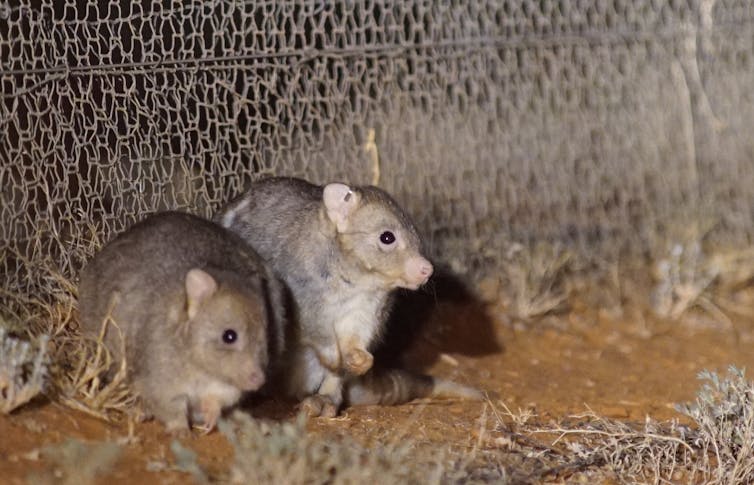
If you want to see some of Australia’s most charismatic threatened mammals such as bilbies, boodies and stick-nest rats, chances are you’ll have to go to a zoo – or a safe haven.
What’s a safe haven? An area safe from feral predators, such as islands too far offshore for foxes to swim to, or mainland sites ringed with cat- and fox-proof fences.
Recent research has suggested we can now take 29 species off the threatened list, thanks in large part to safe havens. But unfortunately, it’s not that simple, as we’ve found in establishing several havens. Safe havens are not the same as the wild. When we try to reintroduce animals outside the fences, they disappear down the maws of cats and foxes.
Yes, they fend off extinctions. But safe havens require ongoing management, which is expensive, challenging and rarely guaranteed long term. We should not rely on them to take species off the threatened list.

What are safe havens for?
In 1995, Australia had just a handful of havens. By 2017, we had 17 mainland havens and 101 island refuges, housing 38 different threatened mammals. The reason is they work, at least over the short term. Most of our threatened mammals are small and unwary, easy prey for two introduced predators which hunt by stealth.
When you take off the pressure from cats and foxes, reintroduced animals bounce back. Inside safe havens, populations soar by an average of 680% over a 17-year period. Outside, their populations declined by an average of 63%. No wonder governments are funding them.
Fenced safe havens are usually small, to make it possible to remove all feral predators and keep watch for any making it over the fence. The threatened mammals inside the fence are isolated, meaning they have a higher chance of inbreeding and are more vulnerable to random disasters. Sometimes, havens even provide extra food and water.
Read more: Why Australia needs to kill cats
There are worrying signs these islands ringed by fence or sea are not entirely sustainable. Many species within safe havens breed frantically, sending their populations skyward to unsustainable levels before a severe population crash. Ideally, they would be controlled by native predators, but the havens are too small to allow this. We’ve seen this play out with burrowing bettongs at one of our safe havens, Arid Recovery, in South Australia.
Some species struggle even inside fenced havens. The stick-nest rat has failed to establish in at least four havens.
 Fences work - but they’re expensive to put up and require maintenance and vigilance.
AAP
Fences work - but they’re expensive to put up and require maintenance and vigilance.
AAP
Are safe haven animals ‘wild’? Not quite
Let’s say you have a growing population of bilbies in our zoo network. Does this mean the species is now safe? Hardly. Safe in zoos doesn’t mean species are safe in the wild.
Safe havens are similar. Yes, the animals are free-roaming. They forage, breed and hide from predators such as snakes and eagles. But safe havens are created and sustained by people. When havens lose funding and fall into disrepair, the predators eventually break in and kill everything they can. Fenced off Shark Bay bandicoots in Western Australia were eventually killed by cats.
When the government works out if a species is threatened or not, it counts the animals in safe havens as contributing to the wild population.
Read more: We found 29 threatened species are back from the brink in Australia. Here's how
If we use this measuring stick, mammals like the bilby, boodie, stick-nest rat, golden bandicoot and Shark Bay bandicoot can indeed be taken off the threatened species list.
But this seems hasty. Threatened species are defined as those where a “relatively large risk of extinction in the wild, sometime in the future, is deemed to exist for a species”, according to our key biodiversity law, the Environment Protection and Biodiversity Conservation Act.
 Golden bandicoots have been almost pushed off the mainland, surviving on islands or fenced havens in the Kimberley.
AAP
Golden bandicoots have been almost pushed off the mainland, surviving on islands or fenced havens in the Kimberley.
AAP
If we remove a species from the threatened species list, we could place it at even higher risk of extinction.
When a species is threatened, it gets special consideration. Mining companies and developers have to ensure plans for land in its range won’t cause significant harm to the species. Companies may have to provide offsets to any damage. At the very least they are required to survey and monitor the species.
Consider the iconic bilby, whose range has shrunk by more than 80% in the last 150 years. It’s now found in the wild only in a small part of Queensland and in remote parts of Northern Territory and Western Australia.
Reports suggest it’s still declining in the wild, due to foxes and cats, more intense grazing and dangerous fire regimes. But because bilbies have been successfully reintroduced to islands and fenced safe havens, they no longer meet the criteria for being threatened.
Let’s say we remove them from the list. They would lose any special consideration when projects affecting their habitat are proposed, and conservation funding would dry up. Bilbies could quietly go extinct in the wild while reintroduced fenced populations thrive, at least in the short term.
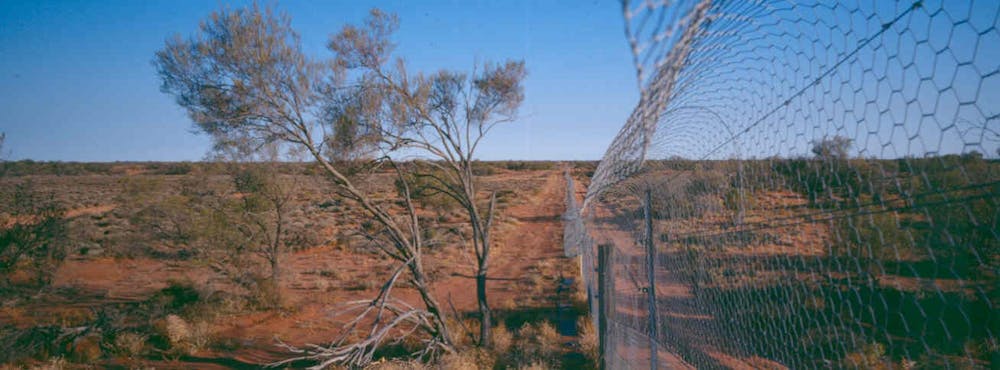 Feral proof fences, like this one at Arid Recovery, have to be specifically built to keep out cunning foxes and cats.
Katherine Moseby, Author provided
Feral proof fences, like this one at Arid Recovery, have to be specifically built to keep out cunning foxes and cats.
Katherine Moseby, Author provided
Does this mean safe havens are a bad idea?
No. We’ve co-founded four fenced safe havens to protect populations of nine threatened species. They are necessary. They ward off extinction and let us research the species. But they are only the first step to recovery.
It’s much harder to reverse the decline of threatened species in the wild. But it’s not impossible. Gene drive technology is maturing, potentially making it possible to force feral predators to breed themselves out of existence by having only male offspring. Almost 70% of Australians favour this approach, if viable. We also have biological controls, new control tools and improved management of fire to draw on. ˇ
Havens are exactly that – a desperate measure to stop extinction. We should keep species on the threatened list even if they have management-dependent haven populations. This will protect wild populations and drive innovation and interest in how we can best control feral predators and other threats.
We cannot simply put our threatened mammals behind fences and consider the job done.
Read more: So you want to cat-proof a bettong: how living with predators could help native species survive
Authors: Katherine Moseby, Associate Professor, UNSW Sydney


















