Tax-free super for the super rich is a bad deal for the rest of us – and Morrison said it first
- Written by: Peter Martin, Visiting Fellow, Crawford School of Public Policy, Australian National University
You’d be forgiven for thinking Treasurer Jim Chalmers had done something dramatic.
From 2025 he will double the tax rate on earnings from superannuation balances above A$3 million, lifting it from 15% to 30%.
Only 80,000 Australians have accounts that large, and many of them who have retired have shoved the maximum permissible $1.7 million into a separate so-called retirement account whose earnings are entirely tax-free.
That’s right. Retirees with $1.7 million in retirement accounts pay nothing whatsoever on what those accounts earn, which in normal years amounts to $85,000.
By way of comparison, wage earners on $85,000 get taxed $18,000.
But though you’d never know it from some of the “socialist tax grab” commentary around this week, Chalmers isn’t the first treasurer to act on this rort. Scott Morrison got there first.
Howard’s super deal for the richest 1%
In 2006, in what economist Saul Eslake describes as one of the worst taxation decisions in modern times (an honour for which he says there’s a fair bit of competition), then Prime Minister John Howard exempted from tax withdrawals from super for Australians aged 60 and over.
By itself, this was unremarkable. We don’t tax withdrawals from bank accounts, because the interest they earn has been taxed within the account.
But Howard left in place a preexisting exemption from tax for earnings within the retirement accounts of Australians aged 60 and over.
This meant the earnings on the sometimes very large accounts of retirees aged 65 and over weren’t taxed at all. Not at the normal super tax rate of 15%, not at any rate – without limit, no matter how much was earned, merely because the person owning the account was aged 65 or over and had retired.
Morrison wound Howard’s policy back
In office, the Labor governments of Kevin Rudd and Julia Gillard didn’t touch the open-ended opportunity to earn unlimited amounts from super tax-free. Instead, we had to wait a decade, until Prime Minister Malcolm Turnbull and his Treasurer Scott Morrison wound it back in 2016.
Facing off against critics in his own party, Morrison cut the amount that could be transferred from an ordinary super account into a tax-free “retirement” super account to $1.6 million, a ceiling that is adjusted every few years with inflation.
“If you’ve got more than $1.6 million in a superannuation account, you’re in the top 1% and you’ve worked hard to get there, that’s fabulous,” Morrison said at the time. “But that $1.6 million is the limit.”
The seeds of Chalmers’ new plan
They were words echoed by Chalmers on Tuesday, who said his change would only affect half of the top 1%. If people had done well, that was “a good thing”.
But Chalmers said the system should be fairer.
And I think for any objective observer, the idea that ordinary working people subsidise incredibly generous tax breaks for people with millions and millions of dollars in superannuation doesn’t stack up.
Chalmers did more than channel Morrison’s language. The idea of a 30% super tax rate isn’t new.
Most Australians pay 15% on contributions, but in 2016 then treasurer Morrison expanded a 30% contributions rate from Australians with combined incomes and super contributions exceeding $300,000 to Australians with incomes and contributions exceeding $250,000.
And Chalmers received encouragement from another source.
In last year’s pre-budget submission, the Association of Superannuation Funds (ASFA) pointed the new treasurer to 11,000 super accounts holding more than $5 million, some of them holding hundreds of millions, “well in excess of retirement needs”.
The peak body for super funds called on the then Morrison government to end super tax concessions when accounts grew to $5 million, an amount it said could not “reasonably be justified as necessary to support a comfortable lifestyle in retirement”.
On Tuesday Chalmers picked up the idea – an idea that came from the super industry itself – but made the limit $3 million, instead of $5 million.
As ASFA proposed, that ceiling won’t climb over time with inflation, meaning over time more and more Australians will be taxed at 30%.
You don’t need millions for a comfortable retirement
There are two points worth noting. One is that the quoted tax rate of 30% won’t work out at 30%. The best guess within the industry is that few pay anything like 15%. They are able to use concessions on capital gains and dividend imputation to drive down the tax actually paid to something nearer 7%.
The other is most Australians don’t need anything like what $3 million would buy in retirement – or even the $1.7 million they are allowed to use tax-free.
The ASFA retirement income standard has a “comfortable” retirement costing $68,014 per year (or $48,266 for each member of a couple).
ASFA defines comfortable to mean $90 per month on broadband, $80 in alcohol, $46 in Netflix-like services, $258 dining out, top-flight private health insurance, and one domestic flight per year and an international flight every seven years.
It’s a level of largess not bestowed on many of us while working. If it was felt necessary in retirement (and doubtless many wealthy retirees do feel it is necessary) there’s no reason to expect them to get it all from super.
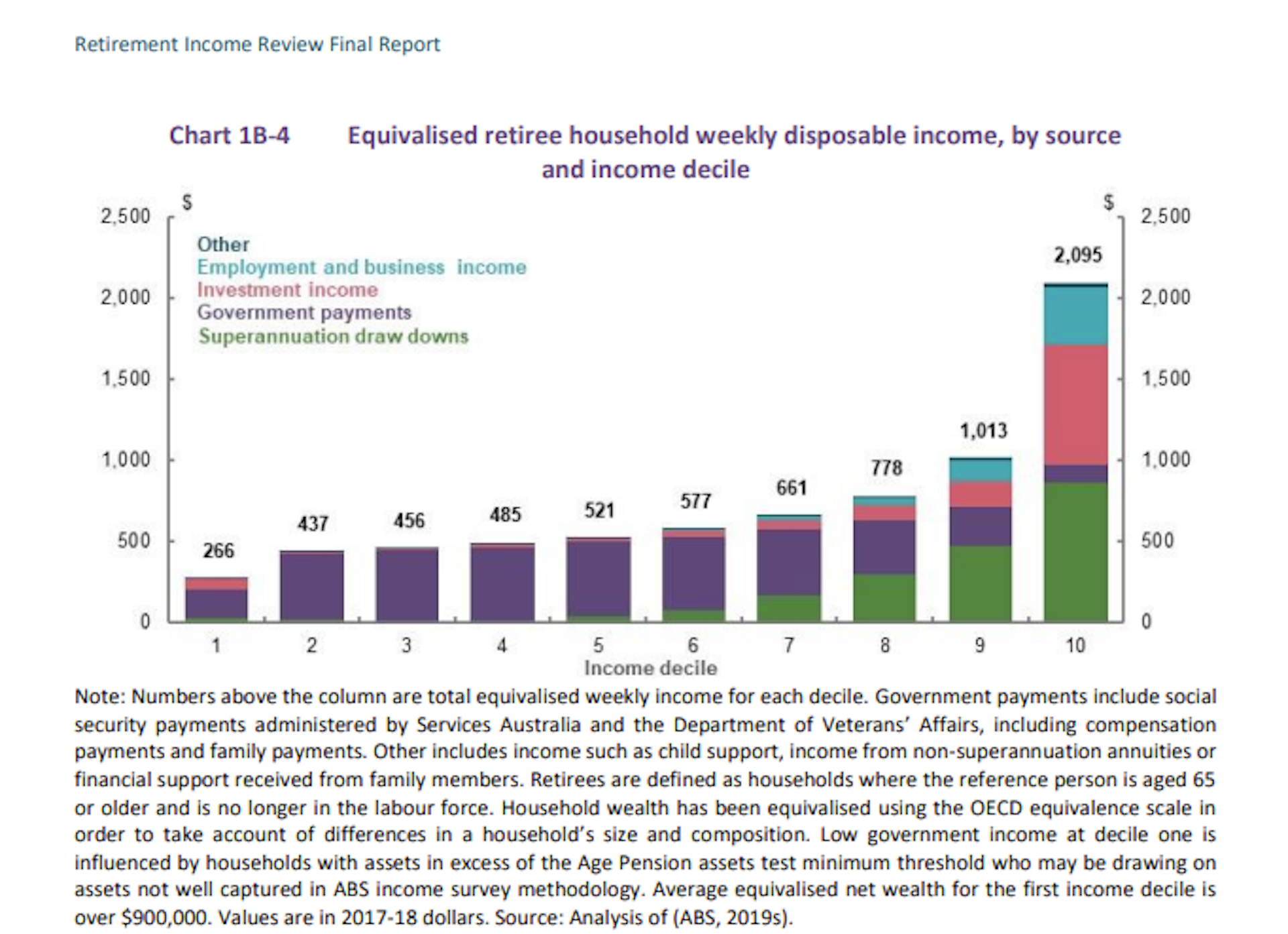
The government’s 2020 retirement income review found high-income Australians earned as much again from investment income outside super as they made from withdrawals from it. They do alright.
Scott Morrison, much criticised for the generosity to high income earners of his Stage 3 tax cuts, moved in the right direction on super. Jim Chalmers is picking up where he left off.
Authors: Peter Martin, Visiting Fellow, Crawford School of Public Policy, Australian National University