

how Edmund Hillary’s Antarctic adventure 65 years ago helped loosen NZ’s colonial ties to Britain
- Written by: Daniella McCahey, Assistant Professor of History, Texas Tech University
When the Commonwealth Trans-Antarctic Expedition ended on March 2, 1958, it marked what many called the last great adventure possible on Earth: an overland crossing of the Antarctic continent.
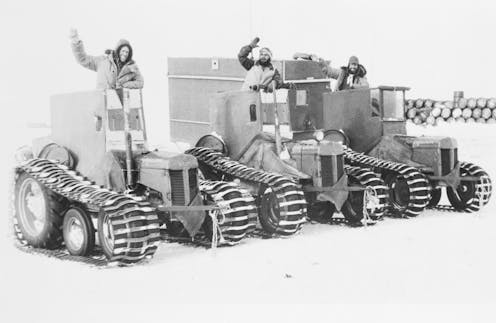
Sixty-five years later, it’s remembered in New Zealand chiefly for Sir Edmund Hillary’s unplanned and controversial “dash” to the South Pole in a convoy of modified Massey Ferguson tractors.
But as a historian of Antarctic science, I believe the expedition tells us about more than just Kiwi ingenuity and attitude. It was also about national competition and prestige, disputed sovereignty, and competing versions of masculinity.
Perhaps most significantly, an exercise designed to showcase Commonwealth unity ended up demonstrating the opposite. And it helped cement New Zealand’s independent relationship with Antarctica, specifically the Ross Dependency and Scott Base, as quite separate from its ties to Britain.
Science and nationalism
The expedition’s origins go back to 1953, when Vivian Fuchs, a geologist with the Falkland Islands Dependency Survey, began circulating a proposal for the Commonwealth Trans-Antarctic Expedition (TAE). This would be the first overland crossing of the frozen continent.
Although Fuchs later stressed the scientific potential of his plan – which he said took initial shape as he sheltered from a blizzard, huddled in a tent on Antarctica’s Stonington Island – the proposal also had geopolitical motivations.
Read more: 200 years of exploring Antarctica – the world's coldest, most forbidding and most peaceful continent
At the time, the United Kingdom’s claims in Antarctica were under increasing threat from Argentina and Chile. Even the American expedition to the Weddell Sea in 1947-48 did not acknowledge British sovereignty. In Fuchs’ words:
A trans-continental journey made wholly within territory claimed by the British Commonwealth […] would gain prestige and at the same time contribute to the solidarity of Commonwealth interests.
Fuchs tied the Trans-Antarctic Expedition to the scientific programme of the International Geophysical Year (IGY) of 1957-1958. This was an international collaborative scientific project that focused on gathering new observations on the oceans, weather systems, outer space and the poles.
Even though the expedition remained officially separate, it could be seen as supporting the IGY’s wide-ranging scientific research efforts. While Fuchs soon won the support of many in the Commonwealth polar and scientific communities, some derided what appeared to be a geopolitical exercise using the supposedly apolitical, science-focused IGY.
The Hillary factor
For Fuchs to succeed in journeying from the Weddell Sea to the Ross Sea via the South Pole, his plan – like that of Ernest Shackleton’s ill-fated attempt 40 years earlier – depended on a supporting party from New Zealand.
Led by Edmund Hillary, an international celebrity since his 1953 ascent of Mt Everest, this party would lay depots of food and fuel to support the second part of Fuchs’ journey, from the South Pole to the Ross Sea.
Read more: The wreck of Endurance is a bridge to a bygone age, and a reminder of Antarctica's uncertain future
Hillary’s expedition, intended to be largely privately funded, initially lacked widespread support from New Zealanders, many of whom believed their government should cover the entire cost.
But the Ross Sea Committee, which organised the expedition, worked to imbue the public with a sense that their country had a stake in the Antarctic territory they claimed: the New Zealand Antarctic Expedition, as it was often called domestically, would be a triumph for their nation.
At the head of a major public relations campaign, Hillary’s attachment to the expedition was a big factor in growing support for the expedition. In the end, New Zealanders donated more to the TAE per capita than the British public did. Nonetheless, the New Zealand government still had to heavily subsidise the enterprise.
To the Pole by tractor
The newly established Scott Base was intended to serve the interests of both New Zealand’s IGY and TAE parties, and was placed under Hillary’s command. In fact, it was Hillary who selected, in a last-minute change, the base’s location on Ross Island, as it was more convenient for the TAE’s priority of travelling over the Polar Plateau.
This was to the chagrin of many scientists in both parties, including the IGY scientific leader Trevor Hatherton, who decried the site’s poor conditions for geologic, geomagnetic and seismic research.
Hillary began his depot-laying journey on October 14, 1957. To reduce costs and reflect New Zealand’s agricultural strengths, he travelled with three TE20 Massey Ferguson tractors, modified with a full tracking system for use in the snowy conditions. His team made good time and established Depot 700, the last one scheduled, in late December.
In the meantime, Fuchs’ team had encountered rough conditions and crossed the continent much more slowly than expected. Deviating from the expedition’s initial plans and disobeying orders from the Ross Sea Committee, Hillary continued to the South Pole and arrived at the US Amundsen-Scott South Pole Station on January 3, 1958, becoming the first to make this journey using overland vehicles.
Between 1992 and 2015, an image of a modified Massey Ferguson tractor graced the New Zealand $5 note, commemorating the achievement.
End of empire
Shortly after his arrival at the Pole, Hillary sent a message to Fuchs suggesting he abandon his plans for completing a crossing, given the difficult conditions. This telegram was accidentally released to the New Zealand press.
By the time Fuchs arrived at the Pole on January 19, a media firestorm had exploded. The expedition was now characterised as a “race to the Pole” by two national parties headed by the “adventurer” Hillary and the “scientist” Fuchs. Like the first race to the Pole between Roald Amundsen and Robert Falcon Scott in 1911-12, this one was framed as yet another loss by Britain.
Read more: Finding Shackleton's ship: why our fascination with Antarctica endures
The remainder of the expedition was an exercise in damage control, with the organising committees in New Zealand and the UK stressing there was indeed only one expedition, and there had been no race to the Pole. Fuchs’ party arrived, rather anticlimactically, at Scott Base on March 2, 1958, completing the historic 3,473 kilometre journey.
Yet the drama was still not over. Three years after Fuchs and Hillary’s official account of the expedition was published, Hillary published his own tell-all version which played up the masculinity and daring of the New Zealand party in opposition to the British.
What had begun as a show of Commonwealth unity with Britain at the head became an international incident, reinforcing perceptions of a fracturing British Empire. Hillary’s dash to the Pole was far more memorable than the actual crossing.
Moreover, it marked the beginning of modern New Zealand’s close identification with Antarctica and its own Scott Base, and the end of old colonial hierarchies on the ice. Indeed, by the end of the Trans-Antarctic Expedition, New Zealand’s biggest partner in Antarctic science was not the United Kingdom, but the United States.
Authors: Daniella McCahey, Assistant Professor of History, Texas Tech University


















