

New results from NASA's DART planetary defence mission confirm we could deflect deadly asteroids
- Written by: Eleanor K. Sansom, Research Associate, Curtin University
What would we do if we spotted a hazardous asteroid on a collision course with Earth? Could we deflect it safely to prevent the impact?
Last year, NASA’s Double Asteroid Redirection Test (DART) mission tried to find out whether a “kinetic impactor” could do the job: smashing a 600kg spacecraft the size of a fridge into an asteroid the size of an Aussie Rules football field.
Early results from this first real-world test of our potential planetary defence systems looked promising. However, it’s only now that the first scientific results are being published: five papers in Nature have recreated the impact, and analysed how it changed the asteroid’s momentum and orbit, while two studies investigate the debris knocked off by the impact.
The conclusion: “kinetic impactor technology is a viable technique to potentially defend Earth if necessary”.
Small asteroids could be dangerous, but hard to spot
Our Solar System is full of debris, left over from the early days of planet formation. Today, some 31,360 asteroids are known to loiter around Earth’s neighbourhood.
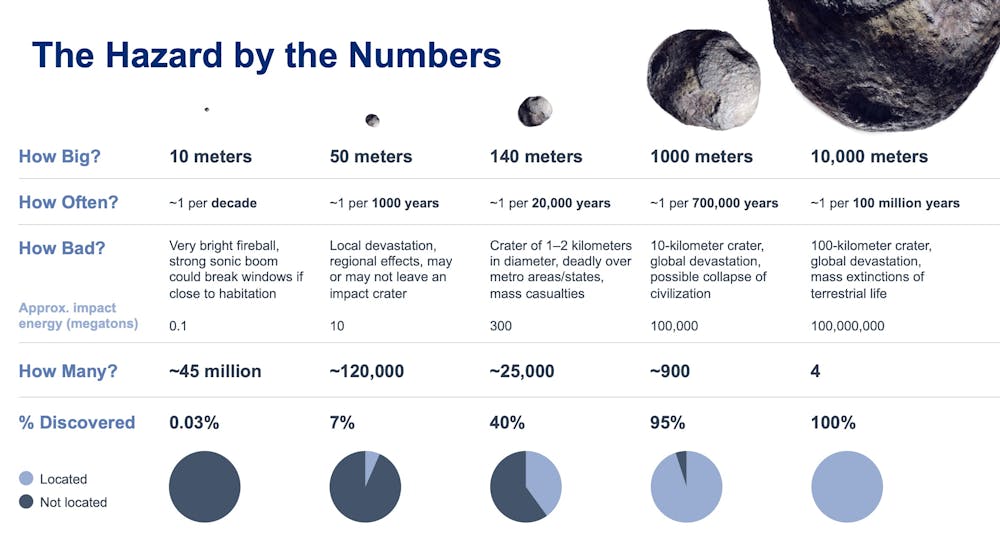
Although we have tabs on most of the big, kilometre-sized ones that could wipe out humanity if they hit Earth, most of the smaller ones go undetected.
Just over ten years ago, an 18-metre asteroid exploded in our atmosphere over Chelyabinsk, Russia. The shockwave smashed thousands of windows, wreaking havoc and injuring some 1,500 people.
A 150-metre asteroid like Dimorphos wouldn’t wipe out civilisation, but it could cause mass casualties and regional devastation. However, these smaller space rocks are harder to find: we think we have only spotted around 40% of them so far.
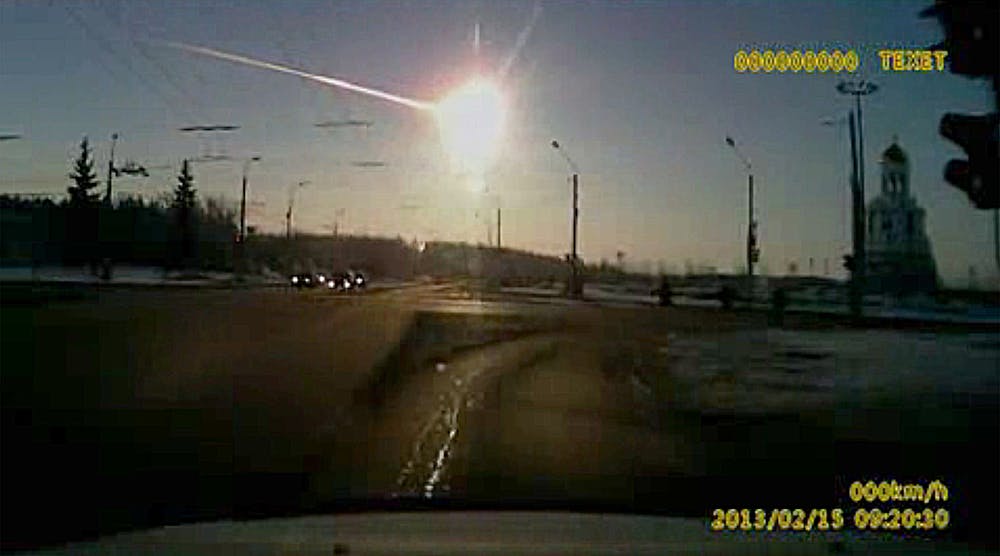 A still from a dashboard camera video shows the Chelyabinsk meteor burning across the sky in 2013.
AP
A still from a dashboard camera video shows the Chelyabinsk meteor burning across the sky in 2013.
AP
The DART mission
Suppose we did spy an asteroid of this scale on a collision course with Earth. Could we nudge it in a different direction, steering it away from disaster?
Hitting an asteroid with enough force to change its orbit is theoretically possible, but can it actually be done? That’s what the DART mission set out to determine.
Specifically, it tested the “kinetic impactor” technique, which is a fancy way of saying “hitting the asteroid with a fast-moving object”.
Read more: NASA's asteroid deflection mission was more successful than expected. An expert explains how
The asteroid Dimorphos was a perfect target. It was in orbit around its larger cousin, Didymos, in a loop that took just under 12 hours to complete.
The impact from the DART spacecraft was designed to slightly change this orbit, slowing it down just a little so that the loop would shrink, shaving an estimated seven minutes off its round trip.
A self-steering spacecraft
For DART to show the kinetic impactor technique is a possible tool for planetary defence, it needed to demonstrate two things:
that its navigation system could autonomously manoeuvre and target an asteroid during a high-speed encounter
that such an impact could change the asteroid’s orbit.
In the words of Cristina Thomas of Northern Arizona University and colleagues, who analysed the changes to Dimorphos’ orbit as a result of the impact, “DART has successfully done both”.
The DART spacecraft steered itself into the path of Dimorphos with a new system called Small-body Manoeuvring Autonomous Real Time Navigation (SMART Nav), which used the onboard camera to get into a position for maximum impact.
More advanced versions of this system could enable future missions to choose their own landing sites on distant asteroids where we can’t image the rubble-pile terrain well from Earth. This would save the trouble of a scouting trip first!
Dimorphos itself was one such asteroid before DART. A team led by Terik Daly of Johns Hopkins University has used high-resolution images from the mission to make a detailed shape model. This gives a better estimate of its mass, improving our understanding of how these types of asteroids will react to impacts.
Dangerous debris
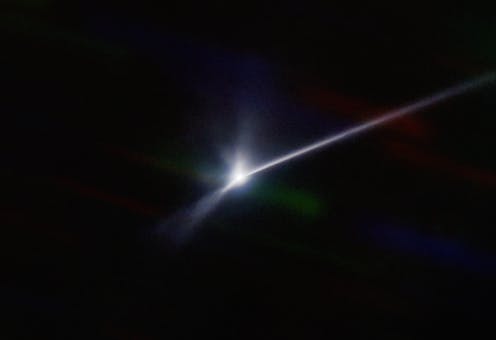
The impact itself produced an incredible plume of material. Jian-Yang Li of the Planetary Science Institute and colleagues have described in detail how the ejected material was kicked up by the impact and streamed out into a 1,500km tail of debris that could be seen for almost a month.
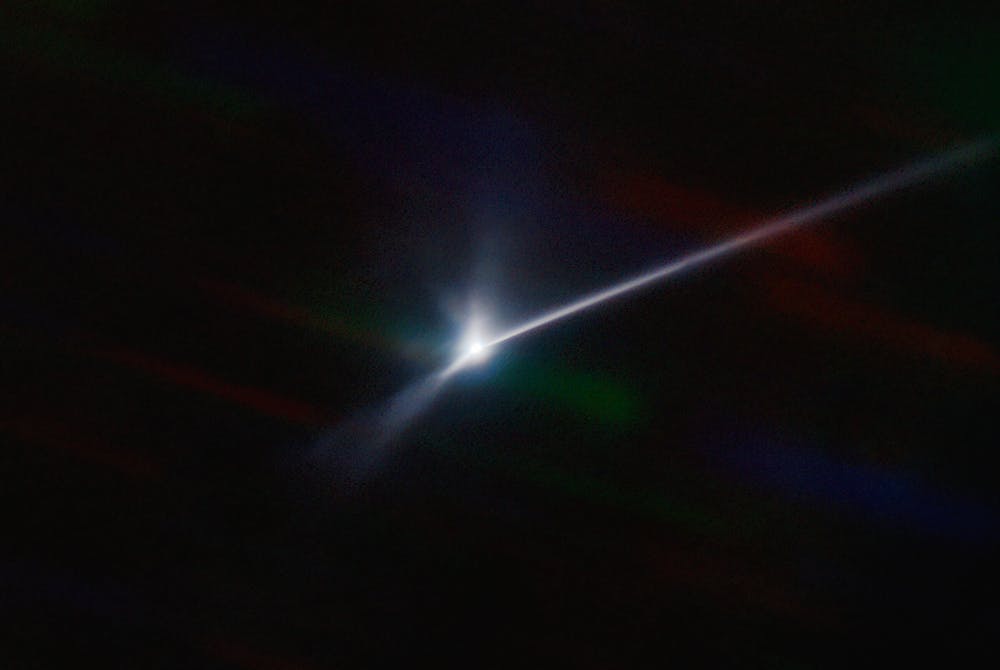 The DART impact blasted a vast plume of dust and debris from the surface of the asteroid Dimorphos.
CTIO / NOIRLab / SOAR / NSF / AURA / T. Kareta (Lowell Observatory), M. Knight (US Naval Academy)
The DART impact blasted a vast plume of dust and debris from the surface of the asteroid Dimorphos.
CTIO / NOIRLab / SOAR / NSF / AURA / T. Kareta (Lowell Observatory), M. Knight (US Naval Academy)
Streams of material from comets are well known and documented. They are mainly dust and ice, and are seen as harmless meteor showers if they cross paths with Earth.
Asteroids are made of rockier, stronger stuff, so their streams could pose a greater hazard if we encounter them. Recording a real example of the creation and evolution of debris trails in the wake of an asteroid is very exciting. Identifying and monitoring such asteroid streams is a key objective of planetary defence efforts such as the Desert Fireball Network we operate from Curtin University.
A bigger than expected result
So how much did the impact change Dimorphous’ orbit? By much more than the expected amount. Rather than changing by seven minutes, it had become 33 minutes shorter!
This larger-than-expected result shows the change in Dimorphos’ orbit was not just from the impact of the DART spacecraft. The larger part of the change was due to a recoil effect from all the ejected material flying off into space, which Ariel Graykowski of the SETI Institute and colleagues estimated as between 0.3% and 0.5% of the asteroid’s total mass.
A first success
The success of NASA’s DART mission is the first demonstration of our ability to protect Earth from the threat of hazardous asteroids.
At this stage, we still need quite a bit of warning to use this kinetic impactor technique. The earlier we intervene in an asteroid’s orbit, the smaller the change we need to make to push it away from hitting Earth. (To see how it all works, you can have a play with NASA’s NEO Deflection app.)
But should we? This is a question that will need answering if we ever do have to redirect a hazardous asteroid. In changing the orbit, we’d have to be sure we weren’t going to push it in a direction that would hit us in future too.
Read more: How satellites, radar and drones are tracking meteorites and aiding Earth's asteroid defence
However, we are getting better at detecting asteroids before they reach us. We have seen two in the past few months alone: 2022WJ1, which impacted over Canada in November, and Sar2667, which came in over France in February.
We can expect to detect a lot more in future, with the opening of the Vera Rubin Observatory in Chile at the end of this year.
Authors: Eleanor K. Sansom, Research Associate, Curtin University


















