

why the world’s other humanitarian crises don’t see the same response as Ukraine
- Written by: Ritesh Shah, Senior Lecturer in Education, University of Auckland
With the war in Ukraine now in its second year, nearly a third of the country’s population has been displaced, including 8 million people who have sought refuge beyond its borders.
International support for the plight of these refugees has been heartening. Nearly 4.5 million Ukrainians having been granted temporary protection status across the European Union (EU).
But we also need to ask: how does this response compare to the countless other humanitarian crises around the world right now?
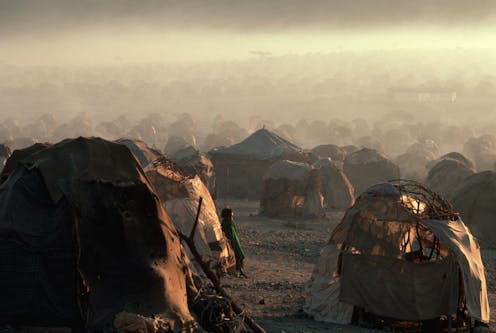
Last year, the Norwegian Refugee Council (NRC) reported there were ten “forgotten crises” in the world, all in Africa. The suffering of people in these countries or regions rarely makes international headlines. And there is seemingly little political interest or will from the international community to address the situation.
Furthermore, the war in Ukraine has redirected humanitarian assistance and resources away from these other crises. While children in Ukraine have been supported, millions of young people in countries like Sudan and Yemen have lost access to vital food aid. They are now at heightened risk of malnutrition and starvation.
NRC Secretary-General Jan Egeland put it like this:
The war in Ukraine has demonstrated the immense gap between what is possible when the international community rallies behind a crisis, and the daily reality for millions of people suffering in silence [from crises] that the world has chosen to ignore. [This is] not only unjust […] but comes with a tremendous cost.
A recent report from Save the Children compared the EU’s response to Ukrainians seeking temporary protection and asylum to those from elsewhere. Syrian refugees, for example, described being detained in inhumane or substandard conditions until their asylum claims were considered.
They certainly weren’t granted the temporary protection status afforded Ukrainian refugees. The report called this “dysfunctional at best and cruel at worst”, part of a policy designed to “contain those who arrived and deter others from coming”.
Us and them
As Oxford University researcher Hugo Slim has argued, humanitarian principles are “ethically simplistic and routinely fall victim to bias”. Decisions on allocations of humanitarian funding are increasingly politicised and driven by the interests of the “powerful West”.
This was particularly apparent in 2016, when the EU committed €6 billion to supporting Turkey’s response to the Syrian crisis, in return for Turkey stopping irregular migration of those refugees into Europe. Why the open-door policy to Ukrainian refugees as opposed to a containment approach for others?
Read more: Why has New Zealand welcomed Ukrainians fleeing war and not others trying to do the same?
Some argue it is because of the economic and geopolitical implications of Russia’s invasion, not only for Europe, but the entire world. But the idea that some crises have bigger implications for the West than for others (and hence “we” should respond differently) signals an inability to impartially identify and address the most acute needs.
For example, only months after starting construction of a steel wall along its border with Belarus to keep out asylum seekers from the Middle East and Africa, Poland opened its borders to Ukrainian refugees. There have also been numerous accounts of people of colour fleeing Ukraine but being turned around at the border by Polish nationalists or border officials.
Media reporting has sometimes played into such prejudice, referring to Ukrainian refugees as “civilised” and “so much like us”.
White saviour complex
As has been argued elsewhere, the global humanitarian apparatus is underpinned by often unspoken racial distinctions and hierarchies based on notions of expertise and competency. The majority of those in high-paid, decision-making positions are from developed nations and mostly white. Field workers tend to come from the developing world and are often brown or black.
The Nigerian-American writer Teju Cole has called this the “white-saviour industrial complex”, not unlike the attitudes of missionaries and early colonisers. The American-Iranian scholar Reza Aslan defined this as the “all-too-familiar pattern of white people of privilege seeking personal catharsis by attempting to liberate, rescue or otherwise uplift underprivileged people of colour.”
Cynical perhaps, but most humanitarian organisations make very little mention of race. The “commitments to action” from the 2016 World Humanitarian Summit are notably silent on the topic. Humanitarian principles of neutrality and impartiality, which erase race as a concern and shut off dissent, perpetuate “global white ignorance”, as philosopher Charles Mills labels it.
Perhaps we should not be surprised. Acknowledging structural racism within humanitarianism would require ceding power and authority to those who have been marginalised.
Read more: Ukraine refugee crisis exposes racism and contradictions in the definition of human
What can be done?
The first step towards changing this would be an acknowledgement by the UN, other agencies, media and politicians that racial and cultural bias within humanitarian structures exists. Much greater care needs to be taken with the language used to describe and depict those living through crises.
Practically, there needs to be a greater representation, in all decision making within large humanitarian organisations, of voices and perspectives from the Global South, especially those directly affected by crisis.
Humanitarian aid would also need to be depoliticised. Money should be channelled through pooled funds like the UN’s Central Emergency Response Fund, which directly responds to the most acute and underfunded humanitarian needs globally.
These are not quick fixes. But to do nothing will leave millions largely invisible. As one Palestinian refugee described their feelings to me recently: “The entire world has forgotten about us and has left us to fight our struggles alone.”
Authors: Ritesh Shah, Senior Lecturer in Education, University of Auckland


















