

No, the Fukushima water release is not going to kill the Pacific Ocean
- Written by: Nigel Marks, Associate Professor of Physics, Curtin University
Japanese authorities are preparing to release treated radioactive wastewater into the Pacific Ocean, nearly 12 years after the Fukushima nuclear disaster. This will relieve pressure on more than 1,000 storage tanks, creating much-needed space for other vital remediation works. But the plan has attracted controversy.
At first glance, releasing radioactive water into the ocean does sound like a terrible idea. Greenpeace feared the radioactivity released might change human DNA, China and South Korea expressed disquiet, while Pacific Island nations were concerned about further nuclear contamination of the Blue Pacific. One academic publication claimed the total global social welfare cost could exceed US$200 billion.
But the Japanese government, the International Atomic Energy Agency (IAEA) and independent scientists have declared the planned release to be reasonable and safe.
Based on our collective professional experience in nuclear science and nuclear power, we have reached the same conclusion. Our assessment is based on the type of radioactivity to be released, the amount of radioactivity already present in the ocean, and the high level of independent oversight from the IAEA.
How much water is there, and what’s in it?
The storage tanks at Fukushima contain 1.3 million tonnes of water, equivalent to around 500 Olympic-sized swimming pools.
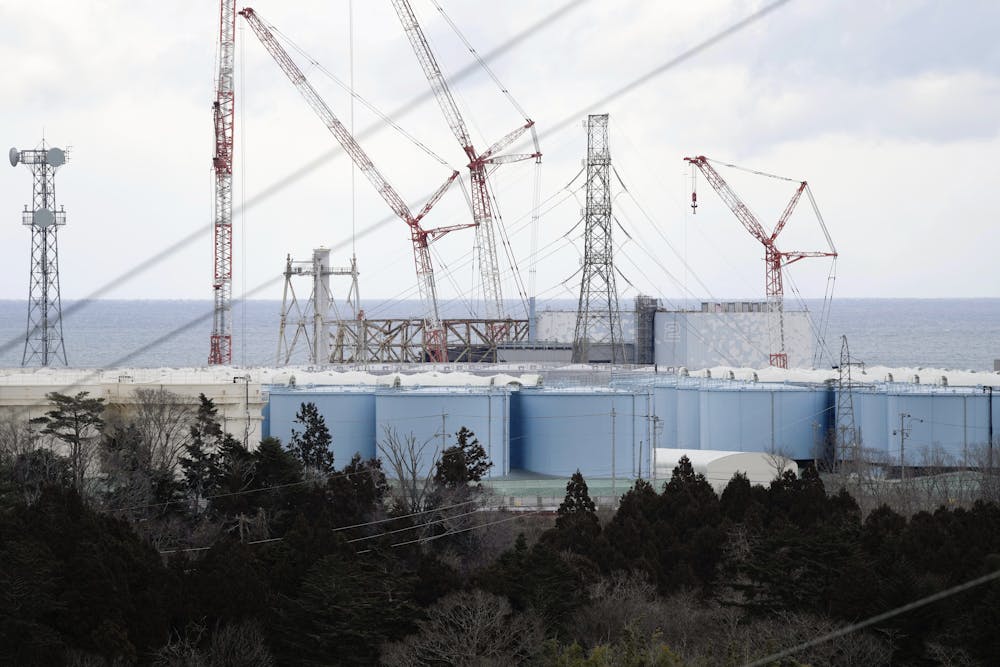
Contaminated water is produced daily by ongoing reactor cooling. Contaminated groundwater also collects in the basements of the damaged reactor buildings.
The water is being cleaned by a technology called ALPS, or Advanced Liquid Processing System. This removes the vast majority of the problematic elements.
The ALPS treatment can be repeated until concentrations are below regulatory limits. Independent monitoring by the IAEA will ensure all requirements are met before discharge.
The main radioactive contaminant remaining after treatment is tritium, a radioactive form of hydrogen (H) that is difficult to remove from water (H₂O). There is no technology to remove trace levels of tritium from this volume of water.
Tritium has a half-life of 12.3 years, meaning 100 years passes before the radioactivity is negligible. It is unrealistic to store the water for such a long time as the volumes are too great. Extended storage also increases the risk of accidental uncontrolled release.
Like all radioactive elements, international standards exist for safe levels of tritium. For liquids, these are measured in Bq per litre, where one Bq (becquerel) is defined as one radioactive decay per second. At the point of release, the Japanese authorities have chosen a conservative concentration limit of 1,500Bq per litre, seven times smaller than the World Health Organization’s recommended limit of 10,000Bq per litre for drinking water.
Why is it acceptable to release tritium into the ocean?
One surprising thing about radiation is how common it is. Almost everything is radioactive to some degree, including air, water, plants, basements and granite benchtops. Even a long-haul airline flight supplies a few chest X-rays worth of radiation to everyone on board.
In the case of tritium, natural processes in the atmosphere generate 50-70 peta-becquerels (PBq) of tritium every year. This number is difficult to grasp, so it’s helpful to think of it as grams of pure tritium. Using the conversion factor of 1PBq = 2.79g, we see that 150-200g of tritium is created naturally each year.
Looking at the Pacific Ocean, around 8.4kg (3,000PBq) of tritium is already in the water. By comparison, the total amount of tritium in the Fukushima wastewater is vastly smaller, at around 3g (1PBq).
Japanese authorities are not planning to release the water all at once. Instead, just 0.06g (22TBq) of tritium is scheduled for release each year. Compared with the radioactivity already present in the Pacific, the planned annual release is a literal drop in the ocean.
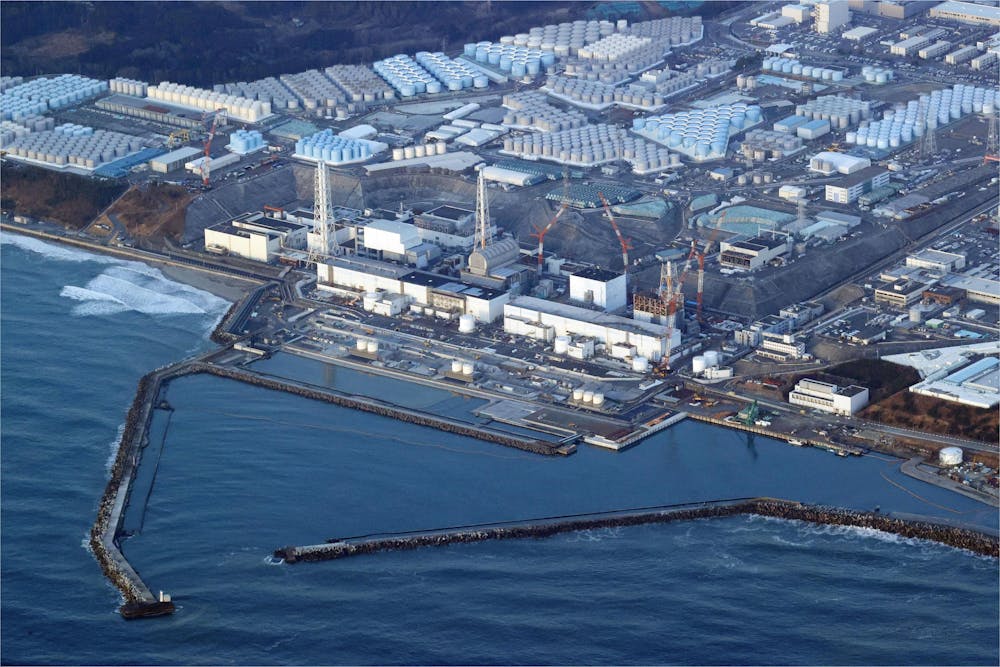 The planned release to the sea of treated but still radioactive wastewater at the Fukushima nuclear power plant has already been delayed, to allow time for the construction of a release tunnel and to gain public support.
Shohei Miyano/AP
The planned release to the sea of treated but still radioactive wastewater at the Fukushima nuclear power plant has already been delayed, to allow time for the construction of a release tunnel and to gain public support.
Shohei Miyano/AP
The current levels of tritium radioactivity in the Pacific are not of concern, and so the small amount to be added by the Fukushima water won’t cause any harm.
What’s more, tritium only makes a tiny contribution to the total radioactivity of the oceans. Ocean radioactivity is mostly due to potassium, an element essential for life and present in all cells. In the Pacific Ocean there is 7.4 million PBq of radioactivity from potassium, more than 1,000 times greater than the amount due to tritium.
Read more: Nuclear power: how might radioactive waste water affect the environment?
How do other countries manage the discharge of tritium?
All nuclear power plants produce some tritium, which is routinely discharged into the ocean and other waterways. The amount generated depends on the type of reactor.
Boiling water reactors, such as at Fukushima, produce relatively low quantities. When Fukushima was operating, the tritium discharge limit was set at 22TBq per year. That figure is far below a level that could cause harm, but is reasonably achievable for this type of power plant.
In contrast, the UK Heysham nuclear power plant has a limit of 1300TBq per year because this type of gas-cooled reactor produces a lot of tritium. Heysham has been discharging tritium for 40 years without harm to people or the environment.
Annual tritium discharge at nearby nuclear power plants far exceeds what is proposed for Fukushima. The Fuqing plant in China discharged 52TBq in 2020, while the Kori plant in South Korea discharged 50TBq in 2018.
Each of these power plants releases more than twice the amount to be released from Fukushima.
Are there other reasons for not releasing the water?
Objections to the planned release have been the subject of widespread media coverage. TIME magazine recently explained how Pacific Island nations have been grappling for decades with the legacy of Cold War nuclear testing. The Guardian ran an opinion piece from Pacific activists, who argued if the waste was safe, then “dump it in Tokyo, test it in Paris, and store it in Washington, but keep our Pacific nuclear-free”.
But the Pacific has always contained radioactivity, from potassium in particular. The extra radioactivity to be added from the Fukushima water will make the most miniscule of differences.
Read more: Fukushima: ten years on from the disaster, was Japan's response right?
Striking a different tone, The Pacific Island Forum commissioned a panel of experts to provide independent technical advice and guidance, and help address concerns on the wastewater. The panel was critical of the quantity and quality of data from the Japanese authorities, and advised that Japan should defer the impending discharge.
While we are sympathetic to the view that the scientific data could be improved, our assessment is the panel is unfairly critical of ocean release.
The main thing missing from the report is a sense of perspective. The public seminar from the expert panel, available on YouTube, presents only a portion of the context we provide above. Existing tritium in the ocean isn’t discussed, and the dominance of potassium is glossed over.
The most reasonable comments regard the performance of ALPS. This is largely in the context of strontium-90 and cesium-137, both of which are legitimate isotopes of concern.
However, the panel implies that the authorities don’t know what is in the tanks, and that ALPS doesn’t work properly. There actually is a lot of public information on both topics. Perhaps it could be repackaged in a clearer way for others to understand. But the inferences made by the panel give the wrong impression.
The most important thing the panel overlooks is that the contaminated water can be repeatedly passed through ALPS until it is safe for release. For some tanks a single pass will suffice, while for others additional cycles are required.
The big picture
The earthquake was the primary environmental disaster, and the planet will be dealing with the consequences for decades. In our view, the release of Fukushima wastewater does not add to the disaster.
It’s easy to understand why people are concerned about the prospect of radioactive liquid waste being released into the ocean. But the water is not dangerous. The nastiest elements have been removed, and what remains is modest compared with natural radioactivity.
We hope science will prevail and Japan will be allowed to continue the recovery process.
Authors: Nigel Marks, Associate Professor of Physics, Curtin University


















