

When is a nature reserve not a nature reserve? When it's already been burned and logged
- Written by: David Lindenmayer, Professor, The Fenner School of Environment and Society, Australian National University
Australia has the world’s worst mammal extinction record, with nearly 40 native mammal species lost since European colonisation. By contrast, the United States has lost three.
Last year, the federal Labor government made a welcome commitment to stop further extinctions. One essential tool to do this is protecting habitat in dedicated conservation reserves.
Reserves can and do work – especially when well designed and then well managed. By some estimates, a quarter of the world’s bird species have been saved from extinction because of conservation reserves. Here too, the government is to be commended for plans to conserve 30% of the continent by 2030.
In light of this, we analysed Victoria’s newest conservation reserves - called Immediate Protection Areas - designed to conserve forest biodiversity in Victoria as the state prepares to phase out native forest logging by 2030.
We found Immediate Protection Areas didn’t do what they were supposed to do. The protected areas were small, and well short of the area needed to adequately conserve threatened species. Many Immediate Protection Areas were established in forests already burned, logged, or both, meaning their value as habitat was limited. Some areas even appeared to have been chosen because they were no longer needed for logging, rather than for their conservation value.
As we accelerate plans to protect more Australian habitat, we must watch for problems like this. Land with high conservation value must be prioritised for protection.
What were these new conservation reserves meant to do?
Victoria’s state government has pledged to conserve biodiversity. This includes measures such as protecting the critically endangered Leadbeater’s Possum, ambitious investments to protect the Southern Greater Glider, and ending native forest logging by 2030.
As a prelude, the government established Immediate Protection Areas to better protect forest species from the impacts of logging.
We compared the known and mapped ranges of threatened species against the new conservation reserve areas. We wanted to see where 53 threatened species – including animals such as Leadbeater’s Possum and Southern Greater Glider – were most likely to occur. We also examined what had happened to these areas previously, to determine their habitat value. Had they been logged or burned?
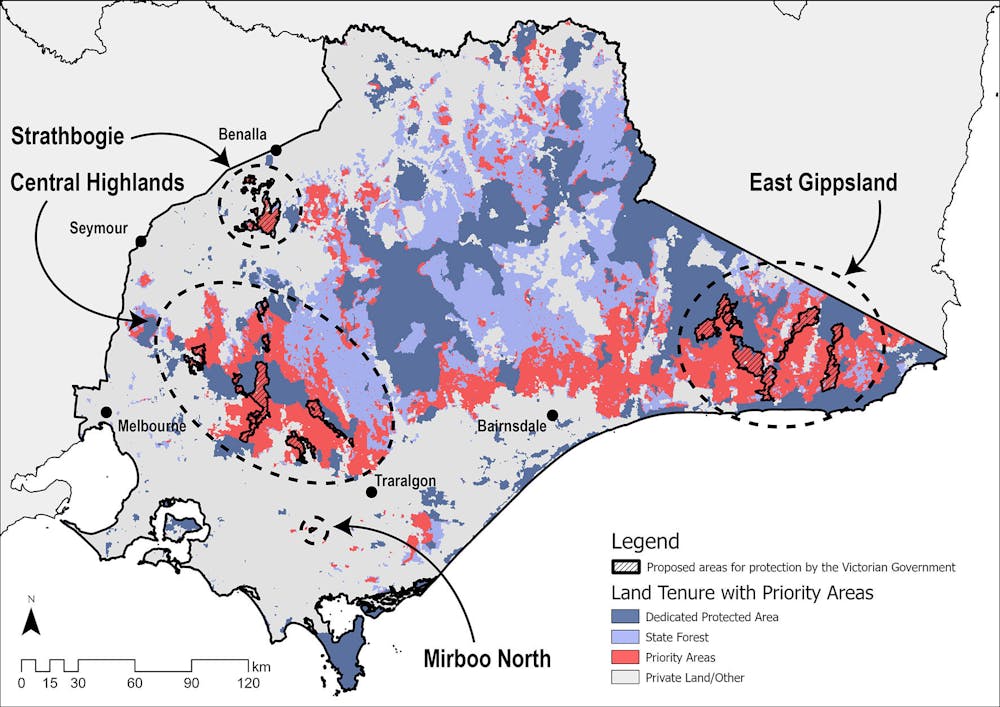 Here you can see the Immediate Protection Areas (hatched areas) compared to the areas which we actually need to be protected (red), across the forests of eastern Victoria.
Chris Taylor, Author provided
Here you can see the Immediate Protection Areas (hatched areas) compared to the areas which we actually need to be protected (red), across the forests of eastern Victoria.
Chris Taylor, Author provided
The results were sobering. The Immediate Protection Areas, combined with Victoria’s existing set of formal conservation reserves, fell well short of adequately protecting remaining areas of habitat for 23 of the 53 species analysed, such as the Southern Greater Glider, Leadbeater’s Possum, and Barred Galaxias.
This wouldn’t matter so much if the forests outside Victoria’s existing parks and reserves weren’t under pressure from continued industrial-scale logging of native forests by the state-owned forestry business, VicForests.
But they are. And worse, areas of highest conservation value for threatened forest-dependent species, such as the Central Highlands north east of Melbourne, and East Gippsland in the far east of Victoria, will actually be targeted for logging under the Timber Release Plan.
These high conservation value areas are important because they provide critical habitat for rare and threatened species, including endemic species found nowhere else.
Even as native forest logging is supposedly winding down, a major conflict between logging and conservation remains.
VicForests is legally bound to supply 350,000 cubic metres of logs from native forests to industry until 2030. This is the same year the Victorian government intends to cease native forest logging in Victoria.
In 2020, VicForest’s senior legal counsel testified in court that VicForests would have to shut down all its operations in the Central Highlands if it couldn’t continue to log threatened species’ habitat.
This is at at odds with both federal and state governments’ commitment to stop extinctions. Logging the remaining high conservation value habitat is going to accelerate rather than prevent extinctions.
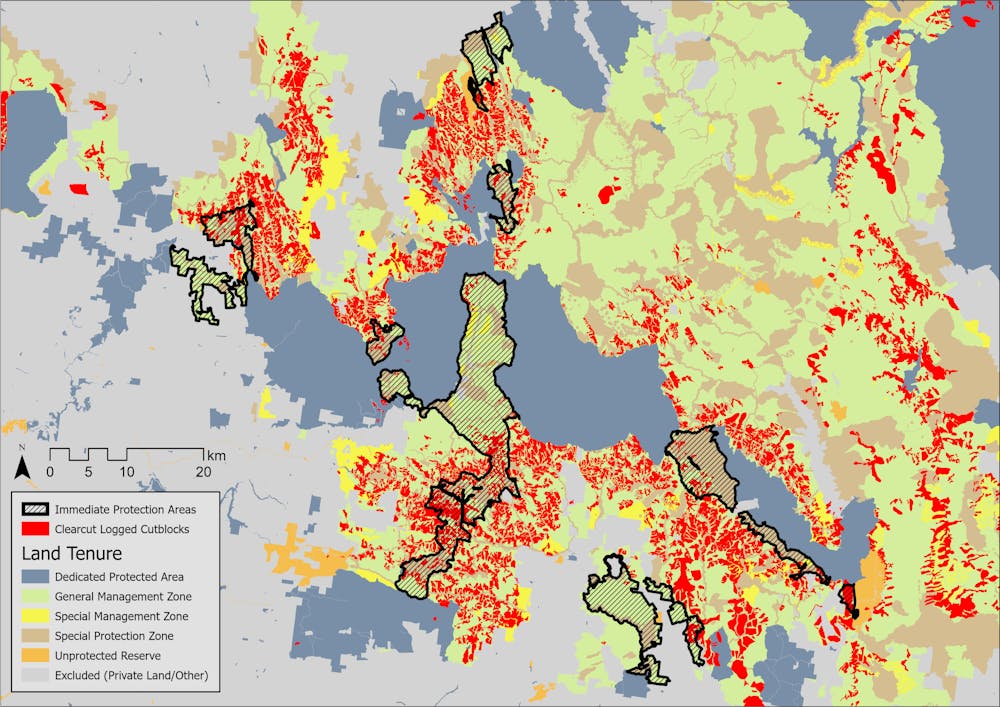 You can see the impact of large-scale logging in red inside the Immediate Protection Areas across the Central Highlands (hatched areas). Logging is done intensively, clearcutting whole areas.
Chris Taylor, Author provided
You can see the impact of large-scale logging in red inside the Immediate Protection Areas across the Central Highlands (hatched areas). Logging is done intensively, clearcutting whole areas.
Chris Taylor, Author provided
Protect all remaining habitat for species on the edge
An outsider might wonder why there has to be conflict. Aren’t there enough native forests to sustain seven more years of logging, especially now these Immediate Protection Areas have been established?
For many species, the answer is no. The number of sites occupied by species teetering on the edge of extinction, such as Leadbeater’s Possum, has fallen by half in the last 25 years. Logging is a major driver of its decline.
Protecting all Mountain and Alpine Ash forests where Leadbeater’s Possum occur should not be controversial. The federal government’s Threatened Species Scientific Committee declared in 2015 that the most effective way to prevent further decline and rebuild the possum population was to cease logging in Mountain Ash and Alpine Ash forests of the Central Highlands.
But this isn’t just a cautionary tale about logging in Victoria. Unless we’re careful, we’ll see the same story again and again.
Protecting 30% of Australian land by 2030, as the government intends, means rapidly protecting large areas of land. At present, around 20% of our land is protected in some way. Increasing this by half again in seven years is fast.
The danger is that governments will look for ways to rapidly boost the percentage of land area under protection without determining whether the land is effective for conservation.
As important as the size of the areas of land protected is what lives on it, and the ecosystem services it provides. To prevent extinctions in Australia, some ecosystems will need total protection of every fragment remaining, especially those under significant threat where key species are in marked decline.
Read more: Protecting 30% of Australia's land and sea by 2030 sounds great – but it's not what it seems
Authors: David Lindenmayer, Professor, The Fenner School of Environment and Society, Australian National University


















