

Is the poisoning of schoolgirls in Iran a new front in the war against girls' education?
- Written by: Shireen Daft, Lecturer, Macquarie Law School, Macquarie University
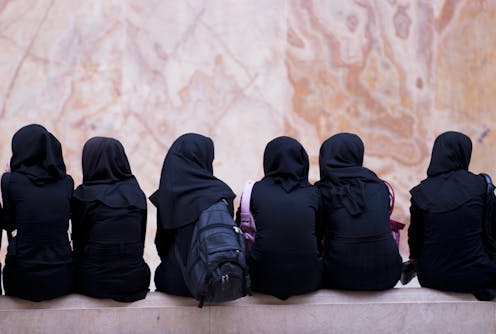
Recent media attention has drawn global focus on an escalating number of Iranian schoolgirls falling ill over the past few months because of suspected chemical attacks. Accounts differ, but many reports cite more than 1,000 cases of poisoning at schools across Iran. At least 58 schools in ten provinces across the country have been affected.
The first known cases were reported in the city of Qom in November. There has been an escalation of reported cases, with 26 schools affected in a wave of attacks last week. The students have reported respiratory problems, nausea, dizziness and fatigue, with several girls hospitalised. Parents have been keeping their daughters home from school to protect them from these attacks.
Escalating public unrest and international attention has led Iran’s Supreme Leader Ayatollah Ali Khamenei to publicly denounce the attacks as a “major and unforgivable crime”, promising an investigation and swift punishment for those responsible.
This follows months of contradictory statements from government officials, the arrest of a journalist investigating the issue earlier this week, and the reported use of tear gas to disperse an organised demonstration about the poisonings in Tehran on Sunday.
Many consider the attacks a direct response to the ongoing protests in Iran since the death of Mahsa Amini in September. Students, mostly university students but also schoolgirls, have been at the forefront of those protests.
To date, there has been no direct evidence about who is responsible for the poisonings, and continued uncertainty about how they are carried out. Part of the difficulty in collecting information is the extreme limits imposed on press freedom in Iran. There have been calls from the international community for the United Nations to conduct an independent investigation.
Read more: Women-led protests in Iran gather momentum - but will they be enough to bring about change?
There are some claims that question whether there has in fact been any chemical attacks at all. Instead, they speculate that this is in fact evidence of a mass psychogenic illness.
This would not be unprecedented – in an investigation of alleged poisonings of schoolgirls in Afghanistan between 2012-16, the UN concluded it was most likely a result of mass psychogenic illness, after finding no trace of chemical gas or poison.
However, the reality is that poisonous substances can degrade rapidly, especially nitrogen dioxide, which one government probe in Iran has indicated may be the cause. There have also been unconfirmed witness reports of suspicious objects being thrown into schoolyards.
Global threats to girls’ education
Another reason that the deliberate poisonings of the Iranian schoolgirls is so credible is that it is far from unusual. While education, including girls’ education, is highly respected in Iran, schoolgirls globally are all too often the object of attacks.
A report conducted by the Global Coalition to Protect Education from Attack looked at attacks on girls’ education between 2014 and 2018 in regions of conflict and instability. It found that schoolgirls and female teachers have been directly targeted in at least 18 countries, including Afghanistan, Cameroon, the Central African Republic, Colombia, the Democratic Republic of Congo, Egypt, India, Iraq, Libya, Mali, Myanmar, Nigeria, Pakistan, the Philippines, South Sudan, Syria, Venezuela, and Yemen.
The nature of attacks is wide and varied, including the bombing of girls’ schools and abduction of girls. Teachers and students have been attacked either en route to school or while there. There have also been reports of sexual violence and sometimes forced marriage of both girls and their female teachers.
One of the most infamous cases of violence directed at girls for “daring” to attend school remains Malala Yousafzai being shot in the head in 2012 in Pakistan. There are also less direct forms of attacks, including the repurposing and shutting down of girls’ schools as a lower priority than boys’ education, threats to keep girls away from school, and the imposition and violent enforcement of restrictive dress codes.
Attacks on schools have escalated sharply in recent decades, but this escalation has been particularly acute in relation to schools dedicated to girls. All too often, these attacks occur with impunity.
The impact of attacks on education for girls
Even if the effects of the poisonings on the Iranian schoolgirls have so far not shown any evidence of serious impacts on their health, there are still long-term psychological effects of being the target of a systematic and gendered attack, and unknown long-term physical consequences.
Aside from the direct impact on the right of everyone to an education for the “full development of the human personality and […] dignity”, attacks on education have a profound and lasting effect on girls.
Girls deprived of an education are more likely to be vulnerable to child or forced marriages, usually also resulting in reduced reproductive and sexual autonomy. There is also increased risk of domestic violence and a life of poverty. Attacks on schools have also been linked to an increased likelihood of girls being forced into recruitment to armed groups and becoming victims of human and sexual trafficking.
More generally, the violation of the right to education, and systemic gender discrimination results in girls and women having fewer opportunities to participate meaningfully in political, cultural, and social life. This loss affects not just individual girls and women, but society generally.
Read more: Not 'powerless victims': how young Iranian women have long led a quiet revolution
There is no quick fix
Unfortunately, there is no simple fix to such attacks on girls’ education. While the investigation and prosecution of those responsible in Iran is an important step for accountability, it does not address the underlying problems.
Girls’ education under attack is always going to be part of broader contexts of systemic and widespread discrimination against women, and systems of oppression that reinforce stereotypical attitudes towards girls and women.
But protecting the right of girls to an education should be the cornerstone of any efforts towards gender equality. Such blatant and horrific attacks on girls in schools, as in Iran, should act as a clarion call for urgent change.
Authors: Shireen Daft, Lecturer, Macquarie Law School, Macquarie University


















