

Five questions about Nazi Germany and how it relates to Australian politics today
- Written by: Matt Fitzpatrick, Associate Professor in International History, Flinders University
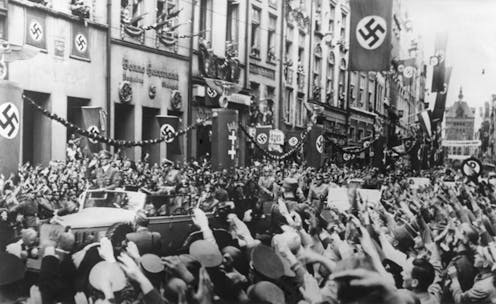
Almost every day comparisons of contemporary politics to Nazi Germany are cropping up in the news. But are these comparisons historically grounded, or are they an abuse of Godwin’s law? Here are some answers to some questions that have cropped up recently.
1) What is Nazism? What is fascism? Would Australia’s right-wing populists fit into either of these categories?
Nazism and fascism were aligned far-right political movements that came to power in Germany (Nazism) and Italy (fascism) after the first world war. There were also fascist parties elsewhere, including in Britain and in Nazi-allied states like Croatia and Romania.
Their policies were grounded in radical nationalism (which often drew on racist ideas), economic corporatism (that is, a particularly authoritarian form of capitalism), anti-democratic, authoritarian and violent politics, anti-unionism and anti-communism.
These parties were an outgrowth of the specific political and economic conditions of the post-war period, but they have attracted some on the radical right globally, who either consider themselves or are considered by others to be neo-Nazi or neo-fascist. In Australia, there are few avowed neo-Nazis or neo-fascist parties, and those that exist are not popular.
Populist parties in Australia that are seeking to gain votes by appealing to anti-immigration and racist sentiments are generally outgrowths of the long-standing tradition of such politics in the political history of post-1788 Australia.
Read more: View from The Hill: A ray of bipartisan good comes out of obscure senator's hate speech
Unlike the Nazis and the fascists, who ruthlessly destroyed democratic institutions upon coming to power, the most prominent anti-immigration parties in Australia don’t claim to want to abolish democracy. Instead they want to use the liberal democratic system to entrench what might be called “white” or “settler” privilege, at the expense of migrants and Indigenous people. Their model is generally the White Australia Policy, not Nazi Germany.
2) Why do people talk about Nazism or fascism with such fear and horror?
The primary legacy of Nazism was the second world war, which led to the deaths of more than 50 million people. Nazis killed almost 6 million European Jews and (directly and indirectly) around 20 million Russians, all in pursuit of an illusory territory secure from racial or political threats. It has been usefully referred to as thanatopolitics – a politics of death founded on the false promise of securing life.
3) Senator Fraser Anning used the phrase ‘final solution‘ and it upset people. Why?
The phrase is a direct reference to the Nazi term Endlösung der Judenfrage (The final solution of the Jewish question), which in the end meant genocide. It is clear that this goes well beyond “dog whistling”. It is instead the kind of language that (until now) only the most rabid and marginal of Nazis would deliberately choose to use.
The term recalls the desire of the state to kill its citizens and the citizens of states around it to secure its own racial fantasy. Anning argues that his usage was unintentional. This is difficult to believe, given the context of the speech.
What is especially chilling about it is that evokes not only the genocidal policies of the Nazi regime, but also its earlier “final solutions” (grounded in the global eugenics movement for 'racial hygiene’) which included halting Jewish migration, then taking away the civic rights of Jews, then expelling Jews, and then finally murdering them.
To use this kind of historically and racially charged language to talk about migrants was a new low, even in Australian politics, where tolerance of racially charged political statements is extraordinarily high.
4) Some Australian press commentators have said that Nazism was left-wing. Is this right?
No. Nazis and fascists were decidedly right-wing and fervently anti-communist. There was a small and short-lived group of Nazis clustered around the Strasser brothers who were interested in a racial strain of anti-capitalist politics. They might loosely be termed “socialist”, but they were completely purged from the Nazi party very early on.
On coming to power, the first targets of the Nazis were communists and socialists. The formal name of the Nazi party, the NSDAP (National Socialist German Workers Party), was a failed attempt to attract workers to the party and away from the left. It failed, and the main voters for the Nazis remained the lower middle classes - the economically vulnerable who most feared the spectre of socialism.
5) Some activists have likened Australia’s offshore detention centres to concentration camps **Is that a fair description?
It pays to be careful here. Firstly, not all concentration camps were in Nazi Germany. Concentration camps were used by the British in South Africa, by the Spanish in Cuba and by the US in the Philippines.
Secondly, when talking about Nazi Germany, a distinction should be drawn between concentration camps (which were places of detention without trial used by the state to sequester undesired non-criminal elements from other citizens) and extermination camps, which were places of execution.
Read more: George Brandis warns Liberals against rise of populist right
It was in the extermination camps (among other, less organised sites) that the Nazis perpetrated the Holocaust.
No two historical examples of concentration camps are exactly alike, but Australia’s offshore mandatory detention centres fit most elements of the description. Those in them are detained without trial. Their purpose is political rather than penological. These are not places of rehabilitation or even punishment. They are indefinite holding centres for those classed as politically problematic.
However, to say Australia is running a detention network with many of the attributes of earlier concentration camps does not mean that Australia is a dictatorship, or that the policy is intrinsically “fascist”. Liberal democracies have their own forms of inhumanity and nations such as Britain and the US have also made use of such camps in the past.
Authors: Matt Fitzpatrick, Associate Professor in International History, Flinders University


















