

Fairy-wrens are more likely to help their closest friends but not strangers, just like us humans
- Written by: Ettore Camerlenghi, PhD student, Monash University
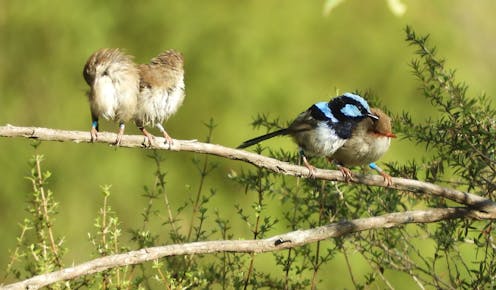
Multilevel societies are among the most complex societies known in nature. They are organised like Russian nesting dolls – individuals belong to family groups, which belong to clans, which belong to tribes.
At each level, the relationships between these social units (individuals, families, clans and tribes) are stable and predictable.
Such a social structure, which has been described in some primates , whales, elephants and more recently in birds, has likely characterised much of human evolution. In fact, it’s still common among many hunter-gatherer societies around the world.
Even though multilevel societies are documented across the animal world, it’s not entirely clear what their benefits are.
One hypothesis, based on observations of two populations of contemporary hunter-gatherer people, is that living in a multilevel society allows people to simultaneously have different types (levels) of cooperative relationships.
Read more: To share is human, to collaborate divine
In our research, published today in Current Biology, we tested this hypothesis in a wild population of superb fairy-wrens, a familiar little songbird across southeastern Australia’s parks and gardens.
Living together means helping each other out
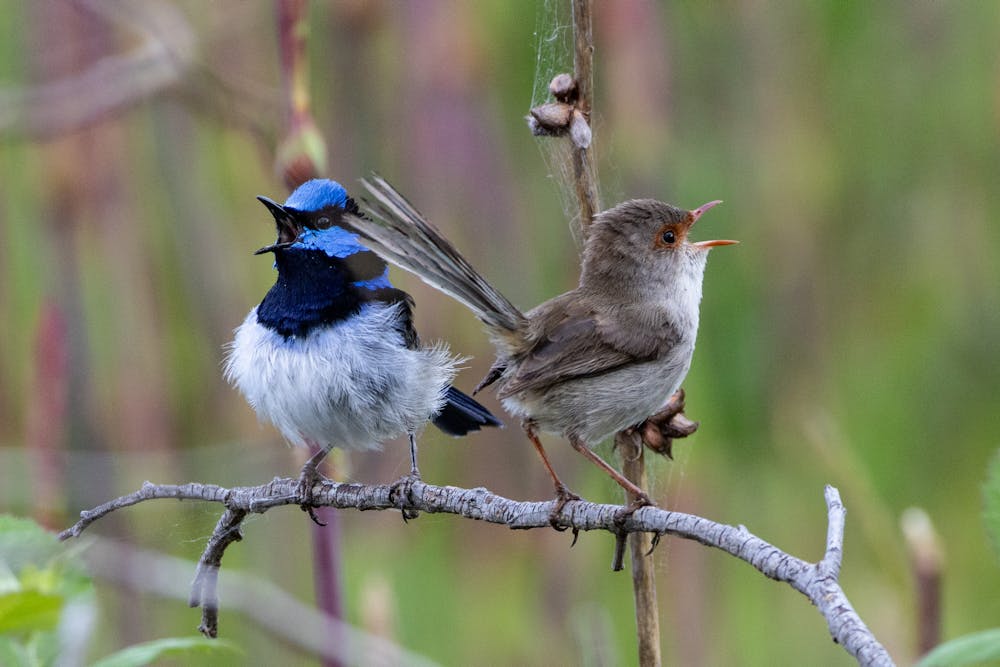
Superb fairy-wrens live in multilevel societies in which breeding groups – between two and six birds – represent the lowest social level, with tight social bonds among individuals.
During the non-breeding season, neighbouring breeding groups associate closely with a few other breeding groups, and these “supergroups” then associate to form communities (the highest social level). As a result, these birds develop social relationships of varying levels of intensity.
Read more: (The most social) bird of the year: why superb fairy-wren societies may be as complex as our own
To make it possible to track those complex relationships, we attached different-coloured leg bands to superb fairy-wrens in our study population so we could recognise all individuals through binoculars. While we are attaching their bands, we recorded any birds that gave distress calls, distinctive calls that individuals use to seek help when they’re in imminent danger, for example from a predator.
Other wrens commonly respond to such calls and try to help, for example by approaching the predator and giving alarm calls. They may also use a distraction tactic called a “rodent-run”. To do this, birds approach the threat to within striking range, assume a hunched posture, and scurry back and forth like a mouse. This distracts the predator, and this “altruistic distraction display” places the bird that performs it at high risk.
Here we tested whether altruistic responses to calls for help vary across the distinct social levels of the society, akin to food sharing among hunter-gatherers, but with much higher stakes.
Male and female superb fairy-wrens performing rodent-run distraction displays, a striking transformation from a bird to a mouse (which isn’t easy if you are blue). Amber Hodgson, Eliza Campbell & Abigail Robinson.Read more: It isn't easy being blue – the cost of colour in fairy wrens
To simulate a predator threatening a fellow wren, we presented a stuffed kookaburra – a fierce predator of small birds, including fairy-wrens – while playing back a distress call recorded from a local fairy-wren. We then recorded the responses of all wren-witnesses.
For each breeding group, we tested if social relatedness affected how willing birds were to help another in distress. We played back, on different occasions, a distress call from an individual within the same breeding group, one from the same community, or one from an unfamiliar individual outside the community.
We found that superb fairy-wrens were more likely to heed the calls for help from birds of the same breeding group. They responded less fervently, taking fewer risks and never performing rodent-runs, when a merely familiar wren – from the same community – called for help.
As for strangers? They ignored them completely. So being part of a complex society lets the birds carefully “dose” their cooperative assistance.
Like birds, like people
This pattern mirrors what was previously found in hunter-gatherers. Here, food is shared mostly by people from the same household, followed by members of the same cluster of households. The least sharing happens between members of the same camp – the highest social level of their multilevel society.
Similarly, living in a multilevel society helps the wrens to distinguish whom to cooperate with and how much. The cooperation at different social levels likely has different social functions, too.
For example, cooperative relationships between breeding group members might increase group cohesion, survival and reproduction. At the community level, alliances between neighbouring breeding groups are likely to help the birds defend against predators better, and to have less aggression between groups.
Humans and superb fairy-wrens belong to very distant branches within the tree of life (our common ancestor lived at least 200 million years ago. Nevertheless, the pattern of cooperative behaviour shown by these little songbirds is astonishingly similar to ours.
This suggests the complex cooperative patterns we see in our own society may have emerged independently many times in different species, and first appeared millions of years before we set the first foot on this planet.
Acknowledgements: we thank Holsworth Wildlife Research Endowment and the Ecological Society of Australia, the Australian Research Council, The Australian National University (ANU), the University of Zurich, the Max Planck Institute of Animal Behavior and Monash University for support. We are grateful to our colleagues Robert Magrath, Sergio Nolazco and Damien Farine who co-authored this study, and thank Robert Magrath for co-authoring this article.
Authors: Ettore Camerlenghi, PhD student, Monash University


















