

Squid fishing grew by 68% in just three years, raising fears the industry is out of control
- Written by: Quentin Hanich, Professor, University of Wollongong
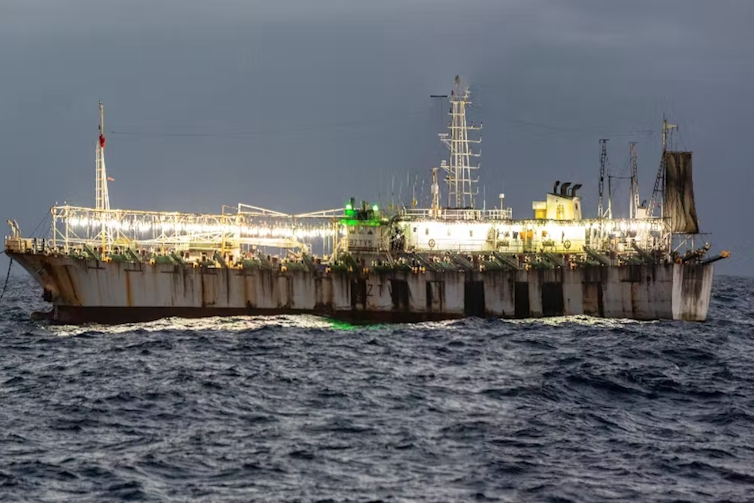
Global squid fishing increased by 68% between 2017 and 2020, according to our international analysis, prompting concerns that much of the international fishing fleet is sidestepping necessary conservation and management.
Our study, carried out with colleagues in Australia, Japan, the United States, Chile and Canada, and published today in Science Advances, reveals that almost all of the increase in squid fishing has occurred in unregulated areas, with 86% of squid fishing now occurring in places with little or no scrutiny of catch sizes.
Unregulated fishing poses a significant challenge to fishery sustainability and raises substantial equity concerns. While attention has tended to focus on illegal fishing, the growth in legal but unregulated fishing may pose an even bigger threat, particularly to species such as squid, whose fisheries can cover entire oceans.
To estimate the scale of global squid fishing, we analysed satellite imagery and vessel tracking data to see how many vessels are fishing for squid, and where and how often they operate.
Read more: We now have a treaty governing the high seas. Can it protect the Wild West of the oceans?
Squid fishing vessels are typically outfitted with powerful lamps to attract squid to the surface. These lamps are so powerful that they are visible from space. This means we can use satellite data to spot these lights at night, along with data from the ships’ Automatic Identification System (AIS), which allows authorities to monitor the location and course of registered vessels.
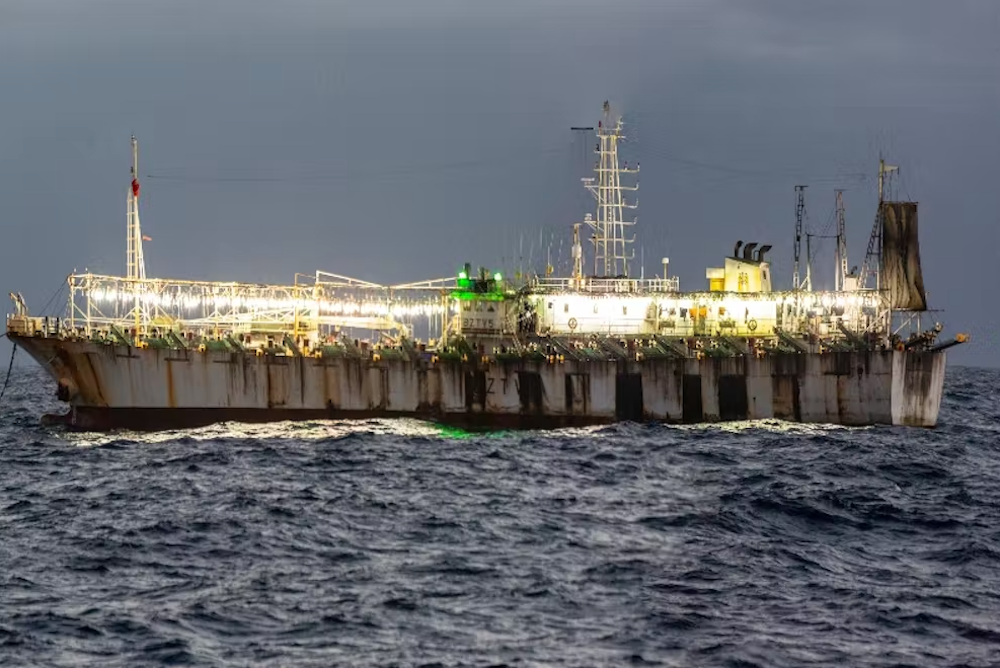
Using this data, we estimate that the amount of light-luring vessel effort increased from an estimated 149,000 vessel days in 2017, to 251,000 vessel days in 2020. Of these, 61-63% were by vessels not broadcasting their AIS, and thus only visible by the loom from their lamps. This light-luring vessel effort represents an estimated total of 801,000 vessel days over the period 2017–20.
Finally, we correlated these data with national and regional management bodies, and determine how much of this activity is unregulated.
A complex problem
Regulation and management of globalised squid fisheries is complex, because this fishing takes place both in waters that are under national jurisdiction and on the high seas. Consequently, cooperation is fundamental to ensure fisheries are regulated at sustainable levels and avoid gaps or loopholes.
Regional fisheries management organisations have been established through international treaties to provide the framework for such cooperation, and to regulate so-called “transboundary” fisheries. However, out of 17 such organisations in existence, only two – the North Pacific Fisheries Commission and the South Pacific Fisheries Management Organisation – have dealt with squid fisheries. This means there are still large gaps in the Indian and Atlantic oceans.
Furthermore, it is not enough to create a regional fisheries management organisations; parties must also ensure the organisation actually adopts regulations. The United Nations’ International Plan of Action to Prevent, Deter and Eliminate Illegal, Unreported and Unregulated Fishing defines unregulated fishing (among other things) as that which occurs “in areas or for fish stocks in relation to which there are no applicable conservation or management measures”. Regional fisheries management organisations must do more than simply exist or adopt general measures if their fisheries are to be considered regulated.
What we found
Our analysis defines “regulated” fisheries as those within the exclusive economic zones of coastal countries, or within regional fisheries management organisations that have implemented specific conservation and management measures for squid stocks. In contrast, we define “unregulated” fisheries as those on the high seas where there is no such organisation in place, or where the relevant organisation has failed to adopt regulations pertaining specifically to squid stocks.
Using satellite imagery, vessel tracking, and data monitoring, our study found that globalised light-luring squid fishing fleets are truly global in scope, fishing across multiple oceans within a given year, moving freely between regulated and unregulated spaces, and catching vast amounts of squid with little or no oversight. Often, there is no requirement to report their catches to anyone other than their flag nation, with little or no independent verification.
Unregulated spaces are often directly adjacent to regulated ones, and different fleets often target the same fisheries. This creates equity concerns for coastal communities that rely on species targeted by large industrial fleets, and for the governments of developing nations that depend on revenue from stocks that move between regulated and unregulated areas.
Furthermore, many of the fishing vessels carrying out unregulated fishing stay at sea for exceptionally long periods (months to years), often refuelling and offloading their catches to other vessels while still at sea, and thus avoiding the oversight that accompanies port calls.
Like all activities that draw on global resources, fishing on transboundary stocks should be fully regulated. Yet the regional bodies with the competence to adopt management measures are often restrained by distant water fishing nations that stall or oppose conservation and management measures.
The global squid fishery shows how important it is to strengthen regional management of high seas resources and to continue international calls for states and regional bodies to take this challenge seriously. These fisheries are ultimately shared by us all, yet few receive any benefit, and nearby countries’ own fish stocks are sometimes unfairly depleted.
Furthermore, the trans-oceanic nature of these fisheries highlights the crucial importance of comprehensive data-sharing agreements between regional fisheries management organisations for improving understanding of the movements of these vessels, and quantifying their impacts on squid stocks.
Authors: Quentin Hanich, Professor, University of Wollongong


















