

Astronomers just discovered a comet that could be brighter than most stars when we see it next year. Or will it?
- Written by: Jonti Horner, Professor (Astrophysics), University of Southern Queensland

Hot on the heels of the disappointing Green Comet, astronomers have just discovered a new comet with the potential to be next year’s big story – C/2023 A3 (Tsuchinshan-ATLAS).
Although it is still more than 18 months from its closest approach to Earth and the Sun, comet Tsuchinshan-ATLAS already has social media buzzing, with optimistic articles being written about how it could be a spectacular sight. What’s the full story on this new icy wanderer?
Introducing comet C/2023 A3 (Tsuchinshan-ATLAS)
Every year, a few dozen new comets are discovered – dirty snowballs moving on highly elongated paths around the Sun. The vast majority are far too faint to see with the unaided eye. Perhaps one comet per year will approach the edge of naked-eye visibility.
Occasionally, however, a much brighter comet will come along. Because comets are things of ephemeral and transient beauty, the discovery of a comet with potential always leads to excitement.
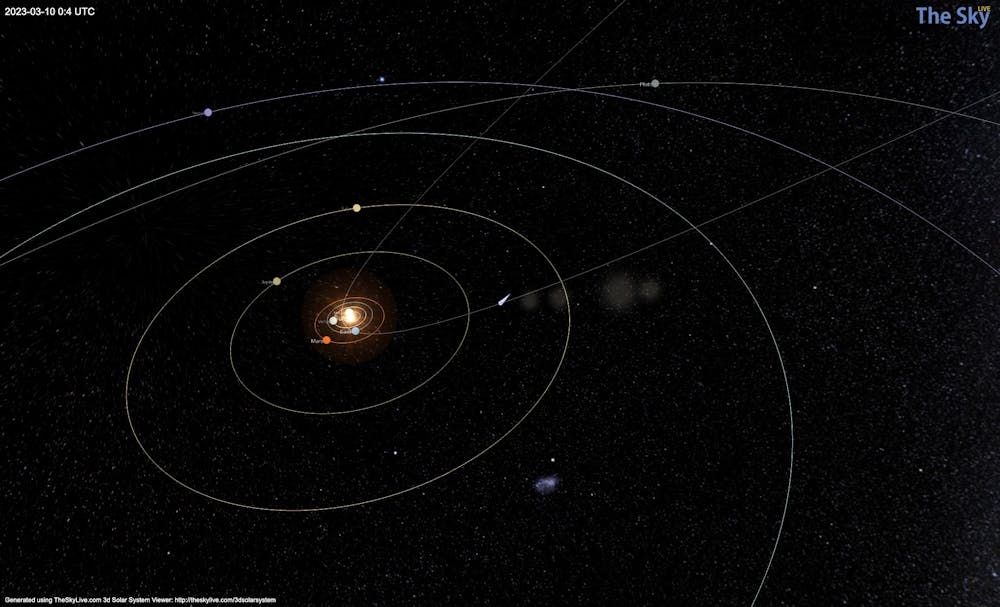
Comet C/2023 A3 (Tsuchinshan-ATLAS) certainly fits the bill. Discovered independently by astronomers at Purple Mountain Observatory in China and the Asteroid Terrestrical-impact Last Alert System, ATLAS, the comet is currently between the orbits of Jupiter and Saturn, a billion kilometres from Earth. It is falling inwards, moving on an orbit that will bring it to within 59 million kilometres of the Sun in September 2024.
The fact the comet was found while it’s so far away is part of the reason for astronomers’ excitement. Although currently some 60,000 times too faint to see with the naked eye, the comet is bright for something so far from the Sun. And observations suggest it’s following an orbit that could allow it to become truly spectacular.
A recipe for comet greatness
It’s all down to a combination of the comet’s path through the Solar System, and the potential size of its nucleus – the solid centre.
As comets swing closer to the Sun, they heat up, and their surface ices sublime (turn from a solid to a gas). Erupting from the comet’s surface, this gas carries along dust, shrouding the nucleus in what’s called a coma – a giant cloud of gas and dust. The coma is then pushed away from the Sun by solar wind, resulting in a tail (or tails) pointing directly away from the Sun.
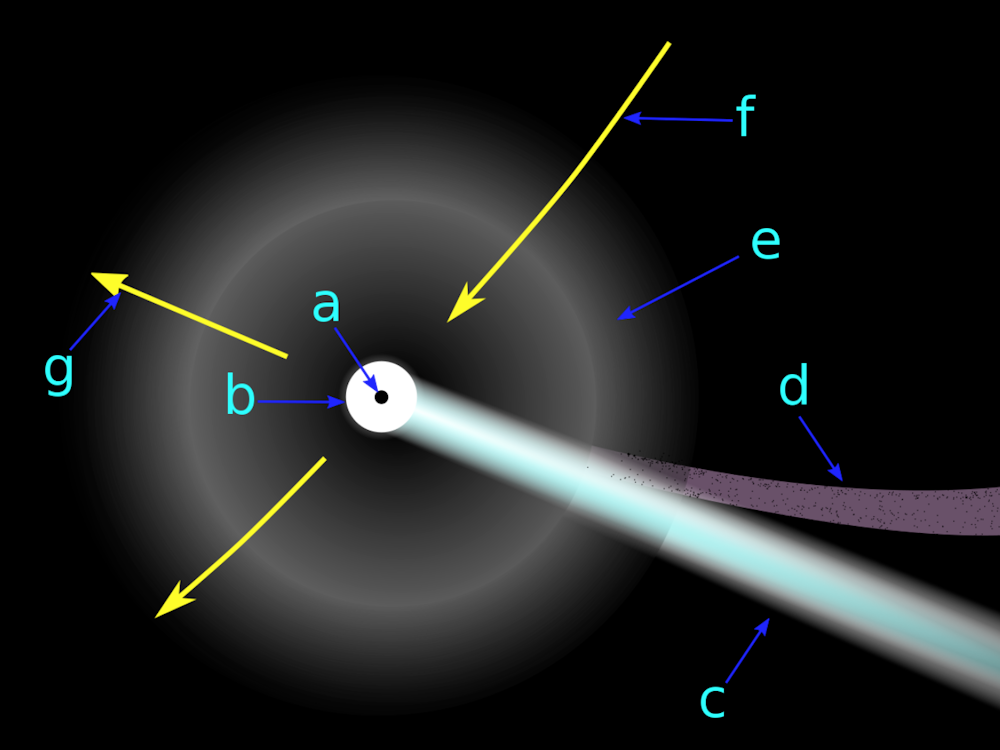 A schematic view of a comet, not to scale, showing the comet’s nucleus (a), coma (b), and gas and dust tails (c and d). Those tails always point away from the Sun (which lies in the direction of g) no matter how the comet is moving (direction f in the figure).
Sanu N/Wkimedia Commons, CC BY-SA
A schematic view of a comet, not to scale, showing the comet’s nucleus (a), coma (b), and gas and dust tails (c and d). Those tails always point away from the Sun (which lies in the direction of g) no matter how the comet is moving (direction f in the figure).
Sanu N/Wkimedia Commons, CC BY-SA
The closer a comet gets to the Sun, the hotter its surface becomes, and the more active it will get. Historically, the vast majority of the brightest, most spectacular comets have followed orbits that brought them closer to the Sun than Earth’s orbit. The closer, the better, and Tsuchinshan-ATLAS certainly ticks that box.
In fact, this new comet seems to tick all the boxes. It appears to have a sizeable nucleus, making it brighter (bright enough to be discovered so far from the Sun). It is destined to have a very close encounter with our star. And, the kicker, it will then pass almost directly between Earth and the Sun, approaching within 70 million kilometres of us just two weeks after perihelion (the closest approach to the Sun). The closer a comet comes to Earth, the brighter it will appear to us.
Put that together, and you have a recipe for a comet that could shine as brightly as the brightest stars. Some forecasts are even more bullish, suggesting it could be up to a hundred times brighter still!
Read more: Meteors seem to be raining down on New Zealand, but why are some bright green?
The curse of prediction
Comets are like cats: they have tails, and they do precisely what they want – astronomer David H. Levy.
Predicting how newly discovered comets will behave is a dangerous game. Some may be spectacular, while others fizzle.
Take, for example, comet Kohoutek, in 1973. Like Tsuchinshan-ATLAS, Kohoutek was discovered unusually far from the Sun, moving on an orbit that swung close to our star. Cue the hype. Astronomers promised the public “the comet of the century”, predicting Kohoutek could become bright enough to see in broad daylight.
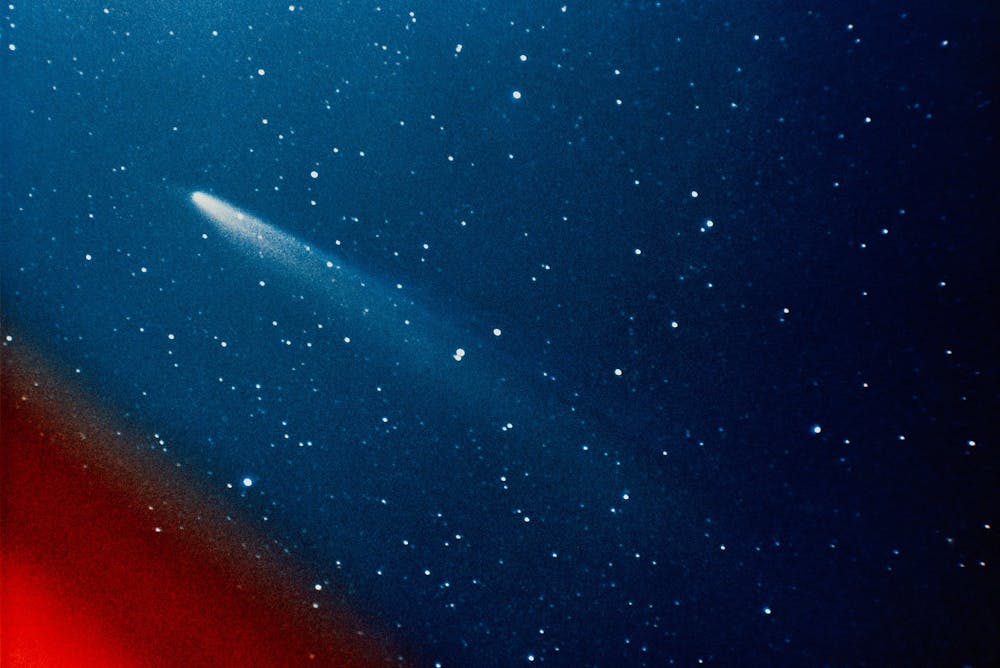 Photo of the comet Kohoutek (C/1973 E1) taken by members of the lunar and planetary laboratory photographic team from the University of Arizona, at the Catalina observatory with a 35mm camera on January 11 1974.
NASA
Photo of the comet Kohoutek (C/1973 E1) taken by members of the lunar and planetary laboratory photographic team from the University of Arizona, at the Catalina observatory with a 35mm camera on January 11 1974.
NASA
But comets are like cats. Kohoutek brightened as it swung in towards the Sun, but more slowly than expected. Rather than being visible in broad daylight, it was only as bright as the brightest stars, and faded quickly after perihelion. It was still a good show, but far from the comet of the century. Because of the hype, many dubbed Kohoutek a spectacular disappointment.
It turns out Kohoutek was passing through the inner Solar System for the very first time. It had never come so close to the Sun, so its surface was rich in highly volatile ice which began to sublime when the comet was still far away. At that great distance, the comet was much brighter than other, more experienced comets – and that brightness suggested the comet would be truly spectacular.
As it came closer to the Sun, those volatiles were exhausted, and the comet’s final activity was less than initially predicted, making it fainter.
There is a very real chance Tsuchinshan-ATLAS might, like comet Kohoutek, be approaching the inner Solar System for the first time. We’re not yet sure – but if it is, it might also wind up being less spectacular than predicted.
 Comet C/2020 F8 (SWAN), as photographed by Jonti in early May 2020. The bright near vertical streak is an Eta Aquariid - a fragment of comet 1P/Halley burning up harmlessly in the foreground. The coma of the comet lies at the bottom right, with the tail extending up to the top left corner of the frame.
Jonti Horner
Comet C/2020 F8 (SWAN), as photographed by Jonti in early May 2020. The bright near vertical streak is an Eta Aquariid - a fragment of comet 1P/Halley burning up harmlessly in the foreground. The coma of the comet lies at the bottom right, with the tail extending up to the top left corner of the frame.
Jonti Horner
Where it all falls apart
But it could be even worse. Comets are prone to disaster. They fragment, fall apart, and disintegrate surprisingly often. Those coming into the inner Solar System for the first time are particularly fragile.
A recent example of such a fragmentation was comet C/2020 F8 (SWAN). When SWAN was discovered, it looked promising – likely to become a naked-eye object in May 2020. But as it approached the Sun, it suddenly brightened, then became fuzzy, and began to fade away. By the time it should have been brightest, it had all but disappeared, having fallen apart before our very eyes.
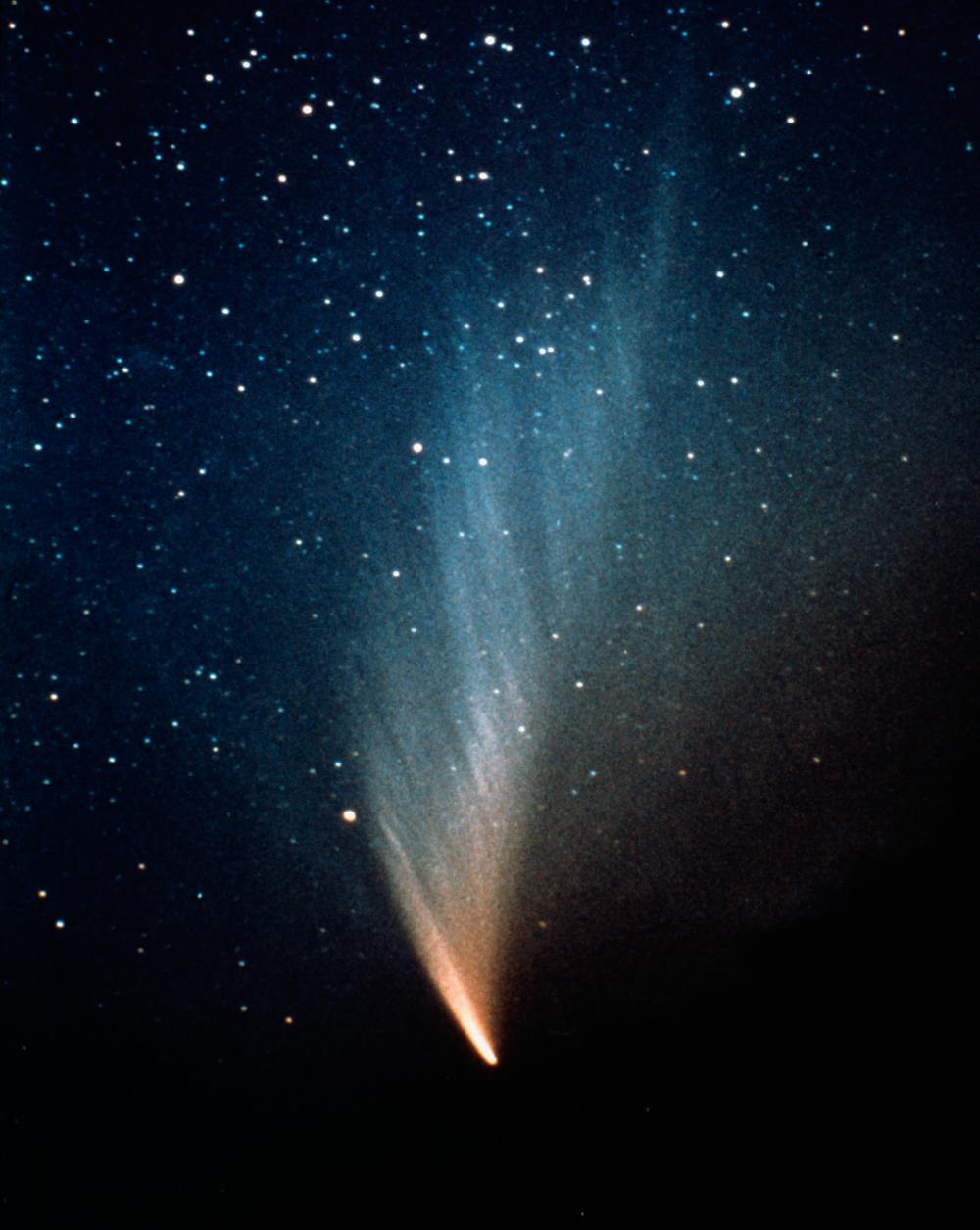 Comet West reached peak brightness in March 1976, as seen here. During its peak, observers reported that it was bright enough to study during full daylight.
P. Stättmayer/ESO, CC BY
Comet West reached peak brightness in March 1976, as seen here. During its peak, observers reported that it was bright enough to study during full daylight.
P. Stättmayer/ESO, CC BY
On the flip side, fragmentation events can sometimes turn a good comet into a great one. Three years after Kohoutek came comet C/1975 V1 (West), and it was truly spectacular.
It passed even closer to the Sun than Tsuchinshan-ATLAS will – and was already dazzling when, at perihelion, its nucleus broke into four pieces. That fragmentation event released a huge amount of gas and dust, and the comet brightened markedly, even becoming visible in broad daylight.
Will Tsuchinshan-ATLAS be worth the anticipation?
We won’t know for certain whether comet Tsuchinshan-ATLAS will be a spectacle until it arrives. It could fall apart and become less bright, or it could surprise us.
It could brighten more than expected – which would make for an amazing sight in the morning sky in late September and early October 2024, and an even better one in the evening sky in mid-October 2024
We just don’t know. But we’ll get our first hints in the months to come. By tracking how the comet brightens as it glides sunwards, we will get our first indications as to its true fate – so keep your fingers crossed.
Read more: Comet families similar to our own are found around another star
Authors: Jonti Horner, Professor (Astrophysics), University of Southern Queensland



















.jpg)