

Google AI


Modern Australian

the end of daily letter deliveries is in sight

  • Written by: Paul Alexander, Adjunct Associate Professor of Supply Chain Management, Curtin University
the end of daily letter deliveries is in sight

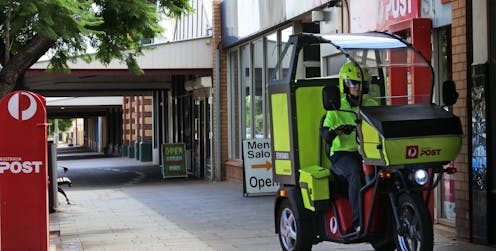
Australia Post is seeing red. A lot of it.

After posting a razor-thin profit of $23.6 million in the last six months of 2022, it anticipates a loss for the full 2022-23 financial year – only the second time since being corporatised in 1989.

The last loss was in 2014-15, following a $190 million investment in “transformational reform” of Australia Post’s letters business. At the time, it expressed confidence those efficiency improvements would allow it “to maintain a five-day-a-week delivery”. Now it is pessimistic. With the ongoing collapse in demand for letter delivery, it sees only more losses ahead.

That’s a huge problem, because Australia Post has two main obligations, enshrined in federal legislation. It is required to operate on commercial principles – that is, the federal government wants it to deliver a dividend – while also meeting strict community service obligations.

Those obligations – established in 1989 and last reviewed in 2019 – require delivering letters to 98% of all Australian addresses five days a week, and in more remote areas to 99.7% of addresses at least twice a week, generally within two days of posting.

The Morrison government temporarily relaxed those obligations between May 2020 and June 2021 so Australia Post could divert resources to its parcel delivery services as online shopping boomed during the pandemic. Now the organisation wants those community service obligations reduced permanently.

Read more: COVID hands Australia Post opportunity to end daily delivery

Cost of service obligations

Meeting the obligations cost $348.5 million in 2021-22, says a federal government discussion paper on “postal services modernisation” published this month. It says they “are no longer financially sustainable and are not well targeted at the needs of Australians due to changes brought about by the digitisation of the economy”.

It’s hard to disagree. The numbers are incontrovertible. The hundreds of millions of dollars a year being lost on letter delivery will only get bigger. People just don’t need a daily postal service like they used to.

In the red, and dying

In the 2021-22 financial year, Australia Post made a slim profit of $55 million on revenues of $8.97 billion. That’s a 0.6% profit margin, far below the 8.5% average within the transport services sector.

The surplus was due only to its parcel-delivery business, which grew about 12% in 2021-22 after four years of growing at more than 20%. Letters now account for less than 20% of Australia Post’s revenue.

The discussion paper notes letter volumes in Australia is now less than half what they were in 2008. This is not as severe as countries such as New Zealand or Denmark, but worse than Germany, Japan, the United States and the United Kingdom.

Declines in postal organisation letter volumes

Australian Government, Postal Services Modernisation Discussion Paper, March 2023
Australian Government, Postal Services Modernisation Discussion Paper, March 2023, CC BY Government agencies and businesses now account for 97% of mail sent. Overall volume will decline as they move to cheaper, more efficient online methods. Even major postal events like election campaigns are likely to disappear, with postal voting replaced by digital technology. What can be done? The discussion paper flags a range of possible responses. One is to charge higher prices. Britain’s Royal Mail, for example, has raised postage prices by 64% over the past five years. Australia Post increased the rate for standard letter delivery from A$1.10 to A$1.20 in January, which the discussion paper notes is significantly less than the average of $2.08 for OECD countries. Higher prices may boost profit for a year or two, but in the longer term will just accelerate the transition to non-postal methods. Another option is investing in more efficient sorting technology, particularly automation. The French and German postal services are doing this. But Australia Post has already made huge investments in efficiencies, and doing more will cost the federal government money – something it won’t want to do given the budget position. What about local post offices? Another option is to reduce Australia Post’s network of post offices, of which there are more than 4,300. This number is tied to another community service obligation: that no one live further than 2.5km from a post office in a metropolitan area, or 7.5km in a non-metropolitan area. The discussion paper notes Australia has more post offices than supermarkets. They cost $1.3 billion to operate in 2021-22. These provide posting, pickup, banking, transaction and retail services. But their need is diminishing as all things are progressively digitised. An argument could be made that some, at least in metropolitan areas, could be replaced with smart lockers for parcel pick-up. But that’s likely to be politically contentious, with less financial gain, than the most obvious choice – to scrap the community service obligation to deliver post five days a week. New Zealand’s postal service did this in 2013, moving to delivery every other day. Sweden did so in 2020 as a trial, with the intention of making it permanent. Some will miss the daily service. But most of us won’t. As the relaxation to deliveries every second day showed during the COVID period, it is likely most people won’t even notice. Authors: Paul Alexander, Adjunct Associate Professor of Supply Chain Management, Curtin University

Read more https://theconversation.com/post-apocalypse-the-end-of-daily-letter-deliveries-is-in-sight-201094

What to Do When an Older Car Is No Longer Worth Keeping in Melbourne

Ever looked at another repair quote and wondered whether your old car is still worth the trouble? It is a common turning point for Melbourne motoris...

Your Baby's First Year: A Local Guide to Feeding, Sleep, and When to Get Extra Support

Ask ten parents in a Brisbane mothers' group how their baby is feeding or sleeping, and expect ten different answers.  Someone's baby sleeps throug...

Kitchen and Laundry Makeover Ideas That Don't Require a Full Renovation

Full kitchen renos are expensive — and most people don't actually need one.  They need the kitchen to stop looking like it's stuck in 2009, or they...

How Technology Is Reshaping the Modern Australian Commercial Kitchen

The commercial kitchen has always been shaped by technology. Refrigeration changed how ingredients could be stored, modern ventilation transformed k...

The Number on a Roller Blind Fabric That Nobody Explains

Somewhere in the fabric book, next to the colour name, there is a percentage. Three per cent. Five per cent. Ten per cent. Nobody explains it, most c...

What’s Trending in Men’s Jewellery This Father’s Day!

Finding a Father’s Day gift that feels personal, stylish and genuinely wearable is not always easy. While socks and novelty mugs have traditionally ...

Road Signs: Understanding Their Role in Clear and Effective Signage

Effective signage and display hardware can help businesses communicate information, promote products and organise customer or visitor movement. Road...

Bottle Label Printing: Key Factors to Consider Before Your Next Packaging Run

Effective packaging begins with understanding the product, bottle material, artwork and production requirements when planning bottle label printing. H...

Planning a Long-Distance Move With Interstate Movers Melbourne

Moving between states involves more planning than a typical local relocation. Along with packing and transporting household belongings, you need to...

Understanding the Role of an I/O Controller in Industrial Automation

Modern industrial systems depend on accurate communication between sensors, machines and control systems. An I/O controller can help manage this commu...

How the Right Mining Hose Supports Demanding Operations

Mining environments place considerable demands on equipment used for material transfer, water management and processing. Hoses operating in these co...

Simple Ideas for Making Social Gatherings More Memorable

We have all been to those parties where everyone just stands around the kitchen island, staring at their phones, waiting for someone else to make a mo...

Outdoor Wall Lights: Improving Exterior Lighting Around Your Home

Lighting can influence how a room looks, feels and functions, so the right fitting should be selected according to both appearance and practical req...

Commercial Office Cleaning: Combining Routine Office Cleaning With Melbourne Service

Keeping a workplace clean requires a service that can accommodate everyday tasks as well as the particular needs of the business. Professional comme...

Caravan Sales in Queensland: How to Find the Right Caravan for Sale QLD

Caravan ownership is about more than having somewhere to sleep while travelling. For many Queenslanders, it is one of the best ways to explore regio...

What Sir Walter Buffalo Turf Actually Costs in 2026 (And Why Quotes Vary So Much)

Two quotes landed on a Hills District homeowner's kitchen table last spring for the exact same 80-square-metre backyard. One said $12 a metre. The o...

Nearly 1,300 NSW Hospital Beds Are Occupied By People Who Are Ready To Go Home

1,276 people in NSW hospitals have been medically cleared for discharge but remain in hospital because they're still waiting for NDIS or aged care sup...

National Survey Launched to Measure Operational Impacts of Federal NDIS Policy Reforms

The effects of recent NDIS reforms are beginning to move beyond policy papers and into day to day service delivery. A new national survey is asking ...
















