

The full credit list featured at the beginning of Tár is a nod to the hidden hierarchies of labour in screen production
- Written by: Alex Munt, Associate Professor, Media Arts & Production, University of Technology Sydney
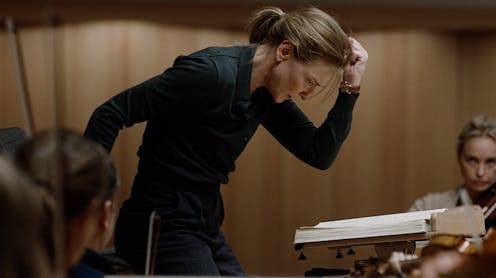
In a recent interview on her portrayal of a renowned (fictional) female conductor, the autocratic maestro Lydia Tár, Cate Blanchett noted ways in which orchestral music-making is not a democratic enterprise. Neither is film-making.
Written, directed and produced by Todd Field, the film courted controversy for situating a woman as the power-play sexual predator in a post-Weinstein world. At the start of the film, or even before the start, audiences noted something else distinctive about the film: that the full screen credit list, attributing the labour of the production, came before the film proper.
More specifically, Tár obliges its audience to patiently sit through a full three minutes of opening credits. This is a big ask, in the age of streaming media where audiences embrace the “skip” function (for opening credits) and where end credits rush by at an unfathomable pace, arguably creating invisibility of the creative labour of the screen production.
A democracy of credits
Far from the trend to lavish, expensive, opening credit sequences, the screen credits for Tár are a sombre experience and materialise in small, white typography on a black screen, which gently fade in and out, set to a minimal musical score.
They are non-dynamic to the point that this slow-burning, 180-second credit sequence won’t find its way onto YouTube (unless to make a thematic point). In one sense, the style of the credits are uneventful. But they also present an opportunity for an audience to consider the history of screen credits, and the way in which this particular creative choice foreshadows the story of Lydia Tár to come.
In his Oscar-nominated screenplay, Field (unusually) spelled out his desire to return the end credits to the start of this film. His screenplay notes:
Punctuating credits filling a single black frame. One after the other, side-by-side, like players seated on a cramped stage.
To return to Blanchett’s quote above, Field appears to want to reinstate a democracy of credits, to represent the large-scale shared creative labour of screen production.
In an interview Field said “I wanted to recalibrate the viewer’s expectations about hierarchy.”
Read more: Australian thriller The Stranger puts anxiety centre frame
The labour of film production
Field’s creative decision has a historical precedent, in the 1963 French feature film Contempt by the late Jean-Luc Godard.
In place of typographic opening credits, Godard narrates the labour of the film production, with his own voice, an exercise in Brechtian-inspired reflexivity, to make transparent the ways in which a film work arrives to an audience.
Interestingly, Godard retains the “possessory” film credit of “a film by” – something that Field rescinded, taking the more didactic (yet less dominant) “written, directed and produced by”. Field had to convince the producers that the extended end-credits-as-opening-credits would not be audience-unfriendly, in an attention-distracted world.
In Tár, the hierarchy is inverted: Field appears last, after the three-minute “communal” credits sequence. In making his decision to invert the hierarchy of the behind-the-scenes power relations, Field attempted to (from the outset) draw the viewer’s attention to the primary investigation of the film: the power relations on screen.
In consideration of the hierarchy, or signification of power within a screen production, of screen credits – this has been both culturally and historically determined. In early (silent) cinema, before the medium was highly industrialised, film roles remained shared, undefined or ambiguous.
As the motion picture industry advanced to become a highly managed creative realm, a stricter demarcation and hierarchy of roles followed.

A return to the past
The opening credit roll of Tár is not new – it represents a return to the past.
For much of the 20th century, there was only opening film credits, with the end credit being simply, and literally, marked “The End”. Relatively soon, a template for screen credits was in situ, which signalled a clear hierarchy of labour “above the line” (producers, screenwriters, director, major actors) which took the prominence of the opening credits, with the “below the line” creative crew and production support labour relegated to the end credits, in small font as a closing credit roll.
For example, a film’s cinematographer typically sits below the line even though they make a significant contribution to the visual storytelling and authorship of the film. And, invisibly to audiences, screen credits also determine the copyright provisions for a film work.
Next time you’re in the cinema, look around as the end credits roll. It’s mostly industry people, cinephiles or film students who stick around to the very end.
Even once the hierarchy of screen credits had been generally agreed for the placement and order of screen credits, it remained contested territory.
George Lucas attracted a hefty fine from the Directors Guild of America for omitting the role of the films’ directors for Star Wars (1977) and The Empire Strikes Back (1980). Lucas resigned and the rest is history – his spatialised prose sequence set to the famous John Williams score claimed its place as a core aspect of the Star Wars story-verse.
In the opening credits for Pulp Fiction (1995), the screenwriting is credited to “Stories By: Quentin Tarantino & Roger Avary”, who shared the Academy Award for Best Original Screenplay on stage. But behind the scenes, Avary was paid out to enable the (then) new auteur to maintain the possessive credit of “A film by Quentin Tarantino”.
In more recent times, the rise of the episodic streaming television “showrunner” has displaced the possessive screen credit of the auteur director, to a more generic “created by”. The story of the hidden, or not so hidden, hierarchies of labour in screen production is to be continued.
Authors: Alex Munt, Associate Professor, Media Arts & Production, University of Technology Sydney


















