
Our bedrooms aren't refuges anymore – working, studying and eating in them is bad for our sleep
- Written by: Christian Tietz, Senior Lecturer in Industrial Design, UNSW Sydney
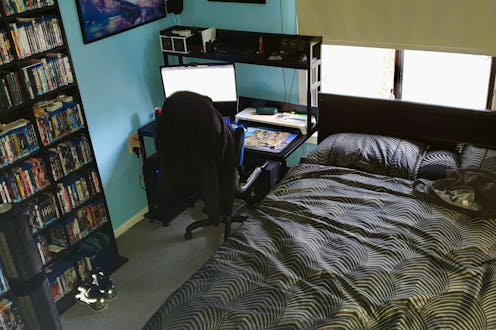
It’s the end of a long day and you’re finally home, ready to unwind and recharge for the next day. You head to your bedroom, hoping to find solace and relaxation in your personal refuge. But it’s not just a place for sleeping anymore, as our recently published study shows. Your bedroom has become a catch-all place for all sorts of activities – from work to entertainment to exercise – and it’s having a major impact on your sleep.
We asked 300 Australians about their sleep environments and how they use them. Half of them said they have or might have a sleep problem. And almost half said their bedroom was also their living space and they would prefer a different arrangement.
Despite this preference, with the rise of remote work and digital entertainment, many of us have transformed our bedrooms into multi-functional spaces. We use them for work calls and emails, watch movies or play video games, and even exercise before bed.
This versatility comes at a cost. It can be difficult to mentally disconnect from these activities and create a peaceful environment that promotes restful sleep.
What’s driving these changes?
Urban density, rising rents and housing costs, and changes in how we work affect how we use our bedrooms and what they mean to us. The COVID pandemic meant more people started working from home and many had a set-up in their bedrooms. Using the bed for activities other than sleeping became more common.
Like eating, sleep is fundamental for human survival. Sleep studies show a lack of sleep has significant impacts on our wellbeing, mental and physical health as well as social and work performance.
Despite its importance and the fact that we spend around a third of our lives asleep, our domestic sleep spaces and how we use them are relatively unexplored. We wanted to question if today’s bedrooms are still quiet places of refuge or privacy where one rests – and that no longer seems to be the case for many people.
The sleep environment plays a significant role in the way we sleep, and we wanted to learn more about where we sleep today when it isn’t simply a room with a bed. And not everyone sleeps in a bed. Sofa beds are the second-most-mentioned sleep space in our study, while close to 10% sleep in a spare room and 1% sleep in a car.
About 50% sometimes or always use the bed for studying, working or eating. And 59 respondents had a desk in their bedrooms, while 80 mentioned studying or working from their bedrooms, and 104 mentioned using their laptops. One in six people worked from their bed. Among the other activities in the sleep environment, watching TV or streaming shows was predictably the most common, followed by reading, studying or working, eating and then exercising.
Professor Dorothy Bruck talks about good sleep habits.People spent an average of about 9.5 hours a day in their sleep environment but just over seven hours sleeping. That’s two-and-a-half hours a day in their sleep area not sleeping. About 20% of respondents spend 12 or more hours in the rooms they sleep in.
Younger participants spent more time in their bedrooms than any other age groups. For children and teenagers their bedroom plays an important role in play, developing their own personality and character and becoming socialised. However, our study surveyed Australian residents 18 years and older.
One of the significant concerns to highlight is about a quarter mentioned having a sleep problem and another 26% were not sure whether they have a sleep problem or not. That suggests nearly 50% are not sleeping well. While 60% said they have a consistent sleeping routine, these figures suggest a consistent routine isn’t necessarily a good routine.
Read more: Is there such a thing as the perfect alarm tone? We think so (and this is what it might sound like)
We still have much to learn about bedrooms
We have a relatively good understanding of the environmental factors that contribute to good sleep. These include noise levels under 40 decibels and limited or no lighting during sleep. Yet we know very little about bedroom layouts and furnishings.
Bedrooms are one of our most private spaces. A Belgian researcher resorted to forensic crime scene photographs of bedrooms from the 1930s and ’40s to gain insight into what bedrooms actually look like. Because what we can glean about bedrooms from architectual and interior magazines, home renovation TV shows or sales room displays is based on idealised and aspirational settings.
The kitchen, on the other hand, is very well researched and the outcomes are practically applied to our everyday lives. We know more about efficient kitchen layouts, counter top heights, drawer width, ideal distances between sink and working top to enhance hygiene and how many steps are taken to prepare a meal, among many other details.
It should be noted that many of us, particularly renter-occupiers, are limited in what we can do to personalise and change our bedrooms. It would be ideal if our laws allowed renters more flexibility to customise their space beyond just furnishings, especially if they intend to stay for a long time.
This study is the first part of a research project that in its next phase will survey existing bedrooms in homes. If you are interested in participating please contact the authors.
Read more: Why do we wake around 3am and dwell on our fears and shortcomings?
Authors: Christian Tietz, Senior Lecturer in Industrial Design, UNSW Sydney


















