

If AUKUS is all about nuclear submarines, how can it comply with nuclear non-proliferation treaties? A law scholar explains
- Written by: Lauren Sanders, Senior Research Fellow on Law and the Future of War, The University of Queensland
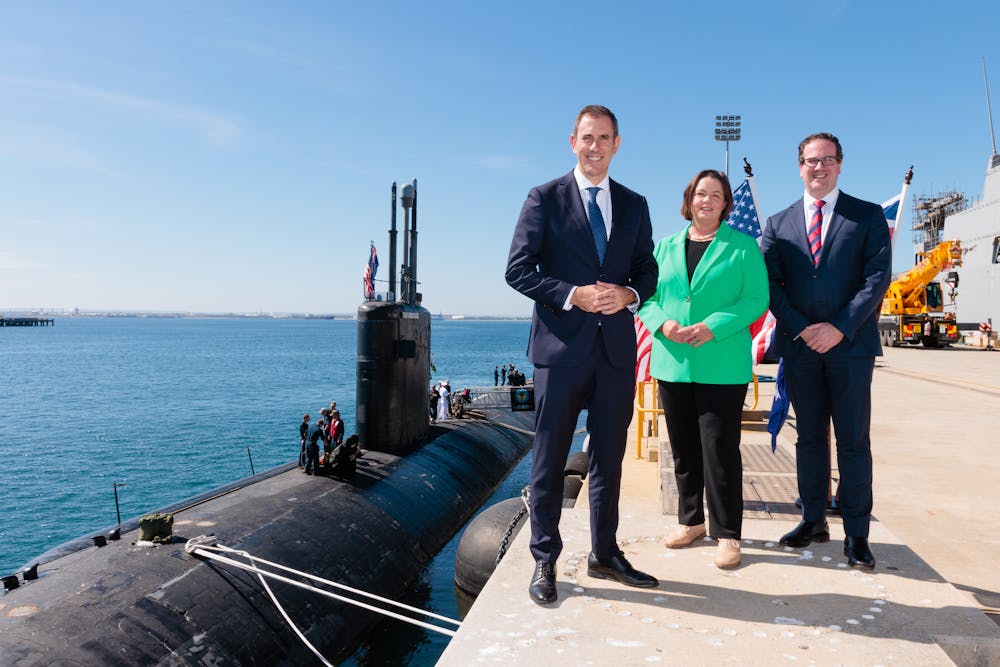
The issue of nuclear non-proliferation is back in the headlines, thanks to details announced yesterday at a US navy base of a deal involving Australia’s purchase of nuclear submarines.
The AUKUS plan, which may cost Australia upwards of A$300 billion over the next 30 years, involves Australia purchasing three Virginia-class nuclear-powered, conventionally armed submarines by the early 2030s. Australia will also build its own nuclear powered submarines using US nuclear technology by the 2050s.
Australia, the US and the UK have said the deal complies with their nuclear non-proliferation obligations.
But China has said the AUKUS deal represents “the illegal transfer of nuclear weapon materials, making it essentially an act of nuclear proliferation.”
So what are Australia’s obligations under the existing nuclear non-proliferation regime and does this deal comply?
To answer this question, you need to know a bit more about two key treaties Australia has signed up to: the 1968 Nuclear Non-Proliferation Treaty (sometimes shortened to NPT) and the 1986 Raratonga Treaty.
What is the Nuclear Non-Proliferation Treaty?
The Nuclear Non-Proliferation Treaty essentially requires nuclear weapon states who are a part of the treaty (US, UK, China, Russia and France) to not pass nuclear weapons or technology to non-nuclear weapons states. Of course, other countries do have nuclear weapons but they are not part of the treaty.
Crucially, the treaty only relates to the use of nuclear materials associated with nuclear weapons. It has a specific carve-out in it for the provision of nuclear materials for “peaceful purposes” (in Article 4).
The treaty also outlines processes to ensure the International Atomic Energy Agency monitors nuclear programs and nuclear materials even if used for peaceful purposes (including uranium and the technology to use it).
Australia has a number of subsidiary arrangements with the International Atomic Energy Agency that outline how these safeguard arrangements work.
Despite what critics may say, Australia’s nuclear-powered engines under AUKUS comply with the written rules of the treaty and these subsidiary agreements.
On the face of it, you might think the term “peaceful purposes” would rule out use for military submarine propulsion. But the definition focuses on using nuclear material for purposes that don’t involve the design, acquisition, testing or use of nuclear weapons.
All AUKUS partners have emphasised the nuclear-powered submarines Australia is to acquire will only carry conventional weapons (not nuclear weapons).
Australia’s agreement with the International Atomic Energy Agency clarifies what is covered by the treaty and the concept of peaceful purposes.
Article 14 of this agreement says “non-proscribed military purposes” are allowed.
Effectively, the Australian government has interpreted this to mean nuclear materials can be used for naval nuclear vessel propulsion. That is a usage unrelated to nuclear weapons or explosive devices.
Some have suggested this argument creates a risky precedent that nuclear materials – beyond the supervision of the International Atomic Energy Agency – could be used to make weapons.
But Australia has undertaken to comply with its safeguard obligations with the International Atomic Energy Agency for the AUKUS deal.
This builds on its existing practice around nuclear materials held for other “peaceful purposes” (like research and medical purposes).
What does the Raratonga Treaty require?
Australia is also a signatory to the Raratonga Treaty (also known as the South Pacific Nuclear Free Zone Treaty).
This treaty is a regional agreement that supports the Nuclear Non-Proliferation Treaty.
Signatories to the Raratonga Treaty have effectively agreed to maintaining a nuclear weapon-free zone in the South Pacific.
The Raratonga Treaty entered into force in 1986. It provides that no “nuclear explosive devices” can enter the nuclear-free zone outlined in the agreement. It also includes other limitations on the distribution and acquisition of nuclear fissile material (which are materials that can be used in a nuclear bomb) unless subject to specific safeguards.
The Raratonga Treaty accounts for differences in opinion regarding Australia and New Zealand’s approach to vessels carrying nuclear weapons (New Zealand does not allow nuclear-weapons carrying vessels to visit its ports, while Australia does).
But more importantly for the AUKUS deal, this treaty does not strictly exclude a signatory from using nuclear propulsion. That’s as long as the engine is not considered
a nuclear weapon or other explosive device capable of releasing nuclear energy, irrespective of the purpose for which it could be used.
Providing the engines meet this definition, the AUKUS deal complies with the Raratonga Treaty as well.
Australia will have particular obligations under this treaty to deal with the nuclear waste.
Defence Minister Richard Marles has outlined that waste from the vessels will be kept on Department of Defence land on Australian territory (and not disposed of at sea).
In accordance with international law
More detail is still to come. But the US and UK have decided the risks involved in sharing nuclear propulsion technology with Australia are worth it to hedge against more aggressive China.
On the face of the announcements made so far, the deal complies with international law, despite accusations to the contrary from China and other critics.
Read more: View from The Hill: Anthony Albanese finds Scott Morrison's AUKUS clothes a good fit
Authors: Lauren Sanders, Senior Research Fellow on Law and the Future of War, The University of Queensland


















