

Australia hasn't figured out low-level nuclear waste storage yet – let alone high-level waste from submarines
- Written by Ian Lowe, Emeritus Professor, School of Science, Griffith University
Within ten years, Australia could be in possession of three American-made Virginia-class nuclear submarines under the AUKUS agreement with the United States and United Kingdom. The following decade, we plan to build five next-generation nuclear submarines.
To date, criticism of the deal has largely focused on whether our unstable geopolitical environment and China’s military investment means it’s worth spending up to A$368 billion on eight submarines as a deterrent.
But nuclear submarines mean nuclear waste. And for decades, Australia has failed to find a suitable place for the long-term storage of our small quantities of low and intermediate level nuclear waste from medical isotopes and the Lucas Heights research reactor.
With this deal, we have committed ourselves to managing highly radioactive reactor waste when these submarines are decommissioned – and guarding it, given the fuel for these submarines is weapons-grade uranium.
Where will it be stored? The government says it will be on defence land, making the most likely site Woomera in South Australia.

What nuclear waste will we have to deal with?
Under this deal, Australia will not manufacture nuclear reactors. The US and later the UK will give Australia “complete, welded power units” which do not require refuelling over the lifetime of the submarine.
In this, we’re following the US model, where each submarine is powered by a reactor with fuel built in. When nuclear subs are decommissioned, the reactor is pulled out as a complete unit and treated as waste.
An official fact sheet about this deal states Australia “has committed to managing all radioactive waste generated through its nuclear-powered submarine program, including spent nuclear fuel, in Australia”.
What does this waste look like? When Virginia-class submarines are decommissioned, you have to pull out the “small” reactor and dispose of it. Small, in this context, is relative. It’s small compared to nuclear power plants. But it weighs over 100 tonnes, and contains around 200 kilograms of highly enriched uranium, which is nuclear weapons-grade material.
So, when our first three subs are at the end of their lives – which, according to defence minister Richard Marles, will be in about 30 years time – we will have 600kg of so-called “spent fuel” and potentially tonnes of irradiated material from the reactor and its protective walls. Because the fuel is weapons-grade material, it will need military-scale security.
Australia has no long-term storage facility
There’s one line in the fact sheet which stands out. The UK and US “will assist Australia in developing this capability, leveraging Australia’s decades of safely and securely managing radioactive waste domestically”.
This statement glosses over the tense history of our efforts to manage our much less dangerous radioactive waste.
For decades, the Australian government has been trying to find a single site for disposal of low-level radioactive waste. These are the lightly contaminated items produced in nuclear medicine and laboratory research. The low levels of ionising radiation these items produce means burying them under a few metres of soil is enough to reduce the radiation until it’s little more than the background radiation we all receive from the rocks under our feet, the buildings we live and work in and the technologies we use.
Even though these wastes are comparatively benign, every single proposal has run into strong local opposition. The most recent plans to locate a dump at Kimba, on South Australia’s Eyre Peninsula is still bogged down in the legal system due to opposition by local communities and First Nations groups
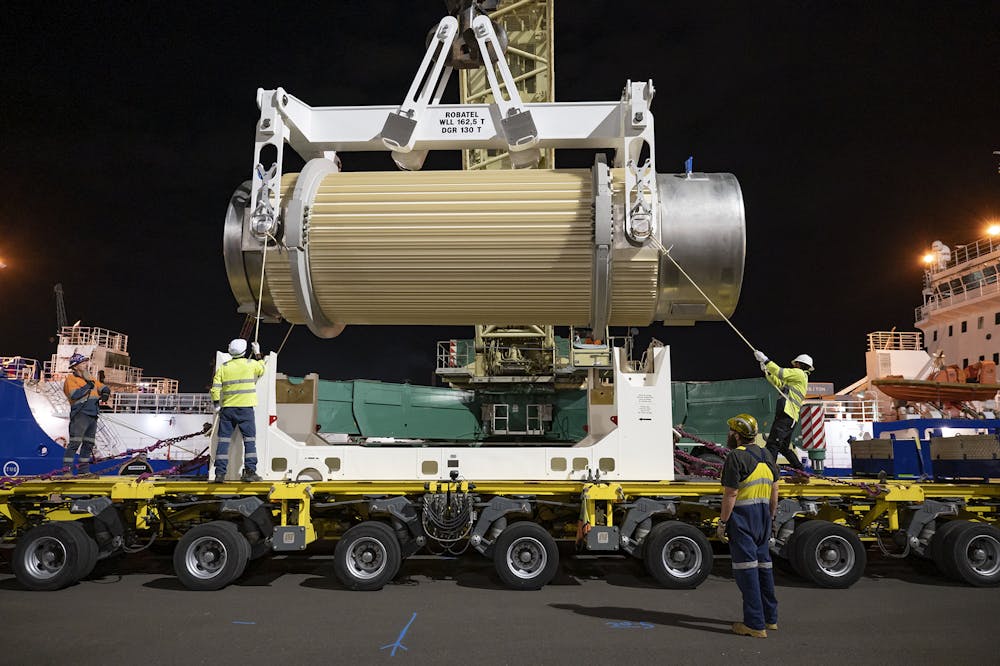 At present, our intermediate level waste is taken overseas for processing and then returned to temporary storage in Sydney’s southern suburb of Lucas Heights, as in this 2022 photo.
ANSTO/AAP
At present, our intermediate level waste is taken overseas for processing and then returned to temporary storage in Sydney’s southern suburb of Lucas Heights, as in this 2022 photo.
ANSTO/AAP
And we’re still dithering about what to do with the intermediate level waste produced by the OPAL research reactor at Lucas Heights in Sydney. At present, spent fuel is sent to France for reprocessing while nuclear waste is now being returned to Australia, where it is held in a temporary store near the reactor.
This waste needs to be permanently isolated from ecosystems and human society, given it will take tens of thousands of years for the radiation to decay to safe levels.
Our allies have not figured out long-term waste storage either
But while Sweden and Finland are building secure storage systems in stable rock layers 500 metres underground, neither the UK nor the US have moved beyond temporary storage.
UK efforts to manage waste from decommissioned nuclear submarines is still at the community consultation stage. At present, high-level waste from sub reactors is removed and taken to Sellafield, a long-established nuclear site near the border with Scotland. But each submarine still holds around one tonne of intermediate level waste, which, according to the UK government, has to be temporarily stored until a long-term underground storage facility is built some time after 2040.
Read more: AUKUS submarine plan will be the biggest defence scheme in Australian history. So how will it work?
In the US, spent fuel and intermediate waste from nuclear submarines is still in temporary storage. After the Obama administration scrapped the long-debated plan to store waste underneath Yucca Mountain in Nevada, no other option has emerged. As a result, nuclear waste from their military and civilian reactors is just piling up with no long-term solution in sight. Successive administrations have kicked the can down the road, assuring the public a permanent geological disposal site will be developed some time in the future.
This should be concerning. To manage the waste from our proposed nuclear submarines properly, we’ll have to develop systems and sites which do not currently exist in Australia.
In 2016, South Australia’s Royal Commission on nuclear fuel suggested Australia’s geological stability and large areas of unpopulated land would position us well to act as a permanent place to store the world’s nuclear waste.
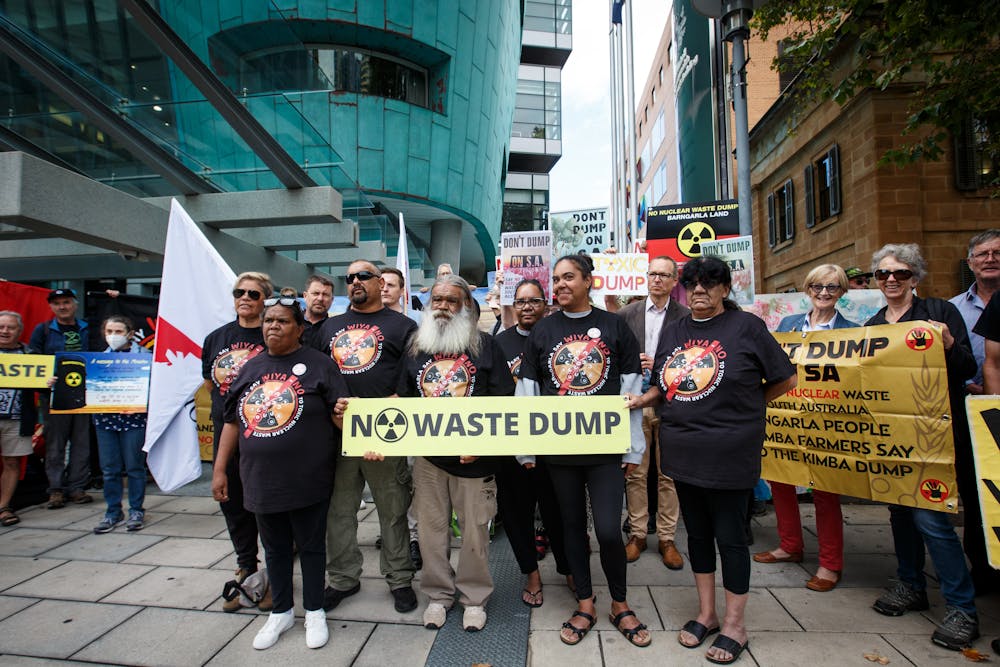 Proposed nuclear waste sites have all hit opposition, as in this March 6 2023 photo of Barngarla Traditional Owners outside the Federal Court where they are opposing a planned radioactive waste dump at Kimba in South Australia.
Matt Turner/AAP
Proposed nuclear waste sites have all hit opposition, as in this March 6 2023 photo of Barngarla Traditional Owners outside the Federal Court where they are opposing a planned radioactive waste dump at Kimba in South Australia.
Matt Turner/AAP
This hasn’t come to pass in any form. An almost intractable problem is that any proposed site will be on the traditional land of a First Nations group. Every site suggested to date has been opposed by its Traditional Owners.
What if we send the high-level waste overseas for processing and bring it back as less dangerous intermediate waste? It’s possible, given it’s what we already do with waste from the OPAL reactor. But that still leaves us with the same problem: where do you permanently store this waste. That’s one we haven’t solved in the 70 years since Australia first entered the nuclear age with our original HIFAR reactor at Lucas Heights.
Read more: The future of nuclear waste: what’s the plan and can it be safe?
Authors: Ian Lowe, Emeritus Professor, School of Science, Griffith University

















