

Antarctic minke whales may be as small as a krill-eating filter feeder can get in our modern oceans
- Written by: Jake Linsky, Researcher, School of Earth and Environmental Sciences, The University of Queensland
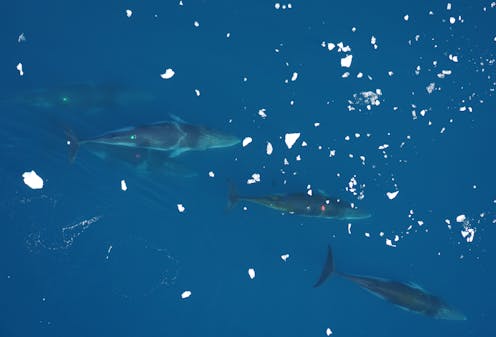
Meagre giants hide in the ice-covered bays and fjords of the Antarctic peninsula. Antarctic minke whales spend their summers foraging in these waters, devouring the dense and abundant krill that feed and grow underneath the sea ice.
These sleek and subtle predators are the smallest members of the rorqual family, which includes some of the largest animals known to have existed, such as blue, fin and sei whales. Minke whales are much smaller than their giant relatives (only about one-twentieth the mass of a blue whale), but a typical minke still weighs about five metric tonnes. That’s equivalent to 18 large grizzly bears or 45 Arnold Schwarzeneggers.
Despite their size, remarkably little is known about the behaviour of minkes or their role in rapidly changing Antarctic ecosystems. So, in the summers of 2018 and 2019, my colleagues and I from Stanford University, UC Santa Cruz and Duke Marine Labs teamed up to study minke whale foraging ecology.
Our team, led by David Cade, made an amazing discovery: minke whales are huge (by human standards), but they are about as small as a whale that feeds by filtering large numbers of tiny prey out of the water can be.
Follow the whale
We recovered high-resolution movement data from 29 tagged minke whales around the west Antarctic peninsula. In addition to these new and enlightening behavioural data, the sizes of tagged individuals were studied from drone-based photographs.
The combination of these two datasets allowed us to investigate minke whale feeding strategies in previously unseen detail.
Antarctic minke whales, along with their supersized rorqual cousins, use a technique called engulfment filtration feeding (or lunge feeding) to hunt Antarctic krill. This strategy requires the whale to accelerate to a speed of about 4 metres per second before filling its mouth with prey-laden water that is then filtered through a sieve-like structure known as baleen.
Engulfment filtration feeding is highly efficient, even for the largest individuals, as blue whales continue to increase in feeding efficiency with greater size.
Hunting at night
Compared to blue whales, each lunging gulp a minke takes contains far less food per kilogram of whale. However, the tag data revealed another way that minkes make up for this energy disparity.
Where a 20m blue whale can take up to two minutes to engulf and filter its prey, 7-10m minkes can complete an engulfment cycle in a matter of seconds. By day, minke whales are rarely able to capitalise on their speedy eating habits, as they may have to dive over 100m to reach their prey.
This means much of their daytime foraging is spent at the surface or swimming to depth, as they need air just like any other mammal. But as night falls, the krill move upward in the water column to the surface.
Soon enough, the minke whales no longer need to hold their breath for minutes at a time just to reach their prey. Then, the minkes become like Pac-Man in their polar environment as they accelerate, engulf, filter and repeat as fast as they possibly can. They consume krill at the absolute limit that their body size imposes on their filtering time.
An evolutionary mystery
The smaller the minke, the faster it filters, but it also becomes less efficient with each gulp. By extrapolating the tag data, we found that minkes below a specific size – 5m, or about the length of a newly weaned minke whale – are not able to filter fast enough to meet their basic energetic needs (the cost of living imposed by metabolism and growth).
Read more: Why are bigger animals more energy-efficient? A new answer to a centuries-old biological puzzle
This tells us that while minke whales are still quite large, they are about as small as they can be in our modern ocean conditions. The specific minimum size limit of these whales is highly dependent on the rorqual foraging strategy, energetically costly lunge feeding and the high costs of heating and maintaining their mammalian bodies.
However, we suspect the basic principle of this minimum size constraint, that only a limited amount of water can be filtered per time, can help crack an evolutionary chicken-or-egg mystery: what came first, filter-feeding or large body size?
Filter feeders have always lived large
Way back in time, when animals first emerged in the early Cambrian era, the first free-swimming filter-feeder was the large (70cm was large for the time) shrimp-like Tamisiocaris borealis, which raked planktonic creatures from the water with its comb-like front appendages.
Over the next 500 million years, the fossil record shows a diverse range of creatures occupying this free-swimming filter feeder role. They include bony fishes, cartilaginous sharks and rays, ancient reptilian ichthyosaurs and the gargantuan mammals we know as modern baleen whales.
Read more: What is the smallest animal ever?
While these animals originate from very different branches of the tree of life, they all have one thing in common: they are large. Most often the largest of their kind.
Our minke whales, the diminutive giants, tell us this is no coincidence. Filter feeding requires a large body size to evolve. But when filter feeding does evolve, it can drive large animals to become colossal.
Authors: Jake Linsky, Researcher, School of Earth and Environmental Sciences, The University of Queensland


















