

it’s vital we protect and grow urban green spaces – new report
- Written by: Timothy Welch, Senior Lecturer in Urban Planning, University of Auckland
Recent extreme weather events have provided a foretaste of how supercharged storms might threaten our future. So the release today of a new report from the Parliamentary Commissioner for the Environment (PCE) is very good timing.
Titled “Are we building harder, hotter cities? The vital importance of urban green spaces”, the report examines the climate vulnerability of urban Aotearoa New Zealand, and the prospects for building resilience.
To combat the multiple threats to cities of a hotter and wetter future due to climate change, the report suggests two potential pathways. We can take an engineering approach, with more air conditioning and stormwater infrastructure. Or we can make our urban areas greener.
The first option, according to the report, lacks the “biodiversity, recreational and cultural co-benefits that make green space such an important element of a healthy, liveable city”. In other words, green spaces aren’t just pleasant places for a family picnic. They are a vital part of an ecosystem, and a key to making cities liveable as the climate changes.
Housing pressure
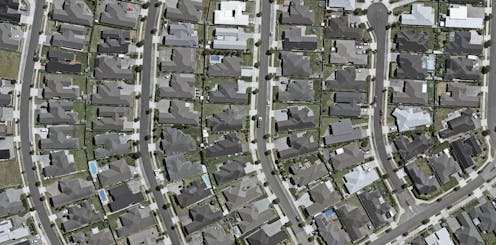
Unfortunately, precious urban green space has dwindled over the past six decades. It’s been replaced by paved roads, car parks and larger buildings on smaller sites. Essentially, existing urban green space is in competition with the demand for more housing.
As the authors state, talk of preserving or expanding green space inevitably leads to a central question:
Whether, in the midst of burgeoning demand for housing, the provision and protection of urban green space is really something that warrants attention. After all, every square metre of potentially developable land that is set aside as parks, yards, gardens or lawns cannot be used for housing.
In the wake of the recent Auckland floods, one of the first council policy actions in the city was a call to delay the housing intensification plan. Housing, planning and environmental agencies are clearly in a difficult position, on the front line of climate adaptation.
Loss of lawns
The three cities analysed in the report – Auckland, Hamilton and Greater Wellington – are greener than some might think. Hamilton’s green space is about 45% of its urban area; Greater Wellington’s is 65%; and Auckland’s was 55% (though Auckland data are over a decade old, so this is likely lower).
But one caveat in the report is that “residential yards and gardens account for slightly more than half of available green space in all three cities”. Since most backyard gardens are mostly grass, they have less to offer environmentally – “limited cooling, no shade provision, low diversity and little support for native species”.
Read more: NZ cities urgently need to become 'spongier' – but system change will be expensive
Fewer lawns also appeared to be the biggest driver of urban green space loss. In Auckland and Hamilton, it’s estimated lawns have declined by at least 10-15% as a proportion of the urban area between 1980 and 2016. This is attributed to infill development placing more and larger houses on single sites.
Perhaps the biggest issue is that disappearing private, urban green spaces such as lawns are not being replaced with public green space by councils. The report highlights that “a number of councils – including in Hamilton, Tauranga and Hutt City – have provided no more than a few square metres of new parkland for each additional resident since 2016”.
Auckland, Wellington and Christchurch have done better in setting aside areas larger then ten hectares. But in Christchurch, the report says, this is only because the 2011 earthquake rendered large areas uninhabitable.
Threats to trees
Big problems with tree protection are also behind the loss of green space. This is attributed to changes to rules in the Resource Management Act in 2009 and 2013. These removed blanket tree protection, with onerous and costly processes now making it harder for councils to protect trees.
Effectively, trees deserving protections have to be identified in a district plan, requiring “councils to undertake a plan change process every time a protection is considered worthy”. In Auckland, it’s estimated that “adding a tree to the Notable Tree Schedule costs $1,484 and takes between 34 and 42 months”.
The numbers show how bad tree protection has become: “Between 2016 and 2021, Auckland Council failed to process any of the 587 nominations it received for tree protections.”
Auckland’s unitary plan only contains 6,000 to 7,000 scheduled (protected) trees, while in “Hamilton, Tauranga, Upper Hutt, Lower Hutt, Porirua and Wellington City, fewer than 500 trees had been scheduled”.
Overall, the report notes, there is “no requirement to plan for or provide public green space in New Zealand cities”. A lack of guidance “tends to mean that parks and reserves are treated as a discretionary ‘nice to have’ when hard decisions about provision levels and funding are made”.
Read more: Slippery slopes: why the Auckland storm caused so many landslides – and what can be done about it
Keeping a green score
The report offers several recommendations for reversing the trend of lost green space. Primarily, councils should adopt “more explicit provisions on green spaces based on consultation with their communities”. They should also measure green space and use standardised monitoring systems.
Part of this involves improving green spaces where they already exist. The government’s Medium Density Residential Standards (MDRS) require 20% of a site to be green space. But this is often done in a piecemeal fashion, with less useful strips of grass scattered around a site.
The report suggests using a “green score” accreditation scheme to measure the potential of private green space to host trees and shrubs, and to measure biodiversity.
A few quick implementation ideas are also offered, including lining road corridors (which “account for 15-20% of the surface of our cities”) with more native plants and trees. Parks could also improve by “simply adding patches of larger shrubs and trees”.
Using the evidence
Ultimately, it will come down to how councils can pay for more and better green space. One suggestion is that developers who “go below a certain level of private green space […] pay for the loss” with a development contribution – a fee paid to the council to help defray the cost of infrastructure (in this case more green space).
Councils might impose citywide or more targeted green space rates levies, though the report doesn’t estimate the cost of adding or improving green spaces in any of the studied cities.
In a way, this report tells us many things we intuitively know. New and denser housing developments are sprouting up, we are losing private green space, we have weak tree protections and we should expand and improve our urban green space.
But the commissioner has done a good job backing this up with research. Given recent events, and looking towards a future of climate extremes, we can use this evidence to demand the changes needed to make our cities more resilient and liveable.
Authors: Timothy Welch, Senior Lecturer in Urban Planning, University of Auckland


















