

Australia's extinct giant eagle was big enough to snatch koalas from trees
- Written by: Ellen K. Mather, Adjunct associate lecturer, Flinders University
The year is 1959. Speleologists descend a 17-metre shaft to explore the depths of Mairs Cave in the southern Flinders Ranges. Some 55 metres into the main chamber, they find fossils scattered throughout a boulder pile. Among these fossils are a claw and part of a wing bone that appear to have come from a large eagle.
Over a decade passes. An expedition to the cave, led by naturalist Hans Mincham and palaeontologist and geologist Brian Daily, now arrives with the purpose of retrieving more fossils. Among the many mammal fossils they recover are another talon and most of a large bird breastbone – from the same large eagle.
No more fossils of this animal are found until more than 50 years later. It is December of 2021, and a team of Flinders University palaeontologists and speleologists have travelled to the cave for a single purpose – to find more of this enigmatic bird. As they descend into the cave’s depths, they hope to find a few more bones. Instead, they find a partial skeleton, including leg and wing bones, and a skull. With this last discovery, we were finally able to name and describe this gigantic eagle in the Journal of Ornithology.
History’s third-largest eagle
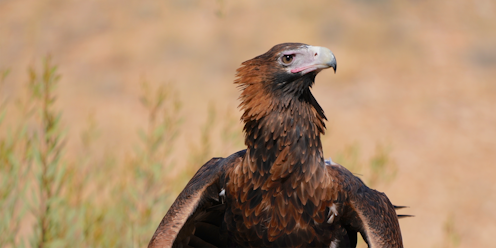
Dynatoaetus gaffae (Gaff’s powerful eagle) lived during the Pleistocene epoch, perhaps between 700,000 and 50,000 years ago. At twice the size of a wedge-tailed eagle (which it coexisted with) and with a potential wingspan of up to 3m, this species is the largest known eagle to have lived in Australia, and one of the largest continental raptors in the world.
Only two larger eagles ever existed anywhere: Gigantohierax suarezi, which hunted giant rodents in Cuba, and the giant Haasts eagle, Hieraaetus moorei that hunted large moa in New Zealand.
Thanks to the relatively complete skeleton from Mairs Cave, we were able to identify other fossils of Dynatoaetus from the Naracoorte caves in South Australia and the Wellington caves in New South Wales. It appears this species was widespread across most of southern Australia.
A surprising family tree
After discovering the fossils, we investigated how Dynatoaetus was related to other eagles, with surprising results.
Dynatoaetus was not closely related to any modern Australian eagle. Instead, these birds (and another fossil Australian raptor Cryptogyps lacertosus) were related to the old-world vultures and to the serpent-eagles of south Asia and Africa.
Dynatoaetus was clearly not a vulture-like scavenger, as indicated by its large and powerful leg bones and talons, so to infer how it lived, we looked to the serpent-eagles.
Serpent-eagles, as their common name suggests, primarily hunt snakes and other reptiles. Most are small to medium-sized raptors and would have been dwarfed by Dynatoaetus.
However, there is one species in this subfamily that is an exception: the Philippine eagle. This raptor is one of the largest eagles alive today, and unlike its reptile-eating relatives, it prefers to prey on monkeys, flying lemurs, bats, birds, and occasionally young pigs or deer.
Strong feet for large prey
Much like the Philippine eagle and other very large raptors, the legs and feet of Dynatoaetus were quite robust. This strongly suggests it was suited for killing large prey, perhaps much heavier than itself.
Dynatoaetus shared ancient Australia with giant kangaroos and flightless birds, the young and sickly of which would have been suitable prey. Koalas and possums would have been plentiful in the treetops, and Dynatoaetus was certainly large enough to snatch them up.
This giant eagle was most likely one of Australia’s top predators during the Pleistocene.
We can also find clues to potential prey via fossils found alongside Dynatoaetus. Small mammals have previously been collected from Mairs Cave, but the 2021 trip also recovered bones of short-faced kangaroos, wombats, bettongs, bandicoots, possums and even koalas (the only record of koalas inhabiting the Flinders Ranges), many of which were potential prey for the giant eagle.
We further found fossils of thylacines, Tasmanian devils and Thylacoleo (the marsupial “lion”), indicating Dynatoaetus competed for prey with a cohort of marsupial carnivores. No one has yet identified beak and talon marks left on fossil bones from this giant raptor – but this may simply reflect that, until now, no-one was looking.
The end of Australia’s megafauna
So why did Dynatoaetus become extinct? It appears to have died out around the same time as much of the Australian megafauna, around 50,000 years ago. Perhaps it was specialised to hunt certain large species, and when this preferred prey went extinct it was unable to adapt.
With the demise of specialist raptors like Dynatoaetus and Cryptogyps, the generalist wedge-tailed eagle was left as the sole survivor of the large inland raptors.
Read more: Meet the prehistoric eagle that ruled Australian forests 25 million years ago
Authors: Ellen K. Mather, Adjunct associate lecturer, Flinders University


















