

Modern Australian
Times Advertising

Why robodebt's use of 'income averaging' lacked basic common sense

  • Written by Peter Whiteford, Professor, Crawford School of Public Policy, Australian National University
Why robodebt's use of 'income averaging' lacked basic common sense

The practice of “income averaging” to calculate debts in the robodebt scheme was completely flawed. This is what I confirmed in my new report conducted for the robodebt royal commission published last Friday, the final day of the commission’s public hearings.

This process effectively assumed many people receiving social security benefits had stable earnings throughout a whole year.

But this is unlikely to be accurate for the many people who don’t work standard full-time hours, and particularly for students, since the tax year and the academic year don’t coincide.

My report finds averaging of incomes is completely inconsistent with social security policies that have been developed by governments since the 1980s.

Since 1980, social security legislation has been amended more than 20 times to encourage recipients to take up part-time and casual work. These include the Working Credit for people receiving unemployment and other payments, and a similar but more generous Income Bank for students.

These measures are specifically designed to encourage people to take up more work, including part-time and irregular casual work, and keep more of their social security payments.

Robodebt’s lack of consistency with long-standing policies should have been obvious from the start.

What is income averaging?

In the robodebt scheme, income averaging involved data-matching historic records of social security benefit payments with past income tax returns, identifying discrepancies between these records.

It reduced human investigation of the discrepancies. The automatic calculation of “overpayments” for many people was based on a simple calculation that averaged income over the financial year.

The “debts” were based on the difference between this averaged income and the income that people actually reported while they were receiving payments.

I wrote an article for The Conversation on this in 2017. At the time, I thought, Centrelink couldn’t possibly have done that.

Well, as the royal commission has found, that’s precisely what it was doing.

Read more: Note to Centrelink: Australian workers' lives have changed

A victim of robodebt, Deanna Amato, brought a test case to the Federal Court in 2019, which caused the government to admit robodebt was unlawful.

Amato also gave evidence at the royal commission in late February this year. She described how it was obvious her debt was in error:

It was averaged over the […] whole financial year. Study usually starts at the beginning of a calendar year. So I had been working full-time for the first six months of that year and then I had stopped working full-time to study. So it was really obvious that they had averaged out over the whole year rather than the six months I was actually only claiming Austudy for.

What I found

It’s well known Australia has a high proportion of casual workers.

Because they’re employed on an “as needed” basis, their hours can vary substantially. Therefore, their income can too.

ABS data showed that in 2014 nearly 40% of casual workers didn’t work the same hours each week. Also, around 53% had pay that varied from one pay period to another. These figures have been broadly stable since 2008.

Read more: Robodebt was a fiasco with a cost we have yet to fully appreciate

My report analyses new data provided by the Department of Social Services to the royal commission. It looks in detail at the circumstances of people who received social security payments between 2010-11 and 2018-19. These payments included Austudy, Newstart, Parenting Payment Partnered, Parenting Payment Single and Youth Allowance.

These payments accounted for around 91% of the people subject to the reviews that identified discrepancies and potential “overpayments” between 2016 and 2019 under the different phases of robodebt.

For Newstart and Youth Allowance recipients – who accounted for 75% of those affected by robodebt – between 20% and 40% had earnings while receiving these benefits.

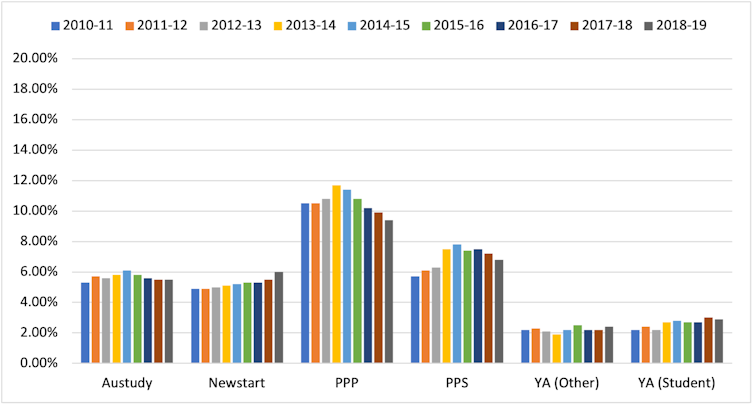
The share of people with income who had stable incomes over the course of the financial year was extremely low. In the Department of Social Services data, it ranged from less than 3% of people receiving youth payments, to around 5% of those receiving Newstart or Austudy, and 5%-10% of those receiving Parenting Payments.

Share of people on social security payments with stable income over the course of each financial year, 2010-11 to 2018-19

Supplied, Author provided For most of these people with variable income, the variations were large. More than 90% had periods when their income was more than $100 per fortnight different from their average, and more than 80% had variations greater than $200 per fortnight. Average earnings varied substantially for people receiving social security payments for only part of a financial year. Receiving social security benefits for many people is a short-term and sometimes recurring experience. To take the example of Newstart, in 2015-16 there were around 783,000 people who received payments at the start of the financial year. About 500,000 people entered the payment system during the year, and 325,000 exited the system. So, in total, nearly 1.2 million people received Newstart payments at some point during the financial year. Flows into and out of the other social security payments were similar. Read more: The Robodebt scheme failed tests of lawfulness, impartiality, integrity and trust For the unemployed and students, most people received payments for only part of the year. Almost nobody who received income had completely stable income over the robodebt period. What’s more, significant numbers of people who received social security payments were on such payments for only part of any financial year. It’s completely inaccurate to assume that income over the course of a financial year can be averaged to produce an accurate figure for the actual patterns of people’s earnings. Using this to then calculate “overpayments” isn’t only inconsistent with the social security policy directions adopted by government for decades, it also lacks basic common sense.

Authors: Peter Whiteford, Professor, Crawford School of Public Policy, Australian National University

Read more https://theconversation.com/why-robodebts-use-of-income-averaging-lacked-basic-common-sense-201296


Why Does My Power Keep Tripping? Common Causes Explained by Electricians Sydney

The electrical system is the lifeblood of your home, powering everything from your phones to cooking utensils and more. But from time to time, your po...

Interstate Car Transporter Urges Buyers to Book Early

As the conflict in the Middle East continues to put increasing pressure on local fuel supply, Australian transport companies are experiencing increasi...

Digital Minimalism for Business Owners: Fewer Tools, Better Systems

Be honest. How many apps are open right now? One for scheduling, another for invoices, a third for customer notes, plus a spreadsheet someone email...

The Importance Of Proactive NDIS Renewal Preparation For Sustaining Your Provider Business

Your NDIS renewal notice is not a signal to start preparing. By the time it arrives, preparation should already be well underway. For new providers, s...

Why Fire Extinguisher Testing in Sydney Is Becoming a Records Game, Not Only a Maintenance Job

A fire extinguisher used to feel like one of the simpler parts of building safety. It hung on the wall, wore a service tag, and sat there quietly unle...

The Switchboard Upgrade Question Every Melbourne Renovator Should Ask Before the Walls Close Up

Renovations have a funny way of making people think on surfaces first. Splashback, stone, joinery, tapware, paint. Fair enough too. That is the exciti...

Winter Sanitation Gaps in Parramatta Kitchens: A Hidden Pest Risk

Winter brings a host of changes to our homes, from the chill in the air to the cozy warmth indoors. However, this season also introduces sanitation ch...

When to Seek Advice from Employment Lawyers in Melbourne

Australian employment law is detailed and, at times, complex, with rights and obligations that aren't always obvious to employees or employers witho...

7 Benefits of Professional Gutter Cleaning for Australian Homeowners

Gutters aren't exactly glamorous. They sit up there on the edge of your roof, doing their job quietly - until they stop working. Clogged, overflowing ...

Pipe Floats Strengthening Pipeline Performance In Demanding Environments

Pipelines often travel through environments that are anything but predictable, water currents shift, terrain changes, and materials keep moving unde...

Why Ceiling Fans Are Essential For Comfort, Efficiency, And Modern Living

Creating a comfortable indoor environment is not just about temperature; it is about how air moves, how a room feels, and how efficiently energy is ...

Why Duct Cleaning In Melbourne Is A Smart Investment For Healthier Living Spaces

Behind your walls, ceilings, and vents lies a network quietly working every day to keep your home comfortable. Yet over time, this system can become...

Disability Service Providers Supporting Inclusive And Independent Living

Finding the right support system can feel like assembling a puzzle where every piece must fit just right. For individuals and families navigating di...

A Beginner's Guide to Owning a Caravan in Australia

Owning a caravan opens up a style of travel that's hard to match for freedom and flexibility. However, for those just starting out, the process of c...

Preparing Your Air Conditioner for Summer: What Most Homeowners Overlook

As temperatures rise, many homeowners switch on their air conditioning for the first time in months — only to find it’s not performing the way i...

What Actually Adds Value to Properties in Newcastle

Newcastle has seen steady growth over the past few years, with more buyers looking beyond Sydney for lifestyle, space, and long-term value. As dema...

What is Design and Build in Construction?

Imagine you’re about to start a new construction project, maybe it’s a custom home or a commercial building. You’ve got the idea, the land, an...

Commercial roof leak detection: why early action protects your building

Water ingress is one of the most disruptive and costly issues facing commercial properties. For property managers and facilities teams, even a minor...
















