

how the world failed Iraq and created a less peaceful, democratic and prosperous state
- Written by: Benjamin Isakhan, Professor of International Politics, Deakin University
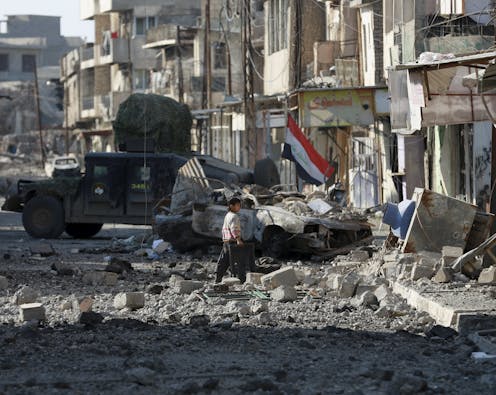
Two decades ago, Australia joined the US-led “coalition of the willing” that staged a major military intervention in Iraq.
To justify the war, leaders like US President George W. Bush and Australian Prime Minister John Howard argued that Iraq had developed weapons of mass destruction and was harbouring terrorist groups like al-Qaeda. Neither could be tolerated in a post-9/11 world.
However, when evidence for Iraq’s weapons program or links to terrorism failed to emerge, the coalition partners were forced to re-frame the war. The goals were threefold:
to topple Iraqi leader Saddam Hussein and bring peace to the Iraqi people
to replace the autocratic Baathist regime with a democratic government
to transform Iraq into a prosperous state governed by a free-market economy.
Twenty years on, the legacy of the war still looms large in Iraq. Despite the enormous human and financial costs, the coalition abjectly failed to achieve its central goals. Today, Iraq is not more peaceful, democratic or prosperous than it was in 2003.
The costs of war
Any reflection of the war must first address the staggering costs.
Although estimates vary, approximately 186,000 Iraqi civilians died and an untold number were injured. And more than nine million Iraqis were internally displaced or forced to flee the country.
Beyond such figures are a series of very real, but far less tangible, costs such as the damage done to much of Iraq’s rich cultural heritage or the deep emotional scars that come with two decades of war.
On the coalition side, 4,487 US military and 238 other coalition troops died during the operation.
The war effort also came at an enormous cost to US taxpayers: US$756 billion (A$1.15 trillion) in military spending from 2003-18. (The true cost, however, is likely far higher.) Over the same period, the cost of Australia’s military operations in Iraq has surpassed A$4 billion.
Read more: The Iraq War has cost the US nearly $2 trillion
Goal 1: Peace at the barrel of a gun
On the purported aims of the invasion, Iraq has clearly gone backwards on many metrics.
On the first goal of bringing peace to Iraq, it is true the coalition forces toppled Hussein and his entire Baathist regime in just six short weeks. He was later captured, put on trial and finally hanged in December 2006.
However, the coalition forces failed to adequately secure the nation after his regime was toppled. This created a security vacuum that was rapidly filled by a host of different militant groups. From 2006 onward, Iraq descended into a dark and unprecedented period of horrific sectarian violence.
This worsened considerably after the US troop withdrawal at the end of 2011. By 2013, the Islamic State had begun to conquer vast swathes of territory across both Syria and Iraq, eventually capturing the city of Mosul in mid-2014.
The group went on to impose strict Sharia law in the territory it controlled and enacted mass genocidal pogroms that included the slaughter, enslavement and forced exodus of thousands of innocent civilians.
Today, Iraq remains one of the most violent places on earth. Since the expulsion of the Islamic State from Mosul in July 2017, over 10,000 civilians have been killed in across Iraq.
The irony here barely needs to be stated: there was no credible terrorist presence in Iraq before the coalition forces staged their invasion, but by mid-2014 roughly a third of the country was controlled by terrorists who remain a threat today.
Goal 2: Democracy as a pathway to authoritarianism
The second key goal of the war was to bring liberal democracy to Iraq.
It, too, has a complicated legacy. On the one hand, the Iraqi people are to be admired for having embraced democracy. Millions of Iraqis vote in the nation’s regular provincial and federal elections.
Iraq is also now home to a strong culture of dissent, as is evidenced by the frequent protests that were not permitted under the former regime.
However, one of the unfortunate consequences of the war has been that many ethno-religious political factions viewed it as an opportunity to peddle their own relatively narrow and divisive political rhetoric.
This led the political elite to tighten their stranglehold on power and frequently crack down hard on Iraqi media and civil society.
According to the annual Democracy Index released by the Economist Intelligence Unit, Iraq has been consistently ranked as among the worst political regimes in the world. And the situation is actually getting worse. By 2022, Iraq had been downgraded to an “authoritarian regime” and was ranked 124th out of 167 countries in the democracy rankings.
So, while Iraq holds regular elections and allows mass protests, it fails to meet the minimum criteria by which we would normally measure a democracy. This speaks volumes about the merits of imposing a top-down model of democracy by force.
Goal 3: Prosperity at any cost
Third, the goal of turning Iraq into a beacon of prosperity driven by a free-market economy has only benefited a handful of corrupt elites.
On the one hand, Iraq’s real GDP (based on purchasing power parity) has skyrocketed in recent years on the back of its oil wealth, reaching an estimated US$390 billion (A$583 billion) in 2021. This is the 50th largest economy in the world.
Yet, this cash flow is not filtering down to the Iraqi people. In 2022, Iraq ranked 157th (out of 180 countries) on Transparency International’s annual Corruption Index.
Also in 2022, the Sustainable Development Report ranked Iraq as 115th (out of 163 countries) on progress towards achieving the UN’s sustainable development goals. It was the worst-performing middle-income country in the world.
In other words, while corrupt Iraqi political elites and major Western oil companies extract billions of dollars in revenues from Iraq’s rich natural resources, millions of Iraqis continue to live in destitution in a country with crumbling and insufficient infrastructure.
Iraq may well be a free-market economy, but what use is that if ordinary Iraqis have sporadic electricity, limited potable water, few working sewage systems and inadequate health care and education?
Australia’s obligations 20 years on
All of this raises deep questions about the political responsibilities and moral obligations of the United States and its key coalition partners such as Australia.
While various Australian organisations run a handful of important programs across Iraq – especially in agriculture, human rights and mine-clearing – these fall well short of meeting the needs of the Iraqi people.
Australia could do much more. Politicians and policy-makers, for instance, could use the 20-year anniversary of the Iraq war to launch a renewed effort on three pragmatic and achievable fronts: education, security and democracy building.
Iraq’s education sector has been crippled by the legacy of war, autocratic leadership and international sanctions. This has left the schools and universities decades behind international standards.
The Australian government could do much more to train Iraqi teachers, fund schools and streamline the process of knowledge-sharing and exchanges between the Iraqi and Australian education sectors.
In terms of security, the Australian government and military must continue to work closely with Iraq’s security forces on training programs. This is needed to prevent Iraq from returning to the grim days of sectarian violence or, worse still, the emergence of a new terrorist threat.
Finally, Australia should stick to its stated goal of supporting universal human rights and fostering democratic participation in the region.
By setting up capacity-building initiatives for Iraq’s media, unions and civil society movements, Australia could greatly enhance Iraq’s fledgling democracy and ensure it does not slip further into authoritarianism.
In fact, Australia is in a unique position to achieve these three goals. Its role as part of the “coalition of the willing” was generally perceived as being less heavy-handed than the US or UK.
This is a moment of consequence. Making good on our commitment to the initial goals of the war will influence how Australia is perceived in Iraq, the Middle East and across the world. And we owe the Iraqi people that much at least.
Authors: Benjamin Isakhan, Professor of International Politics, Deakin University

















