

$18 million a job? The AUKUS subs plan will cost Australia way more than that
- Written by: John Quiggin, Professor, School of Economics, The University of Queensland
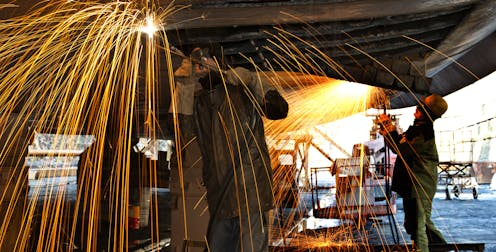
Australian governments have a long and generally dismal history of using defence procurement, and particularly naval procurement, as a form of industry policy.
Examples including the Collins-class submarines, Hobart-class air warfare destroyers and, most recently, the Hunter-class “Future Frigates”.
The stated goal is to build a defence-based manufacturing industry. But there is also a large element of old-fashioned pork-barrelling involved.
In particular, South Australia has nursed grievances over the shutdown of local car making, centred in the state, following the withdrawal of federal government subsidies. The closure of the Osborne Naval Shipyard in north Adelaide would be politically “courageous” for any government.
So the projects roll on, despite technical problems (the six Collins-class subs were plagued by problems with their noise signature, propulsion and combat systems) and cost overruns (the three Hobart destroyers cost $1.4 billion more than the $8 billion budgeted). The $35 billion plan for nine Hunter-class frigates may yet be abandoned given budget constraints.
All these previous ventures are dwarfed by the AUKUS agreement, which involves projected expenditure of up to $368 billion.
Read more: AUKUS submarine plan will be the biggest defence scheme in Australian history. So how will it work?
As Richard Denniss of The Australia Institute has noted, the precision implied by this number is spurious. The cost could come in below $300 billion, or easily approach $500 billion.
Military case lacking
The case for such a massive investment in submarines has proved hard to make in a simple and convincing way. The “Red Alert” articles published this month by The Sydney Morning Herald and The Age has helped to raise alarm about China. But the warning Australia could find itself at war with China in the next few years (over Taiwan) isn’t a persuasive argument for submarines that won’t be delivered until the 2030s.
Other questions have emerged.
In different ways, former prime ministers Paul Keating and Malcolm Turnbull have questioned the sense of a renewed alliance with the United Kingdom. The UK in a state of obvious decline, and Labour leader Keir Starmer, likely to be Britain’s next prime minister, has been noticeably lukewarm in his support for AUKUS, saying: “Whatever the merits of an Indo-Pacific tilt, maintaining security in Europe must remain our primary objective.”
Then there’s the view, held by many experts, that what has made submarines such potent weapons in the past – stealth – is unlikely to endure. Underwater drones and improved satellite technology could make our subs obsolete even before they are launched.
What about the jobs?
In these circumstances, the easiest political strategy to sell the AUKUS package is to present it as a job-creation program.
This is an appealing path for the federal government, given Prime Minister Anthony Albanese’s yearning for “an Australia that make things”. Albanese’s Twitter account has published tweets extolling the economic benefits of the deal, but none about what the submarines will actually do to make Australians safer.
The obvious response is that the 20,000 jobs the government says the program will directly create over the next 30 years will cost more than $18 million apiece.
But that actually understates how bad the case is.
Where will we find the skilled workers?
Australia already has a shortage of the type of skilled workers required to build the nuclear-powered subs: scientists, technicians and trade workers. Our existing training programs are unlikely to fill the gap. So, the new jobs will mostly be filled either by diverting skilled workers from other industries or by additional immigrants.
The government is grappling with the policies that can meet this existing shortage. Our migration program, for example, allocates extra points for technical skills in short supply, putting skilled workers ahead of people whose motive for migration is to be with their families and friends.
Read more: How to improve the migration system for the good of temporary migrants – and Australia
The “Job Ready Graduates” policy introduced by the Morrison government subsidises science, technology, engineering and mathematics degrees, at the expense of humanities and social sciences. This policy is now under review, but may well be maintained in some form.
Such is the scale of the problem that the government’s pre-election commitment to deliver a White Paper on Full Employment (inspired the Chifley government’s 1945 White Paper) has been sidelined by a focus on how to increase the supply of skilled labour, through vocational education, immigration and delayed retirement. Hence the title of the “Jobs and Skills Summit” in September 2022.
There is no indication the shortage of skilled tech workers is going to be resolved any time soon. It is, then, a mistake to boast about the number of technical jobs that will be created by AUKUS.
It would be more accurate to say that, just as the massive financial cost of the submarines will come at the expense of spending on social needs, the workers required to build them will divert skills from addressing needs such as decarbonising the economy.
Perhaps, like previous submarine deals, this plan will be scrapped before consuming the stupendous sums of money now projected. But in the meantime it will divert the Australia’s government from addressing urgent domestic problems.
Authors: John Quiggin, Professor, School of Economics, The University of Queensland

















