

Safeguard deal shows Bandt's Greens party has come of age
- Written by: Mark Kenny, Professor, Australian Studies Institute, Australian National University
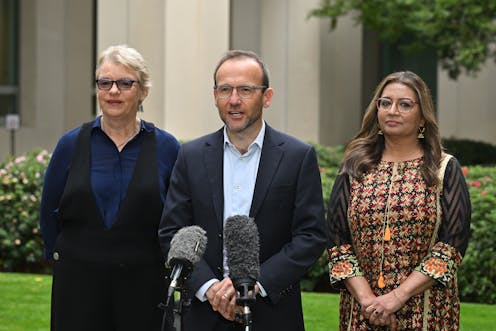
It is understandable if observers have struggled to neatly categorise the agreement struck on Monday between the Albanese Labor Government and the Australian Greens party to progressively reduce industrial emissions.
Across political, environmental, and even business circles, opinions vary over whether Labor’s substantial renovation of the Coalition-era safeguards mechanism represents a decisive break from Australia’s decade of climate paralysis or is simply more tinkering when structural reform was needed.
At best, it is modest progress that could unlock wider action on emissions while making it harder for new fossil fuel projects, particularly coal and gas mines, to get going. That’s the view of the Australian Conservation Foundation for example, and of the Grattan Institute’s Program Director, Energy, Tony Wood.
To that extent then, it is a net environmental positive. Perhaps even a major one. But critics, such as Osman Faruqi, culture news editor for Nine Entertainment, are scathing. The former Greens party candidate believes his old party, whose raison d'etre is environmental protection, has been politically manipulated by Labor.
Under Adam Bandt’s leadership, the Greens played hardball in the negotiations, publicly slamming Labor’s climate credentials and demanding a full ban on all future coal and gas projects in exchange for its crucial Senate votes.
“You can’t put the fire out while you’re pouring petrol on it,” Bandt had said to any microphone he could find. He depicted Labor’s approach of forcing existing industrial players to cut year-on-year emissions while also allowing new fossil fuel ventures as contradictory.
This was, and remains, a serious point – even if in the end, Bandt’s party settled for a hard cap on overall emissions by the 215 industrial polluters, limits on greenhouse gas production from any new projects, and a ministerial obligation to step in if agreed emissions limits are exceeded.
Both sides claimed a major victory, which might be the best sign there is of a fruitful negotiation.
For the Greens though, long derided as a party happier in protest mode rather than legislative process, the deal hints at what might be a subtle shift towards seeking material outcomes, even if that means compromise.
To its supporters’ deep umbrage, the party had long carried the blame for having joined with the Coalition to bury Rudd Labor’s emissions trading scheme in 2009, known formally as the Carbon Pollution Reduction Scheme or CPRS.
According to a persistent narrative, the environmental party had succumbed to the mistake of “making the perfect the enemy of the good”.
Greens’ loyalists still bristle at this criticism, eager to point out that Bob Brown cooperated with the subsequent Gillard-led Labor government to deliver an economy-wide carbon price-cum-emissions trading scheme that was superior to the “flawed” CPRS.
Read more: It's the 10-year anniversary of our climate policy abyss. But don't blame the Greens
Faruqi calls the Clean Energy Act of 2011 that instituted those advances “the most serious climate legislation in Australia’s history”.
While this is arguable, it rather ignores its fatal context – namely a polity so divided on climate following the demise of the CPRS that it boosted Tony Abbott and fellow centre-right climate deniers. This ultimately poisoned the well of public support for Gillard and for progressive policy more broadly.
Wherever one stands on this historical debating point, there is no denying the dark shadow of 2009-10 loomed over the most recent negotiations around Labor’s improved safeguards mechanism.
Bandt appears to have concluded that sinking another Labor attempt at emissions control – and on essentially the same grounds – would be hard to justify.
But if he was limited at that end by the risk of repeating the CPRS error, he was hemmed in at the other end by the very public interventions of Brown and others. Brown, the party’s revered founding leader, publicly defended his party’s need to vote down Labor’s bill unless it contained the coal and gas ban.
Bandt’s answer to this predicament was to talk tough and look immovable on coal and gas in order to secure other improvements.
What does this tell us about his leadership style and nature of the party he leads?
When Bandt succeeded Richard Di Natale three years ago, I suggested in these pages that he might drag his party further to the left, such had been his combative rhetorical style.
On reflection, I now think this underestimated the significance of his status as the party’s only lower house MP.
What the current episode shows, is that if anything, he has pulled his party towards a more practical orientation, with an emphasis on getting things done.
Read more: Australia's safeguard mechanism deal is only a half-win for the Greens, and for the climate
This may reflect several things at once. First, the party’s maturing electoral base, which is seeking something more than determined talk in the face of a gathering climate emergency.
Second, Bandt’s own experience as an MP rather than a senator. And third, the Greens party’s surprising success in the House of Representatives in 2022. In the federal election of May 2022, one MP became four. The presence of other lower house members may have affected the nature of debate and the identification of priorities within the party room.
Lower house electorates call for political representation that is qualitatively different, closer to voters, and therefore closer to political mortality. Terms last a maximum of three years, not six. To hold a House seat, an MP must connect with a broader cross section of voters than in the Senate.
The voting method for senators uses state-wide proportional representation. That means the Greens, as a Senate-based party, could afford to present arguments for strong action on global heating acceptable to a sliver of voters state-wide - sufficient for a senator or two from most jurisdictions.
In contrast, holding onto lower house seats forces MPs to consider the immediate on-ground economic and employment implications of policy positions.
It may well be that the very presence of three new lower house MPs in the Greens party room has shifted the balance of internal debates to more politically attuned goals. And to debates where the economic and employment downsides of policy must be more frontally addressed.
Authors: Mark Kenny, Professor, Australian Studies Institute, Australian National University
Read more https://theconversation.com/safeguard-deal-shows-bandts-greens-party-has-come-of-age-202739


















