

What are auroras, and why do they come in different shapes and colours? Two experts explain
- Written by: Brett Carter, Associate Professor, RMIT University
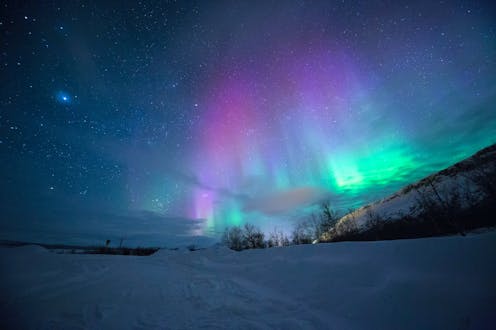
Over millennia, humans have observed and been inspired by beautiful displays of light bands dancing across dark night skies. Today, we call these lights the aurora: the aurora borealis in the northern hemisphere, and the aurora australis in the south.
Nowadays, we understand auroras are caused by charged particles from Earth’s magnetosphere and the solar wind colliding with other particles in Earth’s upper atmosphere. Those collisions excite the atmospheric particles, which then release light as they “relax” back to their unexcited state.
The colour of the light corresponds to the release of discrete chunks of energy by the atmospheric particles, and is also an indicator of how much energy was absorbed in the initial collision.
The frequency and intensity of auroral displays is related to activity on the Sun, which follows an 11-year cycle. Currently, we are approaching the next maximum, which is expected in 2025.
Fox Fires, a short film inspired by the Finnish folk tale of the aurora borealis.Connections to the Sun
Such displays have long been documented by peoples throughout North America, Europe, Asia and Australia.
In the 17th century, scientific explanations for what caused the aurora began to surface. Possible explanations included air from Earth’s atmosphere rising out of Earth’s shadow to become sunlit (Galileo in 1619) and light reflections from high-altitude ice crystals (Rene Descartes and others).
Read more: Do the northern lights make sounds that you can hear?
In 1716, English astronomer Edmund Halley was the first to suggest a possible connection with Earth’s magnetic field. In 1731, a French philosopher named Jean-Jacques d'Ortous de Mairan noted a coincidence between the number of sunspots and aurora. He proposed that the aurora was connected with the Sun’s atmosphere.
It was here that the connection between activity on the Sun was linked with auroras here on Earth, giving rise to the areas of science now called “heliophysics” and “space weather”.
Earth’s magnetic field as a particle trap
The most common source of aurora is particles travelling within Earth’s magnetosphere, the region of space occupied by Earth’s natural magnetic field.
Images of Earth’s magnetosphere typically show how the magnetic field “bubble” protects Earth from space radiation and repels most disturbances in the solar wind. However, what is not normally highlighted is the fact that Earth’s magnetic field contains its own population of electrically charged particles (or “plasma”).
Model representation of Earth’s magnetic field interacting with the solar wind.The magnetosphere is composed of charged particles that have escaped from Earth’s upper atmosphere and charged particles that have entered from the solar wind. Both types of particles are trapped in Earth’s magnetic field.
The motions of electrically charged particles are controlled by electric and magnetic fields. Charged particles gyrate around magnetic field lines, so when viewed at large scales magnetic field lines act as “pipelines” for charged particles in a plasma.
The Earth’s magnetic field is similar to a standard “dipole” magnetic field, with field lines bunching together near the poles. This bunching up of field lines actually alters the particle trajectories, effectively turning them around to go back the way they came, in a process called “magnetic mirroring”.
‘Magnetic mirroring’ makes charged particles bounce back and forth between the poles.Earth’s magnetosphere in a turbulent solar wind
During quiet and stable conditions, most particles in the magnetosphere stay trapped, happily bouncing between the south and north magnetic poles out in space. However, if a disturbance in the solar wind (such as a coronal mass ejection) gives the magnetosphere a “whack”, it becomes disturbed.
The trapped particles are accelerated and the magnetic field “pipelines” suddenly change. Particles that were happily bouncing between north and south now have their bouncing location moved to lower altitudes, where Earth’s atmosphere becomes more dense.
As a result, the charged particles are now likely to collide with atmospheric particles as they reach the polar regions. This is called “particle precipitation”. Then, when each collision occurs, energy is transferred to the atmospheric particles, exciting them. Once they relax, they emit the light that forms the beautiful aurora we see.
Curtains, colours and cameras
The amazing displays of aurora dancing across the sky are the result of the complex interactions between the solar wind and the magnetosphere.
Aurora appearing, disappearing, brightening and forming structures like curtains, swirls, picket fences and travelling waves are all visual representations of the invisible, ever-changing dynamics in Earth’s magnetosphere as it interacts with the solar wind.
As these videos show, aurora comes in all sorts of colours.
The most common are the greens and reds, which are both emitted by oxygen in the upper atmosphere. Green auroras correspond to altitudes close to 100 km, whereas the red auroras are higher up, above 200 km.
Blue colours are emitted by nitrogen – which can also emit some reds. A range of pinks, purples and even white light are also possible due to a mixture of these emissions.
The aurora is more brilliant in photographs because camera sensors are more sensitive than the human eye. Specifically, our eyes are less sensitive to colour at night. However, if the aurora is bright enough it can be quite a sight for the naked eye.
Where and when?
Catching aurora in the southern hemisphere.Even under quiet space weather conditions, aurora can be very prominent at high latitudes, such as in Alaska, Canada, Scandinavia and Antarctica. When a space weather disturbance takes place, auroras can migrate to much lower latitudes to become visible across the continental United States, central Europe and even southern and mainland Australia.
The severity of the space weather event typically controls the range of locations where the aurora is visible. The strongest events are the most rare.
So, if you’re interested in hunting auroras, keep an eye on your local space weather forecasts (US, Australia, UK, South Africa and Europe). There are also numerous space weather experts on social media and even aurora-hunting citizen science projects (such as Aurorasaurus) that you can contribute towards!
A rare sighting of the aurora australis from central Australia, with Uluru in the foreground.Get outside and witness one of nature’s true natural beauties – aurora, Earth’s gateway to the heavens.
Read more: Fire in the sky: The southern lights in Indigenous oral traditions
Authors: Brett Carter, Associate Professor, RMIT University


















