

Torrents of Antarctic meltwater are slowing the currents that drive our vital ocean 'overturning' – and threaten its collapse
- Written by: Matthew England, Scientia Professor and Deputy Director of the ARC Australian Centre for Excellence in Antarctic Science (ACEAS), UNSW Sydney
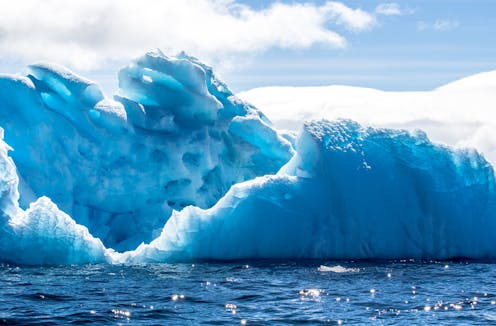
Off the coast of Antarctica, trillions of tonnes of cold salty water sink to great depths. As the water sinks, it drives the deepest flows of the “overturning” circulation – a network of strong currents spanning the world’s oceans. The overturning circulation carries heat, carbon, oxygen and nutrients around the globe, and fundamentally influences climate, sea level and the productivity of marine ecosystems.
But there are worrying signs these currents are slowing down. They may even collapse. If this happens, it would deprive the deep ocean of oxygen, limit the return of nutrients back to the sea surface, and potentially cause further melt back of ice as water near the ice shelves warms in response. There would be major global ramifications for ocean ecosystems, climate, and sea-level rise.
Schematic showing the pathways of flow in the upper, deep and bottom layers of the ocean.Our new research, published today in the journal Nature, uses new ocean model projections to look at changes in the deep ocean out to the year 2050. Our projections show a slowing of the Antarctic overturning circulation and deep ocean warming over the next few decades. Physical measurements confirm these changes are already well underway.
Climate change is to blame. As Antarctica melts, more freshwater flows into the oceans. This disrupts the sinking of cold, salty, oxygen-rich water to the bottom of the ocean. From there this water normally spreads northwards to ventilate the far reaches of the deep Indian, Pacific and Atlantic Oceans. But that could all come to an end soon. In our lifetimes.
Why does this matter?
As part of this overturning, about 250 trillion tonnes of icy cold Antarctic surface water sinks to the ocean abyss each year. The sinking near Antarctica is balanced by upwelling at other latitudes. The resulting overturning circulation carries oxygen to the deep ocean and eventually returns nutrients to the sea surface, where they are available to support marine life.
If the Antarctic overturning slows down, nutrient-rich seawater will build up on the seafloor, five kilometres below the surface. These nutrients will be lost to marine ecosystems at or near the surface, damaging fisheries.
Changes in the overturning circulation could also mean more heat gets to the ice, particularly around West Antarctica, the area with the greatest rate of ice mass loss over the past few decades. This would accelerate global sea-level rise.
An overturning slowdown would also reduce the ocean’s ability to take up carbon dioxide, leaving more greenhouse gas emissions in the atmosphere. And more greenhouse gases means more warming, making matters worse.
Meltwater-induced weakening of the Antarctic overturning circulation could also shift tropical rainfall bands around a thousand kilometres to the north.
Put simply, a slowing or collapse of the overturning circulation would change our climate and marine environment in profound and potentially irreversible ways.
Signs of worrying change
The remote reaches of the oceans that surround Antarctica are some of the toughest regions to plan and undertake field campaigns. Voyages are long, weather can be brutal, and sea ice limits access for much of the year.
This means there are few measurements to track how the Antarctic margin is changing. But where sufficient data exist, we can see clear signs of increased transport of warm waters toward Antarctica, which in turn causes ice melt at key locations.
Indeed, the signs of melting around the edges of Antarctica are very clear, with increasingly large volumes of freshwater flowing into the ocean and making nearby waters less salty and therefore less dense. And that’s all that’s needed to slow the overturning circulation. Denser water sinks, lighter water does not.
Antarctic ice mass loss over the last few decades based on satellite data, showing that between 2002 and 2020, Antarctica shed an average of ~150 billion metric tonnes of ice per year, adding meltwater to the ocean and raising sea-levels (Source: NASA).How did we find this out?
Apart from sparse measurements, incomplete models have limited our understanding of ocean circulation around Antarctica.
For example, the latest set of global coupled model projections analysed by the Intergovernmental Panel on Climate Change exhibit biases in the region. This limits the ability of these models in projecting the future fate of the Antarctic overturning circulation.
To explore future changes, we took a high resolution global ocean model that realistically represents the formation and sinking of dense water near Antarctica.
We ran three different experiments, one where conditions remained unchanged from the 1990s; a second forced by projected changes in temperature and wind; and a third run also including projected changes in meltwater from Antarctica and Greenland.
In this way we could separate the effects of changes in winds and warming, from changes due to ice melt.
The findings were striking. The model projects the overturning circulation around Antarctica will slow by more than 40% over the next three decades, driven almost entirely by pulses of meltwater.
Abyssal ocean warming driven by Antarctic overturning slowdown, Credit: Matthew England and Qian Li.Over the same period, our modelling also predicts a 20% weakening of the famous North Atlantic overturning circulation which keeps Europe’s climate mild. Both changes would dramatically reduce the renewal and overturning of the ocean interior.
We’ve long known the North Atlantic overturning currents are vulnerable, with observations suggesting a slowdown is already well underway, and projections of a tipping point coming soon. Our results suggest Antarctica looks poised to match its northern hemisphere counterpart – and then some.
What next?
Much of the abyssal ocean has warmed in recent decades, with the most rapid trends detected near Antarctica, in a pattern very similar to our model simulations.
Our projections extend out only to 2050. Beyond 2050, in the absence of strong emissions reductions, the climate will continue to warm and the ice sheets will continue to melt. If so, we anticipate the Southern Ocean overturning will continue to slow to the end of the century and beyond.
The projected slowdown of Antarctic overturning is a direct response to input of freshwater from melting ice. Meltwater flows are directly linked to how much the planet warms, which in turn depends on the greenhouse gases we emit.
Our study shows continuing ice melt will not only raise sea-levels, but also change the massive overturning circulation currents which can drive further ice melt and hence more sea level rise, and damage climate and ecosystems worldwide. It’s yet another reason to address the climate crisis – and fast.
Authors: Matthew England, Scientia Professor and Deputy Director of the ARC Australian Centre for Excellence in Antarctic Science (ACEAS), UNSW Sydney


















