

how Australian theatre companies are facing the climate crisis
- Written by: Linda Hassall, Senior Lecturer Humanities, Griffith University
At the launch of the new national cultural policy earlier this year, Prime Minister Anthony Albanese said we must lift the arts beyond the economic debate, and see it as a vital part of Australia’s identity and soul.
If we are to truly revive our cultural and creative institutions in the decades to come, we must take on the full meaning of the term “sustainability”, going beyond its economic associations.
The sustainability of our culture is quite literally dependent on the sustainability of our planet.
Our new report asks if achieving environmental sustainability should be a key goal for all Australian performing arts companies and, if so, how can it be achieved?
Our report focuses on 13 Australian arts organisations demonstrating a commitment to sustainability in their programming, practices and policies.
Everyone interviewed agreed there is a clear need to support a sector-wide transition to sustainability, yet also acknowledged challenges in doing so.
As Ang Collins, marketing manager and sustainability coordinator at Sydney’s Griffin Theatre, told us:
there is no blueprint for how a theatre company should run sustainably or a checklist for things to do, and there are no traditions, there are no networks for borrowing sets or reuse […] no proper knowledge sharing and systems in place.
Building a show
For many small-to-medium organisations, resourcefulness is already a valued part of their operation.
Limited budgets mean reusing and recycling materials is a necessity.
Briony Anderson of Terrapin Puppet Theatre in Hobart points out spending money on labour rather than materials contributes to both ecological and economic goals.
She told us:
We believe our purpose is to make Tasmanian - and Australian - lives better through our work. We understand that rapid transition to a low-carbon economy is imperative in a changing climate.
Sue Giles, co-CEO of Melbourne’s Polyglot Theatre, says the aesthetic challenge of sustainability should be embraced:
sustainability is a relationship between aesthetics and good practice […] it doesn’t have to reflect poorly on the outcome, it can actually enhance the outcome.
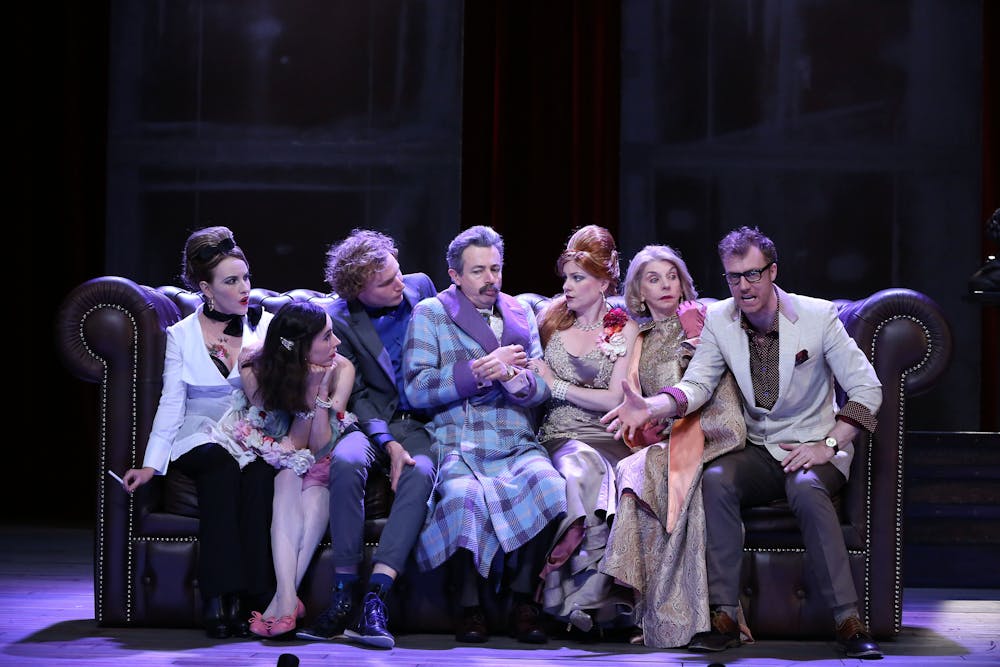
Small companies cite their limited budgets as a spur to reduce and recycle. For larger companies it is the other way around. They argue limited budgets are contributing to less environmentally sustainable choices.
These companies face pressure to produce “high quality” work. Giles Perkins, the executive director of Sydney’s Bell Shakespeare, told us:
being more sustainable has a considerable cost imperative. The cheapest materials are often the least sustainable.
Valuing time and input
Smaller companies are quicker in responding to ecological challenges. They are more agile and face fewer structural barriers to implementing changes.
Larger companies need dedicated policies to guide them through an appropriate transition.
For Griffin Theatre’s Collins, valuing people’s time is crucial:
A priority of ours is to remunerate a passionate individual or individuals for the [sustainability] hours that they do, for someone to take ownership of the program and keep it in check, keep updating it, take on responsibility for the projects.
Everyone we interviewed was upfront about the difficulty of always choosing the eco-friendly option. These options could be hard to identify, and were often more expensive. They indicated a need for cost-effective sustainable materials and products.
Many talked about the importance of shifting the culture of sustainability leadership in the workplace.
Belinda Kelly, executive producer of Hobart’s Terrapin Puppet Theatre, said:
You clearly need the executive or management team to be supporting [the shift to more sustainable practices]. And you need to have a champion on the board to convince them that this is good business as well as [good] ethical reason[ing].
Sustainability practices don’t just happen on stage.
Theatre venues are installing LED lighting and solar panels, and tracking carbon emissions. While on tour, companies are using tools such as Arts on Tour’s Greening Touring Toolkit, which provides advice on how to redesign touring to remove unnecessary emissions.
Read more: Artists organize to offer new visions for tackling climate change
Moving forward
Our report shows many theatre organisations across Australia are contending with implementing ethically-based, eco-friendly initiatives in their production and touring practices.
Through these interviews, we have identified four ways sustainable practices can be better achieved:
celebrating resourceful approaches to theatre making
using sustainability tools to inform practices
sharing resources across artists and organisations
encouraging more mindful and slow touring practices.
Going forwards, there is a strong need to examine policy settings, funding models and support structures to steer the sector towards a sustainable future. By doing so we can encourage new ecological practices, strengthen community bonds, germinate new ways of thinking and reinforce sustainability as a value we can share and celebrate.
If we agree the climate crisis calls for a shift in the way we view the world and in our relationship to it, then the performing arts have a pivotal role to play in this transition.
As Dead Puppet Society’s Helen Stephens told us:
I want to know, what else is possible […] to know what in our lifetime is actually achievable in this space of art making and supporting our planet […] I want more knowledge […] I want there to be a constant conversation […] I want more understanding. I want to know how me doing this tiny thing […] will help all the things that impact climate change.
Read more: It's time for a new age of Enlightenment: why climate change needs 60,000 artists to tell its story
Authors: Linda Hassall, Senior Lecturer Humanities, Griffith University


















