

new research shows your plants could be silently screaming at you
- Written by: Alice Hayward, Molecular Biologist, The University of Queensland
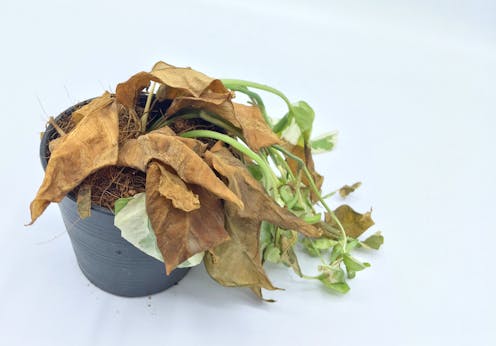
If you’re like me, you’ve managed to kill even the hardiest of indoor plants (yes, despite a doctorate in plant biology). But imagine a world where your plants actually told you exactly when they needed watering. This thought, as it turns out, may not be so silly after all.
You might be familiar with the growing body of work that provides evidence for plants being able to sense sounds around them. Now, new research suggests they can also generate airborne sounds in response to stress (such as from drought, or being cut).
A team led by experts at Tel Aviv University has shown tomato and tobacco plants, among others, not only make sounds, but do so loudly enough for other creatures to hear. Their findings, published today in the journal Cell, are helping us tune into the rich acoustic world of plants – one that plays out all round us, yet never quite within human earshot.
Plants can listen, but now they can talk!
Plants are “sessile” organisms. They can’t run away from stressors such as herbivores or drought.
Instead, they’ve evolved complex biochemical responses and the ability to dynamically alter their growth (and regrow body parts) in response to environmental signals including light, gravity, temperature, touch, and volatile chemicals produced by surrounding organisms.
These signals help them maximise their growth and reproductive success, prepare for and resist stress, and form mutually beneficial relationships with other organisms such as fungi and bacteria.
In 2019, researchers showed the buzzing of bees can cause plants to produce sweeter nectar. Others have shown white noise played to Arabidopsis, a flowering plant in the mustard family, can trigger a drought response.
Now, a team led by Lilach Hadany, who also led the aforementioned bee-nectar study, has recorded airborne sounds produced by tomato and tobacco plants, and five other species (grapevine, henbit deadnettle, pincushion cactus, maize and wheat). These sounds were ultrasonic, in the range of 20-100 kilohertz, and therefore can’t be detected by human ears.
Stressed plants chatter more
To carry out their research, the team placed microphones 10cm from plant stems that were either exposed to drought (less than 5% soil moisture) or had been severed near the soil. They then compared the recorded sounds to those of unstressed plants, as well as empty pots, and found stressed plants emitted significantly more sounds than unstressed plants.
In a cool addition to their paper, they also included a soundbite of a recording, downsampled to an audible range and sped up. The result is a distinguishable “pop” sound.
The number of pops increased as drought stress increased (before starting to decline as the plant dried up). Moreover, the sounds could be detected from a distance of 3-5 metres – suggesting potential for long-range communication.
But what actually causes these sounds?
While this remains unconfirmed, the team’s findings suggest that “cavitation” may be at least partially responsible for the sounds. Cavitation is the process through which air bubbles expand and burst inside a plant’s water-conducting tissue, or “xylem”. This explanation makes sense if we consider that drought stress and cutting will both alter the water dynamics in a plant stem.
Regardless of the mechanism, it seems the sounds produced by stressed plants were informative. Using machine learning algorithms, the researchers could distinguish not only which species produced the sound, but also what type of stress it was suffering from.
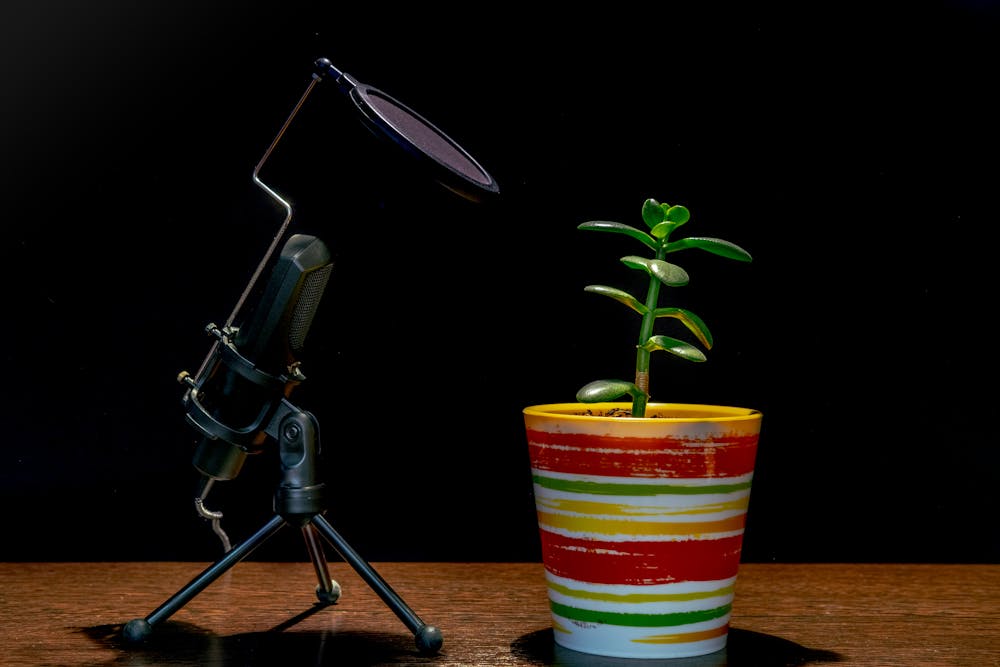
It remains to be seen whether and how these sound signals might be involved in plant-to-plant communication or plant-to-environment communication.
The research has so far failed to detect any sounds from the woody stems of woody species (which includes many tree species), although they could detect sounds from non-woody parts of a grapevine (a woody species).
What could it mean for ecology, and us?
It’s temping to speculate these airborne sounds could help plants communicate their stress more widely. Could this form of communication help plants, and perhaps wider ecosystems, adapt better to change?
Or perhaps the sounds are used by other organisms to detect a plant’s health status. Moths, for example, hear within the ultrasonic range and lay their eggs on leaves, as the researchers point out.
Then there’s the question of whether such findings could help with future food production. The global demand for food will only rise. Tailoring water use to target individual plants or sections of field making the most “noise” could help us more sustainably intensify production and minimise waste.
For me personally, if someone could give a microphone to my neglected veggie patch and have the notifications sent to my phone, that would be much appreciated!
Authors: Alice Hayward, Molecular Biologist, The University of Queensland


















