

What does Trump's indictment mean for his political future – and the strength of US democracy?
- Written by: Emma Shortis, Lecturer, RMIT University
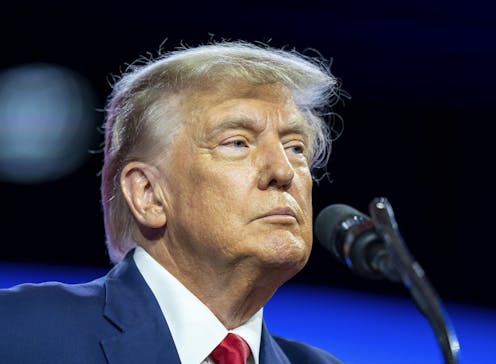
Events often seem inevitable in hindsight. The indictment of former US President Donald Trump on criminal charges has been a possibility since the start of his presidency – arguably, since close to the beginning of his career in New York real estate.
But until now, the potential consequences of such a cataclysmic development in American politics have been purely theoretical.
Today, after much build-up in the media, The New York Times reported that a Manhattan grand jury has voted to indict Trump and the Manhattan district attorney will now likely attempt to negotiate Trump’s surrender.
The indictment stems from a criminal investigation by the district attorney’s office into “hush money” payments made to the adult film star Stormy Daniels (through Trump’s attorney Michael Cohen), and whether they contravened electoral laws.
Trump also faces a swathe of other criminal investigations and civil suits, some of which may also result in state or federal charges. As he pursues another run for the presidency, Trump could simultaneously be dealing with multiple criminal cases and all the court appearances and frenzied media attention that will come with that.
These investigations and possible charges won’t prevent Trump from running, or even serving as president again (though, as with everything in the US legal system, it’s complicated).
But what will the political fallout be – will his indictment hurt Trump, or help him? And what does it mean for American democracy?
Can Trump survive multiple investigations at once?
There are almost too many hypotheticals and “what ifs” to count. Even the immediate fallout of Trump’s indictment isn’t clear.
It is certainly plausible Trump will manage to derive political benefit from the media spectacle – he has a long history of successfully weaponising investigations into his dealings as “witch hunts”, effectively tapping into conservatives’ obsession with “government overreach”.
It’s equally possible multiple investigations and charges will eventually hurt Trump, forcing him off the campaign trail and into situations out of his control, where he doesn’t perform so well. This could go as badly for him as the few hostile media interviews he did as president and open the door for a successful challenge by another aspiring candidate.
Democrats and others opposed to Trump and the movement he heads are also divided on the fallout and risks.
Some legal experts and political pundits have expressed concern about the particular case that led to Trump’s indictment.
The Daniels case is murky and focused on technical election laws, raising questions about whether it would have been less risky to prioritise a more straightforward case, such as the Georgia investigation into Trump’s attempt to influence the outcome of the 2020 presidential election. Indictments may soon be forthcoming in that case, too.
Whatever happens with these investigations and Trump’s reactions to them, it’s already clear his supporters will whip themselves into a frenzy of misinformation, hysteria and perhaps even violence, further destabilising the political landscape.
Are presidents above the law?
There’s a much bigger question to ask, though: where does all of this fit into the deep, ongoing crisis surrounding American democracy and its institutions?
Since the 2016 election, the questions of whether a candidate should be subject to criminal investigations and whether a sitting president can be charged with an offence have plagued US politics.
When then-FBI director James Comey sent a letter to Congress on the eve of the 2016 election about the private email server presidential candidate Hillary Clinton used as secretary of state, it led to a great deal of soul-searching about the impact of perceptions – valid or otherwise – of politically motivated “interference” in the electoral process.
The longstanding reluctance of federal agencies to engage in such “interference”, alongside the established consensus that a president should not be charged while in office, survived until almost the very end of the Trump administration.
The so-called “Russia investigation”, led by Special Counsel Robert Mueller, declined to recommend specific charges against Trump, despite there being ample evidence he had allegedly obstructed justice. The basis for this decision: Mueller said Justice Department policy prevented him from charging a sitting president with a crime.
But between the release of Mueller’s report and Trump’s incitement of an insurrection of the US Capitol on January 6, 2021, attitudes to charging a president or former president appear to have changed dramatically. Trump’s indictment this week makes that abundantly clear.
The shared understanding that has, until now, protected Trump (and predecessors like Richard Nixon), has been turned on its head. Now, there’s a belief among many Democrats and a few anti-Trump Republicans that not pursuing these investigations to their logical ends – that is, an arrest, trial and potential imprisonment – presents a much greater threat to the integrity of American democracy and democratic institutions than the risk of appearing to “interfere”.
This logic argues that, particularly when American democracy is in crisis, even presidents and former presidents cannot be seen to be above the law.
If this perception was widespread, how many Americans would completely lose faith in a political system they already don’t trust entirely? Even more importantly, how would the perpetrators of crimes – and their supporters – respond if they believed they could break the law without consequences?
If, as many experts have argued, January 6 was a test run, what are the consequences of no consequences?
A dangerous and unstable time
We can be fairly certain of the answer to that question. Trump’s reaction to his pending indictment two weeks ago was eerily reminiscent of his incitement of the riot on the Capitol: “Protest, take our nation back!”
The potential for further violence – which is a feature, not a bug, of American politics – is very real.
While the logic behind the criminal pursuit of the ex-president is entirely sound – and necessary to the ongoing integrity of American democratic institutions – that does not necessarily mean the survival of those institutions is assured as they are forced to respond to ongoing attacks.
Trump’s indictment, and the frenzy it has already created, demonstrate just what a dangerous and unstable time this is for American democracy. The road is probably about to get even rockier.
In a 1977 interview, Nixon said in response to a question about why he had authorised illegal actions against anti-Vietnam war protesters,
Well, when the president does it […] that means that it is not illegal.
Almost half a century later, we’re as close as we’ve ever been to finding out if he was right – and if American democracy can survive the answer.
Authors: Emma Shortis, Lecturer, RMIT University


















