

A short history of doomed second harbour crossing proposals for Auckland – and a quicker, cheaper option
- Written by: Timothy Welch, Senior Lecturer in Urban Planning, University of Auckland
New Zealand is a small country that suddenly has big ideas about public transportation projects for its largest city. In February, the physical work began for a partially tunnelled light rail line under the Auckland CBD that will eventually connect to the airport. The project could ultimately have a price tag nearing NZ$30 billion.
Things went big again last week with the release of five options for a second harbour crossing. Four of the five will cost at least $20 billion and involve building another bridge and one or more tunnels for light rail and cars.
While the project is said to be on the fast track, with construction to begin in six years, Aucklanders would be forgiven if they didn’t buy into this timeline. The new options are just the latest in a long line of proposals that date back at least 35 years.
It’s worth reviewing the long and tumultuous history of second Auckland harbour crossing proposals. In the process, we might ask whether a sixth option might, in fact, be the best: apply congestion charging to the Auckland CBD, and give public transport, walking and cycling better access to the existing bridge.
Bridges and tunnels
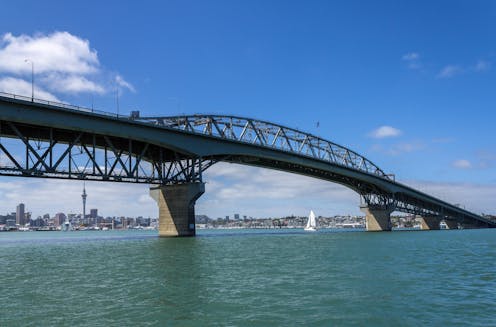
The Auckland Harbour Bridge officially opened on May 30 1959. Construction took four years and cost nearly $250 million (in today’s money), but the structure was already too narrow for traffic volumes. Within a decade, extra lanes built in Japan were bolted to the bridge – the so called “Nippon clip-ons”.
From 1988 until 2010, various second crossing options were studied and presented, including:
1988: a plan was developed for either tunnelled public transport or a second bridge
1997: 11 options for a second crossing were studied and sent out for public consultation, including different tunnel or bridge alignments, with the most expensive option being a tunnel at roughly $2.6 billion in today’s dollars
2003: a followup to the 1997 study suggested a combination of a second bridge and a tunnel, costed at around $4.5 billion in today’s dollars
2008: a study of 159 crossing options was narrowed to three options, included either a new bridge or two possibilities for tunnels
2010: a business case was developed for three crossing options, including a second bridge, tunnelled heavy rail, and a tunnelled road, with the highest cost estimate just under $6 billion.
Walking and cycling
The original plans for the bridge had also included tolled cycle lanes, but these were eventually rejected for cost. In 2011, the idea was revived, with the New Zealand Transport Agency (now Waka Kotahi) announcing a “SkyPath” plan to add walking and cycling lanes to the clip-ons. This was added to Auckland Transport’s strategic priority list the same year.
Resource consent for the SkyPath was lodged in 2015 and approved in 2016. The new Labour-led government in 2017 said it would fund the project, with a revised design for the path to sit on its own piers revealed in 2019.
Read more: Using valuable inner-city land for car parking? In a housing crisis, that just doesn’t add up
In 2021 Waka Kotahi pulled the plug on the SkyPath plan, citing engineering complexity. The same year, a $685 million standalone cycling and walking bridge was announced. The cost estimate quickly rose to $785 million before it was cancelled just four months later – but not before the government spent $51 million on designs, consultants and engineering plan fees.
Since then, it has been a tale of stop-start (but mostly stop) initiatives, including:
November 2021: Waka Kotahi decided against a cycling and walking “trial” across the bridge but endorsed a series of events for cyclists and walkers in December.
August 2022: Waka Kotahi announced a planned $700,000 one-day trial for walking and cycling would be scrapped, primarily citing concerns about the 6% bridge gradient allowing cyclists to reach speeds of 60km per hour and the potential for pedestrian collisions. (Ironically, one of the new cycling bridge options “would be of a similar gradient” to the current bridge.)
December 2022: Waka Kotahi announced a series of “Walk it, Wheel it” events for three Sundays in March for up to 60,000 Aucklanders to cross the bridge on foot or bike. But this was postponed in early 2023, with no future date announced.
Back to the future
The five new harbour crossing options are now out for public consultation, with a decision due by mid-year and construction to begin in 2029. But given the long history of studying, gathering feedback and then doing nothing about a second crossing (or improving public and active transport options on the existing bridge), some scepticism is warranted.
With projected finish dates ranging from 2039 to 2044, and costs up to $25 billion (assuming no delays or budget blowouts), the options also create more vehicle lanes just a few years before the Emission Reduction Plan’s 2050 target for net zero emissions.
Read more: To get New Zealanders out of their cars we'll need to start charging the true cost of driving
Surely a more sustainable solution would be to institute the long-discussed Auckland CBD congestion charge and reallocate a few lanes on the existing bridge for public transport, cycling and walking.
This would reduce the number of CBD car trips and contribute to meeting those climate goals. If a second crossing is still needed, taking this more immediate action would at least offer additional – and more climate-friendly – travel options in the meantime.
Future-proofing part of Auckland’s transportation network may not require billions of dollars and decades of planning and construction. It could simply mean finally embracing a version of what was planned for the Auckland Harbour Bridge almost 65 years ago.
Authors: Timothy Welch, Senior Lecturer in Urban Planning, University of Auckland


















