

First Peoples' knowledge of 'mysterious fairy circles' in Australian deserts has upended a long-standing science debate
- Written by: Fiona Walsh, Ethnoecologist, The University of Western Australia
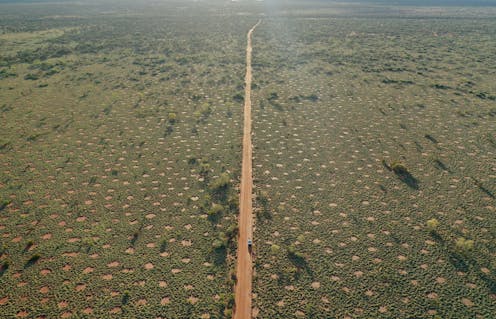
What are “fairy circles”? They are polka dots of bare earth, regularly scattered across arid grasslands. Scientists first described fairy circles in Namibia in the 1970s and sparked a global debate in the scientific community about the causes of the phenomenon.
In 2016, a group of international scientists concluded that, in the Australian Pilbara, “fairy circles” arose from spinifex plants competing for water and nutrients – a similar explanation to the one they proposed for fairy circles in Namibia. These stories were amplified by the media, but the voices of Aboriginal desert people were not reported.
In a study published in Nature Ecology & Evolution today, we show what our Aboriginal coauthors have always known – that fairy circles in the Western Deserts of Australia are flat, hard “pavements” inhabited by spinifex termites (Drepanotermes species).
Knowing the Country
Aboriginal people have lived in Australia’s Western Desert, including the Pilbara, for at least 50,000 years and know their Country deeply. We are grateful to be part of a cross-cultural team of researchers that include Western Desert people and scientists.
Our starting points included open-minded curiosity. Some of us knew little about spinifex grassland ecosystems. None of us knew about “fairy circles” or the international science debate. However, we all wanted to learn, and were interested in learning together. As our research unfolded, the more we learned, the more we realised we didn’t know. We learned things that were new even to those who’ve lived in and studied deserts for a lifetime.
We saw similarities between patterns in specific Aboriginal artworks and aerial views of the pavements. We found paintings that tell deep and complex stories about termites and the activities of termite Jukurrpa (Dreaming) ancestors.
Western Desert Martu people call the fairy circle pavements linyji and the fat-rich flying termites Warturnuma. We learned that the hard surfaces of linyji are used to thresh seed and flying termites are prized foods. Martu colleague Gladys Karimarra Bidu stated:
Linyji are the homes of termites who live underground. We gathered and ate the Warturnuma that flew from linyji. Warturnuma is wama, delicious. Old people also put their seeds on the hard linyji. They hit seed to make damper; our good food. I learnt this from my old people and have seen this myself many times.
Termites as kin
This knowledge about pavements and termites is shared and passed down through generations by Martu and other Indigenous groups. Our Australian Wildlife Conservancy colleagues Alice Nampijinpa Michaels and Lee Nangala Wayne describe their feelings for flying spinifex termites in this video. Alice said:
Pamapardu, big mob. Waturnuma and pamapardu we call them. I been crying for that pamapardu. I was crying for my brother. My brother’s Dreaming.
Why such strong feelings? Spinifex termites are kin to them. Those that live in the pavements are like the krill of desert ecosystems – they are super-abundant. Most people think of above-ground termite mounds, but here is a whole community that lives mostly below the soil surface, only emerging to eat dead spinifex or to fly to reproduce.
Most Australians consider spinifex grasslands to be “rubbish country”. A pastoralist even said so while we were excavating into termite pavements. He was about to set fire to the spinifex (and potentially us). Termites, including those that live in the spinifex, are often maligned and poisoned by Australians. However, these vast tracts of land and their termites are deeply important to Aboriginal people in ways that were invisible to some of our team.
New science findings from Aboriginal knowledge
Our cross-cultural research has led to unexpected findings. Termite pavements hold water after big rains, which was unknown to scientists until we recognised clues in the stories and art of Aboriginal country folk. Purungu Desmond Taylor, Martu interpreter and co-author, remembered the Mulyamiji, great desert skink, and describes breeding behaviour not previously reported by scientists:
After good rains in linyji country, Mulyamiji would be born in water lying on the linyji. My mother, my two fathers, my uncle told me this long ago.
Aboriginal people have refined their encyclopaedic knowledge while living continuously on this continent for thousands of generations. Listening to Aboriginal desert voices improved our understanding of how ubiquitous, but often overlooked, desert Country works.
We learnt that the flat, hard linyji are used to prepare foods, they can become ephemeral sources of water and support the breeding of Mulyamiji, they provide abundant and rich sources of food, and have deep spiritual significance.
This year, Australians will be asked to recognise Australia’s First Nations People in our constitution. In our experience, we strengthen our connections with Country and each other when we nurture relationships, listen well and share together, work equitably and two-ways.
Read more: The Voice: what is it, where did it come from, and what can it achieve?
Authors: Fiona Walsh, Ethnoecologist, The University of Western Australia


















