

Russia’s alleged deportation of Ukrainian children has caused a UN standoff – what international law says and why it matters
- Written by: Claire Breen, Professor of Law, University of Waikato
The New Zealand government’s sanctioning of Russian commissioner for children’s rights Maria Lvova-Belova is a further demonstration of its concern over alleged war crimes in Ukraine. But it is only a small step in what will likely be a very long road to justice.
In March, the reported removal of Ukrainian children from Russian-occupied territory to Russia itself triggered the International Criminal Court to issue arrest warrants for Russian president Vladimir Putin and Lvova-Belova.
The warrants allege the transfer of children to the Russian Federation is unlawful: such actions are war crimes under the Rome Statute of the International Criminal Court. Lvova-Belova and Putin have rejected the accusations, with Putin having claimed the issue would be raised at the United Nations Security Council in early April.
Russia – controversially – now holds the council presidency for the month, but has faced immediate resistance. Because of Lvova-Belova’s involvement, Britain has blocked a planned UN webcast of an informal council meeting to discuss the deportation issue.
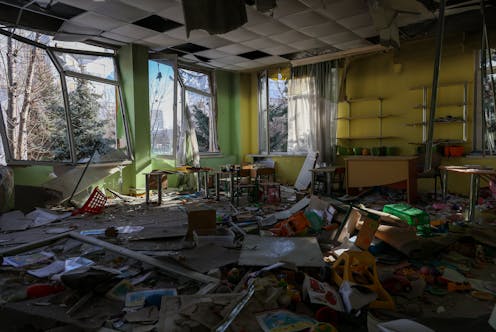
Meanwhile, the war continues to have a profound impact on children. Hundreds have been killed in indiscriminate attacks, schools have been disrupted, some two million have been made refugees or are living in extreme poverty. The deportation of children simply piles misery onto misery.
Families during war
The issue of unlawful deportation or transfer of children goes to the heart of international law around the protection of children, which dates back almost a century. The 1924 Declaration on the Rights of the Child originated in efforts to look after the child victims of World War I.
After World War II, the impact of war on humanity in general was recognised in the UN Charter, which aimed to “save succeeding generations from the scourge of war” and “to reaffirm faith in fundamental human rights”.
Those twin ideals were further elaborated on in a number of international legal instruments. Protection of the family, as the natural and fundamental social unit, and of children and childhood, is central to these. Such rights and obligations apply in peacetime as well as during war.
The importance of these values accumulated over decades until the UN Convention on the Rights of the Child was agreed in 1989. The deportation of children violates various fundamental children’s rights, including their right to:
know and be cared for by their parents
preserve their identity, including their name, nationality and family relations
be free from unlawful interference with their family.
There are strict rules around the separation of children from their parents. Adoption is permitted only in certain circumstances, with inter-country adoption a last resort.
Special protection for children
As the arrest warrants attest, the deportation of children is a grave breach of international humanitarian law (the rules countries must obey during war). At the centre sit the four Geneva Conventions of 1949, and their additional protocols from 1977. The specific aim of these treaties is to protect those who do not take part in hostilities, known as “protected persons”.
Under the Fourth Geneva Convention, children are entitled to special protection, with rules aimed at protecting their relationships with their parents and families. States must ensure the welfare of children who have been orphaned or separated from their families, and must attempt to reunite families separated by conflict.
The evacuation of children is permitted during the course of hostilities, although the rules around this were tightened in 1977.
But it is the rules around occupied territories that are key to the arrest warrants for Putin and Lvova-Belova. Occupying powers are prohibited from deporting protected persons, including children, from occupied territory to the territory of the occupying power (or to any other country).
Occupying powers must also facilitate the identification of children and the registration of their parents, and they must not change children’s personal status. Essentially, they must not fracture the relationship between children and their families.
Read more: Family separations in Ukraine highlight the importance of children's rights
No impunity
Deportation to the territory of an occupying power heightens the risk that the identity and nationality of such children will be erased, particularly where the deported children are adopted.
But the implications don’t stop at the children themselves, because the continued existence of any group depends on its children. This means the forcible transfer of children from one group to another may also violate the 1948 Genocide Convention if done with the intent to “destroy a national, ethnical, racial or religious group, completely or partially”.
The Rome Statute also includes the forcible transfer of children within the crime of genocide, which is a crime against humanity. But the arrest warrants for Putin and Lvova-Belova do not include these particular crimes.
It’s sadly ironic, in light of the arrest warrants and Russia’s presidency of the Security Council this month, that the council not long ago stated “the protection of children should be part of a comprehensive strategy to resolve conflict and sustain peace”.
Russia’s actions must also be examined in light of legal obligatons under the Convention on the Rights of the Child, the Fourth Geneva Convention and the Genocide Convention. There is a long legal road ahead, but the principle is clear: impunity for crimes committed against children in times of war is not an option.
Authors: Claire Breen, Professor of Law, University of Waikato


















