

As tensions escalate in the Middle East, can all-out war be averted?
- Written by Eyal Mayroz, Senior Lecturer in Peace and Conflict Studies, University of Sydney
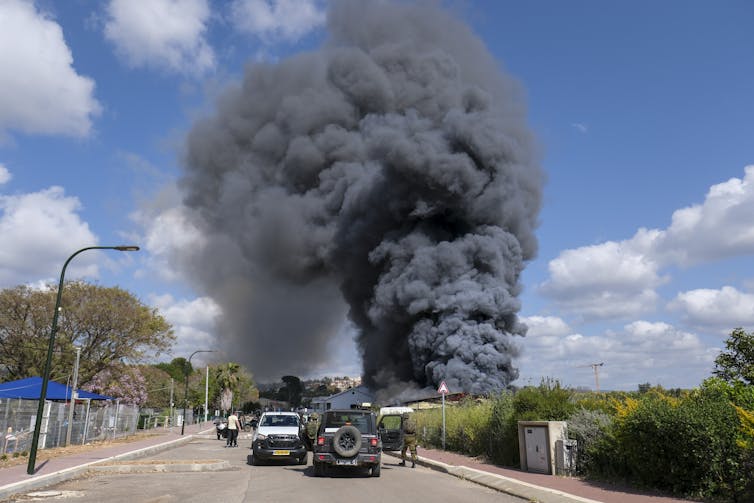
Violence has again erupted in the Middle East during one of the holiest times of year for both Jews and Muslims.
In recent days, militants in southern Lebanon have fired a large number of rockets at Israel in response to an Israeli police raid on the Al-Aqsa mosque compound in Jerusalem.
Israel blamed the Hamas militant group for the attacks and retaliated by launching air strikes at Palestinian militias in Lebanon – the most alarming cross-border violence in 17 years – as well as at the Hamas-run Gaza Strip.
A rare rocket attack then came from Syria, prompting another round of Israeli air strikes against targets there. Clashes also broke out in the West Bank after thousands of Israelis, joined by seven Cabinet ministers, marched to an evacuated settlement there, demanding it be legalised.
The motives behind such provocations include anger, fear, the desire for revenge and frustration. These emotions are driven by the horrors of the Israeli occupation of Palestinian territories on the one hand, and anger at Palestinian terrorist attacks or unbridled desire for Jewish hegemony on the other.
Extreme interpretations of nationalism or religiosity – and often a combination of both – tend to aggravate these sentiments.
These spasms of violence should be seen as provocations since there is no military solution to the ongoing conflict between Israel and the Palestinians.
Deterrence is what the two main actors, Israel and Hamas, are seeking. Maintaining, achieving or increasing deterrence is key in both sides’ calculations of how to react when violence does break out.
Wedged between provocation, retaliation and deterrence, each side estimates how far it can stretch the line before copping a costly response from the other.
Read more: Israel is facing twin existential crises – what is Benjamin Netanyahu doing to solve them?
A multitude of calculations
For Hamas, the key calculation is how to escalate attacks against Israel, while still keeping Gaza out of the violence. The aim is to steer the struggle against the Israeli occupation of Palestinian territories to the West Bank, Jerusalem and into Israel itself.
Recognising this, Israel tries to direct its military responses back to Gaza, as soon as it can establish a link between the provocation and Hamas.
Hezbollah, the militant group in Lebanon that has a growing partnership with Hamas, has a different set of calculations.
These include its long-standing feud with Israel, a desire to settle old scores (including past assassinations of Hezbollah leaders), religious passions (for example, sensitivities in relation to the Al-Aqsa Mosque), and directives from Iran.
Hezbollah is constrained, however, by Israeli military responses and by the need to reconcile its allegiance to Iran with its accountability to the Lebanese people. Many Lebanese already accuse Hezbollah of prioritising Iranian interests over their own. Being held responsible for a costly Israeli retaliation against Lebanese territories would be problematic for the organisation.
Israel, in turn, also fears another war with Hezbollah, which would be extremely costly. The organisation has a huge arsenal of rockets (estimated at more than 100,000), including high-quality and long-range weapons, which it could fire into Israel at will.
The famed Israeli Iron Dome air defence system would not withstand the power and sheer numbers of these weapons.
Israel’s worst fear, however, is of a concurrent escalation on multiple fronts, with Hamas and Islamic Jihad in Gaza in the south, an Intifada-style uprising in East Jerusalem and the West Bank to the east, and Hezbollah in Lebanon to the north.
A fourth front could open up in Israeli cities between Israel’s Palestinians, Jews and security forces. And there’s always a possibility of a fifth front being fought against Iranian forces stationed in Syria.
Israel’s preferred approach to these multiple threats would be to try to isolate the different actors by limiting its retaliations to a single provocation at a time. This, however, would not be easy.
Why both sides have avoided escalation thus far
As we’ve seen recently, the tensions between the various sides tend to originate or are exacerbated by provocations from minor actors – Jewish settlers in the West Bank, Jewish nationalists inside Israel, and Palestinian militants in the occupied territories, inside Israel or in southern Lebanon.
In the past, retaliations to such provocations by Israel, Hamas and other groups were, more often than not, measured. That is, they were aimed to project power and resolve internally to avoid being seen as weak by one’s own people. But a measured response also signals to the other side a wish to avoid escalation.
The targets struck in recent outbreaks of violence illustrate this. On the Hamas side, limiting rocket firing to Jewish towns in southern Israel, as opposed to more central cities, signalled a desire to avoid a major escalation. On Israel’s side, aiming at low-level Palestinian targets, as opposed to primary command posts or key leaders, could mean the same.
However, it is unclear how the new hard-line Israeli government will respond to the evolving violence.
At the moment, Israel seems to prefer avoiding escalation. The latest polls show the new ruling coalition is nose-diving in popularity and would fail to gain a majority of seats in parliament if elections were held today. This may explain why the more vocal nationalists appear to be deferring, at least temporarily, to more cautious voices in government.
However, a significant provocation in Al-Aqsa Mosque, or a significant terrorist attack against Jews, could both alter this mind-set.
Where to from here?
The international community has a critical role to play by forcing or incentivising the various sides into painful but necessary concessions on the (very) long road to peace.
One could appreciate the value of the de-escalation strategies currently in use. However, if the main purpose is to preserve deterrence, then a more honest dialogue within, as well as between, the camps on the risks of violent provocations could offer perhaps better solutions.
In the endless tit-for-tat violent cycle, there are no winners, only losers.
Authors: Eyal Mayroz, Senior Lecturer in Peace and Conflict Studies, University of Sydney

















