

First near-complete sauropod dinosaur skull found in Australia hints at ancient links between continents
- Written by Stephen Poropat, Research associate, Curtin University
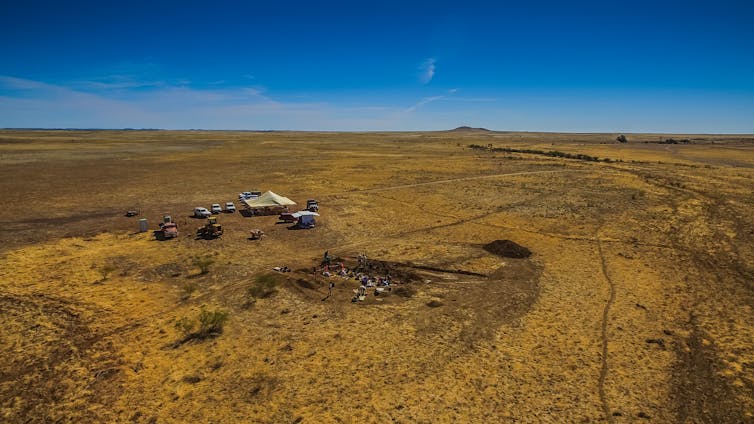
In May and June of 2018, Australia’s first near-complete skull of a sauropod – a group of long-tailed, long-necked, small-headed dinosaurs – was found on a sheep station northwest of Winton in Queensland.
I was part of the dig team from the Australian Age of Dinosaurs Museum that made the discovery, and subsequently had the privilege of leading the team that studied the skull. After years of work, our results are published today in Royal Society Open Science.
The skull belonged to a creature we have dubbed “Ann”: a member of the species Diamantinasaurus matildae which shows surprising similarities to fossils found halfway across the world, lending weight to the theory that dinosaurs once roamed between Australia and South America via an Antarctic land connection.
A good skull is hard to find
The sauropod dinosaurs have been a source of lifelong fascination for me, and finding a sauropod skull was one of my childhood dreams. Sadly, the fossil record is biased towards preserving sauropod limbs, vertebrae and ribs, and heavily against skulls.
This makes sense when you consider the processes that act on an organism’s body after it dies, which palaeontologists call taphonomy.
Large, robust limb bones are resistant to decomposition, and if they are buried rapidly they might fossilise quite readily. Vertebrae and ribs comprise a significant proportion of a vertebrate skeleton, increasing their odds of preservation.
By contrast, sauropod skulls were relatively small, made up of many delicate bones that were only loosely held together by soft tissue, and seemingly easily detached from the end of the neck. They might also have been prime targets for carnivorous dinosaurs: the only previously described sauropod braincase from Australia preserves several bite marks from fierce theropods.
The bones of the skull were found around two metres beneath the surface, scattered over an area of about nine square metres. Much of the right side of the face is missing, but most of the left is present. Sadly, many of the bones show signs of distortion (presumably a result of post mortem scavenging or trampling), which makes physical reassembly of the skull a delicate process.
Modern technology recreates an ancient animal
This being the case, we set out to reconstruct the skull digitally. We CT scanned the bones at St Vincent’s Hospital in Melbourne. This enabled the internal features of each bone to be observed on a computer.
Inside one bone in the snout (which we also had scanned at the Australian Synchrotron), we found replacement teeth. It has long been known that sauropods, like crocodiles today, continually replaced their teeth throughout their lives.
We also scanned all of the bones with a surface scanner, enabling detailed 3D models of each bone to be made on a computer. The skull could then be reassembled in a virtual space with no risk of damage to the fossils themselves.
The teeth in the new sauropod skull were very similar to those found at other sites in the Winton area. Comparisons with Australia’s only other fragmentary sauropod skull (also from Winton) revealed additional similarities.
Meet Diamantinasaurus matildae
Our skull belongs to the species Diamantinasaurus matildae. Diamantinasaurus would have been about as long as a tennis court, as tall as basketball ring at the shoulder, and weighed ~25 tonnes – about as much as two fire engines.
Diamantinasaurus occupies a low branch on the family tree of a group of sauropods called titanosaurs. Other members of the titanosaur group (from higher branches on their family tree) include the largest land animals that ever lived, such as Patagotitan and Argentinosaurus, which exceeded 30 metres in length. Titanosaurs were the only sauropods to live right until the end of the Cretaceous Period (66 million years ago), when the age of dinosaurs came to a close.
Read more: The march of the titanosaurs: the Snake Creek Tracksite unveiled
Diamantinasaurus has a rounded snout, typical of medium- to high-level browsing sauropods. Its teeth are robustly constructed, but those from other sites show little sign of wear by soil or grit, reinforcing the idea Diamantinasaurus preferred to feed some distance above ground level.
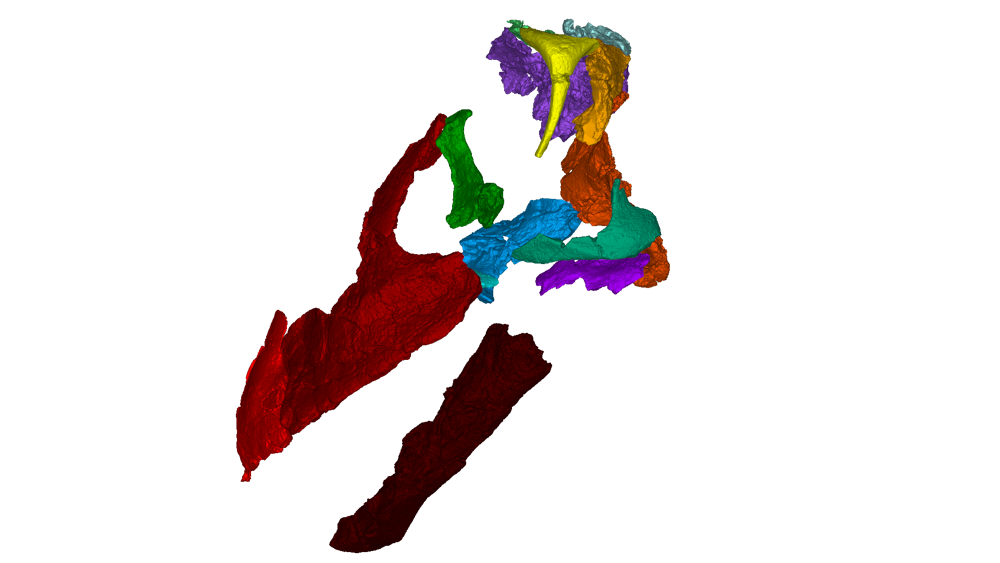
Only two replacement teeth are present in each tooth socket, implying that Diamantinasaurus replaced its teeth relatively slowly. And finally, the teeth are restricted to the front of the snout, meaning that Diamantinasaurus, like all other sauropods, did not chew its food.
Family resemblances
We compared our sauropod skull with others from around the world. The most similar skull was that of Sarmientosaurus musacchioi, which lived in southern South America. Diamantinasaurus and Sarmientosaurus lived at around the same time (about 95 million years ago), and at around the same latitude (50°S).
We had previously hypothesised that these two sauropods were close relatives, albeit on the basis of limited evidence. The new skull shores up that idea in a big way: bone for bone, the skulls of Diamantinasaurus and Sarmientosaurus are extremely similar. This might seem strange, given the great physical distance between South America and Australia today. However, back then each of those continents retained a lingering land connection with Antarctica.
Read more: A key feature contributed to sauropods getting so enormous, new dino foot study reveals
Sauropods seemingly preferred warmer climates at low to medium latitudes. However, 95 million years ago the climate was extremely warm, even by the warm standards of the Cretaceous. With polar latitudes more amenable for sauropods, these scaly behemoths – and other landlubbing animals – could trundle through lush forests at the bottom of the world between South America and Antarctica.
It is a privilege to be able to finally put a face to the name Diamantinasaurus matildae. Future discoveries will hopefully help cement its status as one of the most completely understood titanosaurs worldwide.
Authors: Stephen Poropat, Research associate, Curtin University

















