

what to expect when Australia's oldest coal plant closes
- Written by Joel Gilmore, Associate Professor, Griffith University
After more than five decades, the last operating units of the Liddell coal-fired power station will close this month. The station’s owner, AGL, is Australia’s largest carbon polluter. Liddell’s closure will reduce the company’s emissions by 17%.
Liddell, in the New South Wales Hunter Valley, is Australia’s oldest coal station. It started operations in the early 1970s – about the same time the Datsun 180B was released, and before the Sydney Opera House officially opened!
In the same way a Datsun 180B was a great car in its day, Liddell was the cheapest and most reliable electricity generation technology in the 1970s and 1980s (at least if you ignore the long-term costs of carbon).
But like all coal-fired power stations in Australia, Liddell’s performance declined as it aged. It became unreliable and inefficient. One unit of the station closed last year, leaving three operating.
Governments must act to make sure our electricity grid doesn’t fall short when coal plants close. But the demise of facilities such as Liddell means Australia has a once-in-a-generation opportunity to become a global energy superpower.
Life after Liddell
AGL announced the decision to close Liddell in 2015. Virtually no one in the energy industry argued against the move, but it triggered endless political debate.
Some politicians are still railing against Liddell’s retirement. Federal Nationals leader David Littleproud this week said the closure should be delayed to prevent supply problems, and suggested Australia should have an urgent conversation about building nuclear energy.
But closing Liddell is unlikely to cause the lights to go off in NSW. For now, the state has enough remaining capacity to ensure reliable supply.
In the eight years since the decision to close Liddell, large-scale renewable capacity in NSW has ramped up, as has new rooftop solar.
Plenty of new “firming” capacity is also being developed – that is, flexible energy capacity to be activated if renewables aren’t producing energy or electricity demand suddenly increases. Projects under construction in NSW include the Kurri Kurri and Tallawarra gas-fired power stations, the Waratah “super battery” and the Snowy 2.0 pumped hydro project.
When electricity consumption in NSW is at its highest, about 14,000 MW of power is required. Without Liddell, about 13,500 MW of coal, gas and hydro generation is available.
Add in existing wind and solar capacity, plus energy that can be imported from Victoria and Queensland via transmission lines, and total generation capacity in NSW looks to be more than enough.
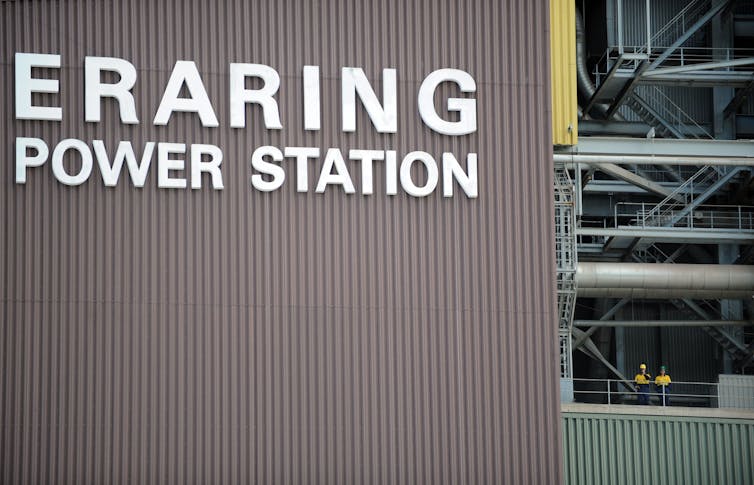
However, the reliability of some of this remaining capacity – namely, remaining coal-fired power stations – is becoming less certain. That’s why the energy industry is looking past Liddell, to the closure of the Eraring coal plant in 2025, and others to follow.
Read more: Global coal use in 2022 is reaching an all-time high, but Australia is bucking the trend
All eyes on Eraring
Modelling by the Australian Energy Market Operator shows the closure of Eraring puts pressure on remaining electricity supply. However, it says the market would still meet the grid “reliabilty standard”, even if no new projects are developed.
Under that standard, expected unserved energy needs (leading to blackouts) should be no more than 0.002% of total energy used in a region. The standard assumes that while the occasional blackout is inconvenient, eliminating them completely is unfeasible because it would require building expensive power stations that are rarely used.
Blackouts could become more common, if extreme weather hits or coal units fail – which happened at Queensland’s Callide C power station in 2021. But blackouts are still far more likely to be the result of a power line problem in your street than a lack of generation capacity.
Over to the Minns government
No electricity supply shortfalls are projected for Australia in the near-term. But to ensure the clean energy transition happens smoothly, we should develop new renewable energy and firming capacity ahead of coal closures.
The earlier-than-expected closure of coal units remains a possibility – as occurred with Victoria’s Hazelwood coal station due to unaffordable repair costs.
We have previously recommended a “waiting room” for capacity that can be brought quickly into the market when required. Batteries and pumped hydro would be developed ahead of coal closures, and brought into the market as soon as coal exits.
The NSW Minns Labor government can also bring forward investment through an existing policy called the NSW Energy Roadmap. This involves asking the Australian Energy Market Operator to enter into long-term contracts to underwrite new renewable energy and firming projects, to help reduce the financial risks proponents face.
One tender round is already under way, but this could be accelerated. Given the global energy crunch, it may be worth commissioning projects now, even if delivery is not required until later. This is a much better way to manage reliability than, for example, the NSW government using taxpayer money to buy Eraring – an option NSW Labor left on the table ahead of last month’s state election.
In the longer term, construction of renewable generation must dramatically scale up to ensure energy reliability and meet emissions reduction targets.
This will be challenging. But we can take heart from news this week that under the federal Albanese government, renewables projects are being approved at twice the rate of previous years.
Read more: Want an easy $400 a year? Ditch the gas heater in your home for an electric split system
A new era
There’s more work to be done to make sure the electricity grid can withstand coal plant closures.
Many new transmission lines must be built to carry electricity from renewables generators to the grid. And the ongoing development of renewable energy zones – clusters of large-scale renewable energy projects – will make establishing new projects quicker and simpler.
Importantly, local communities and First Nations people must be engaged and consulted throughout the transition.
But while adjusting to the exit of coal brings challenges, nuclear power in Australia is unlikely to be the answer.
Australia has world-class wind and solar resources – enough to eventually produce clean, cheap energy for ourselves and for export. Technologies such as batteries, hydrogen and hydro will fill the gaps when needed.
Producing energy from emerging nuclear technologies in the form of “small modular reactors”, as proposed by Littleproud, will be still be more than twice the cost of Australian renewable energy firmed by batteries or other storage technologies, even under the most ambitious scenarios. This gives Australia a global competitive advantage.
Liddell’s closure is an historic moment in the Australian energy landscape. Now, with tweaks to existing policies, the new NSW government can increase reliability, lower electricity prices and get on the path to net-zero.
Read more: Batteries won't cut it – we need solar thermal technology to get us through the night
Authors: Joel Gilmore, Associate Professor, Griffith University

















