

Why using more fertiliser and feed does not necessarily raise dairy farm profits but increases climate harm
- Written by Wanglin Ma, Associate Professor of Economics, Lincoln University, New Zealand
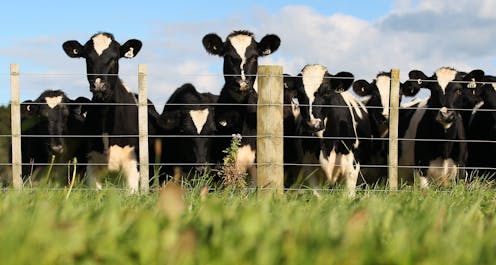
New Zealand is in an unusual position in the developed world when it comes to greenhouse gas emissions. About half of all emissions come from agriculture, and almost a quarter can be attributed to biological emissions (nitrous oxide and methane) from the dairy sector.
The latest synthesis report released by the Intergovernmental Panel on Climate Change (IPCC) in March highlights the challenges climate change presents for New Zealand. And it clearly illustrates the benefits of cutting emissions sooner rather than later.
How did we get here?
Dairy farming in New Zealand was traditionally characterised as a pasture-based and low-input system.
However, in recent times, dairy farmers have intensified production, largely by using more fertiliser and supplementary feed (palm kernel expeller, silage and concentrate) to improve farm performance. Dairy farming has also expanded into less naturally suited regions, which has required greater inputs.
This increase in the use of supplementary feed has occurred not only to feed a growing dairy cow population, which has almost doubled since 1990 to 6.4 million, but also to accommodate more intensive farming systems.
Dairy farming is by far the largest consumer of supplementary feed. In 2022, New Zealand used around 5.8 million tonnes of grain and feed. Imports far exceeded domestic production (3.7 million compared with 2.1 million tonnes, respectively).
Dairy cows consumed around 75% of the total grain and feed. In comparison, the poultry sector and people consumed 12% and 9% of the total, respectively.
New Zealand’s capability to import feed from other countries promotes dairy farming intensification, directly contributing to climate change.
Profit versus planet
It may seem that supplementary feed is being used to increase production and profitability within the sector and that what we are faced with is a classic trade-off between financial performance and the environment (emissions to air and water) and other factors such as animal health and welfare.
Our research on New Zealand’s experience with feed-use intensification suggests dairy farmers who use more supplementary feed are more technically efficient than those who use less. This means they are able to produce more output for each unit of input. This contributes to higher production of milk solids (by 6.3% to 14.2%) and revenue (by 6.3% and 15.6%).
Read more: A new farming proposal to reduce carbon emissions involves a lot of trust – and a lot of uncertainty
There are other benefits associated with supplementary feed which may encourage its use. For example, supplementary feed helps fill feed deficits (periods when there is not sufficient pasture growth) so that milking cows maintain energy intake and production. Supplementary feed can also be used to improve the health of dairy cows and milk quality.
But our further research shows that while feed-use intensification boosts production, costs also rise significantly (by 10.9% to 24.3%). This ultimately leads to a reduced profit margin (by 7.4% to 17.4%).
Significant changes ahead
Dairy farm profitability is jointly determined by the price and output of milk solids and the costs and quantity of production inputs such as feed. As price-takers, dairy farmers can neither directly control the variations in input prices (such as feed prices) nor influence the price of milk.
To increase profitability, farmers must increase the production of milk solids while managing inputs more efficiently. However, other operating expenses increase when systems become more reliant on supplementary feeds. These increases are generally larger than the increases in milk-solids production, thereby reducing profit, on average.
Not all supplementary feeds are equal. Palm kernel expeller (PKE) is widely used as a supplement feed by dairy farmers and it has been shown to embody high emissions (0.51kg CO₂-equivalent per kg of dry matter) compared with other feeds.
New Zealand is the biggest importer of PKE in the world. In 2022, imports were higher than in the previous three years, at more than 2 million tonnes.
Around 54% of PKE used on dairy farms was imported from Indonesia and Malaysia. It is widely claimed that exporting PKE to New Zealand has contributed to deforestation in supplying countries, increasing emissions and risks from climate change. Other concerns have also been raised, for example around PKE’s impacts on animal health.
Read more: Palm kernel product imported for use on dairy farms may actually be harmful to cows
The dairy industry is well aware of these challenges and much effort has been put into encouraging farmers to adopt practices that can save them money while reducing overall emissions. These often focus on maximising the yield from pasture and using less carbon-intensive feeds such as homegrown feeds or byproducts of food and drink production.
The reason why there hasn’t been more progress may be in part because farmers are “locked in” to the current systems through what economists call path dependency. Investments have been made in both human and physical capital, and for many farms, debts have to be serviced. Therefore it is not a case that simply reducing the level of supplementary feed will reduce emissions and maintain profitability.
Reversing the trends requires significant changes to both management practices and physical infrastructure. High fertiliser prices, stricter regulations and the pricing of emissions may encourage this transition, but it may also be time to rethink the role supplementary feed has in our dairy systems.
Authors: Wanglin Ma, Associate Professor of Economics, Lincoln University, New Zealand

















