

The much-anticipated JUICE mission to Jupiter launches today. Here's what it might discover
- Written by Eleanor K. Sansom, Research Associate, Curtin University
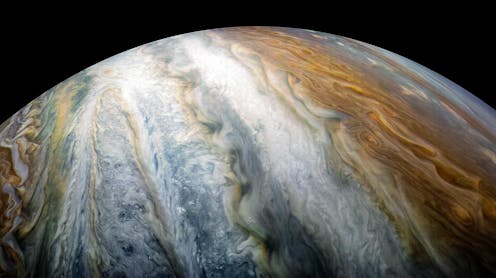
The European Space Agency’s JUICE mission (Jupiter Icy Moons Explorer) is launching today at 10:15pm AEST from Europe’s spaceport in French Guiana.
JUICE will be targeting three water-rich worlds – Jupiter’s moons Ganymede, Europa and Callisto – to check out potential habitats and evidence of past alien life, both on and below the surface. There’s an excellent reason why these worlds in particular are the mission target – they might be habitable for life as we know it.
The moons of Jupiter
Although we have just one moon lighting up our night skies, Jupiter has at least 92. Some, including the four Galilean moons (the largest Jovian moons) formed alongside Jupiter nearly 4.5 billion years ago in the early Solar System. Others have been drawn in and captured by this massive planet, adding to the collection over time.
These moons are made of hugely diverse materials, and some are thought to have conditions favourable for life, or could have in the past.
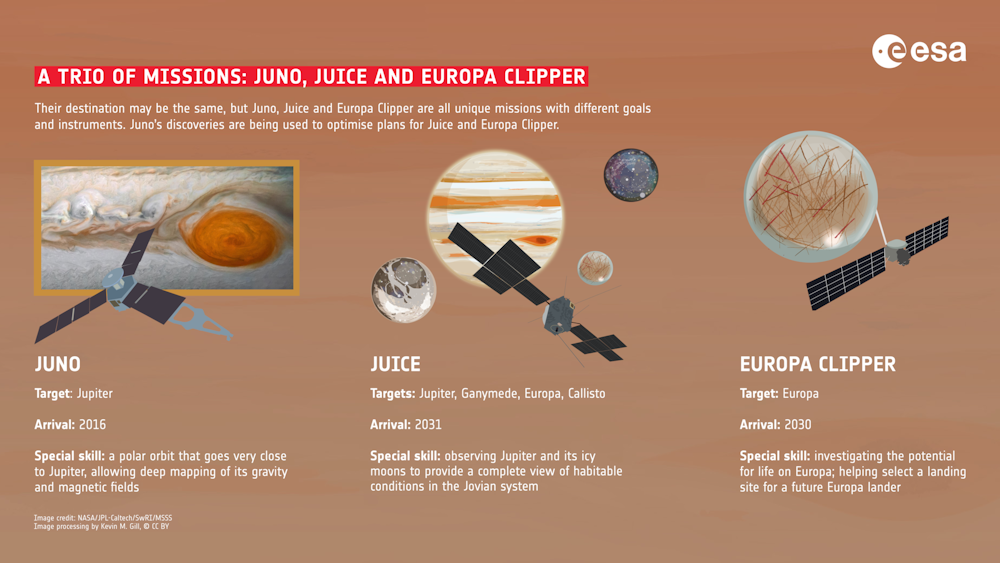
Fewer than ten interplanetary missions have ever flown past Jupiter, with only two NASA missions stopping to orbit the planet and investigate further: the Galileo mission between 1995 and 2003, and the current Juno mission, launched in 2011. These are the only two to have also made dedicated passes of the moons, gathering valuable information for upcoming missions.
Life as we know it
The Galilean moons are of particular interest. The second smallest, Io, may not be habitable, but has some of the largest active volcanoes in the Solar System (with eruptions that can be seen from Earth!).
The other three, Ganymede, Europa and Callisto, are all thought to have large bodies of liquid water under their icy surfaces, and maybe even thin atmospheres.
Ganymede’s liquid iron core also gives it a magnetic field, the only known moon in the Solar System to have one. Our own magnetic field protects Earth’s atmosphere from the harsh solar winds, shielding us from solar radiation. These are factors we associate with fostering and protecting life on Earth.
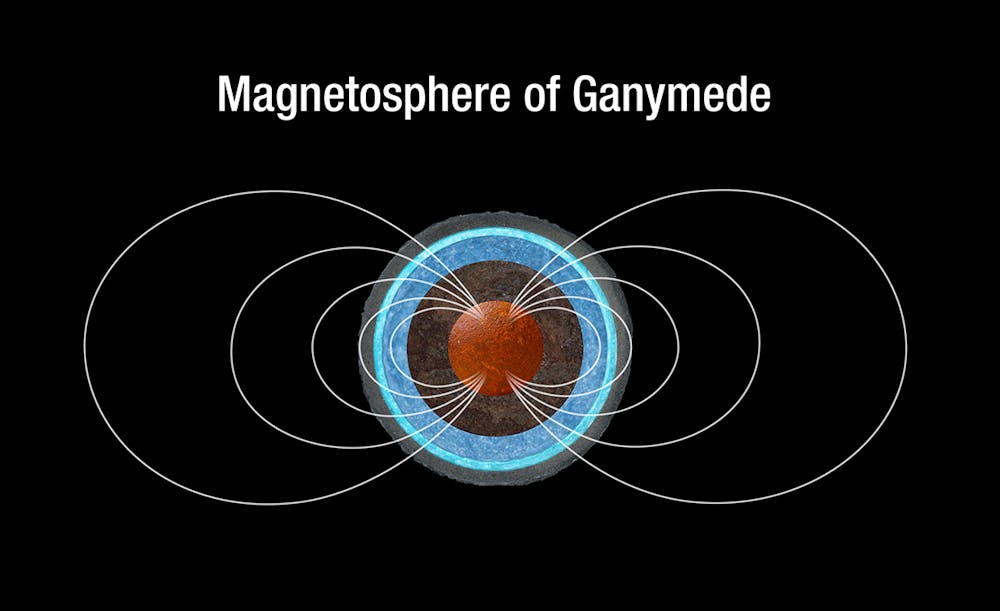 A sketch of the magnetic field lines around Ganymede, which are generated in the moon’s iron core. Hubble Space Telescope measurements of Ganymede’s aurorae, which follow magnetic field lines, suggest that a subsurface saline ocean also influences the behaviour of the moon’s auroras.
NASA, ESA, and A. Feild (STScI)
A sketch of the magnetic field lines around Ganymede, which are generated in the moon’s iron core. Hubble Space Telescope measurements of Ganymede’s aurorae, which follow magnetic field lines, suggest that a subsurface saline ocean also influences the behaviour of the moon’s auroras.
NASA, ESA, and A. Feild (STScI)
We only know of life on Earth, so when we go looking for where life might exist (or once existed) elsewhere, we’re looking for factors we consider essential to life as we know it.
Watery or icy worlds are the first targets, as we know life on Earth originated in and around water. A rocky surface with warmish temperatures would be even more ideal. Jupiter itself is a complete write-off: the crushing pressures, toxic gases, freezing temperatures and lack of a stable surface would never support life as we know it. But the big, icy moons have good protection deep under the ice, potentially liquid water, and elements like carbon and oxygen.
JUICE will use its suite of science instruments to check out the thicknesses of the moons’ icy crusts, what they’re made of, and look for subsurface liquid water. On Europa in particular, it will look for evidence of organic molecules.
Read more: The search for life beneath the ice: why we're going back to Europa
An extremely efficient journey
After its launch, the solar-powered JUICE will take nearly eight years to get to Jupiter. The spacecraft will use minimal propulsion, instead using other planets to give it speed and set its course.
These manoeuvres are called “gravity assists”. This essentially means JUICE will fly purposefully toward a planet, just missing it, in order to get pulled in by its gravity and “slingshot” past the other side. It may take time, but it is extremely efficient.
Juice’s first gravity assist in 2024 will go around both Earth and our Moon – the first time this has ever been done. Other gravity assists will take it around Venus in 2025, and Earth (only) in 2026 and 2029, before being kicked out to Jupiter for an arrival in mid-2031.
What happens when JUICE meets Jupiter?
Fun fact: it will be the first spacecraft to orbit a moon other than our own!
Usually a spacecraft will orbit the main planet (in this case Jupiter) and merely flyby the moons as it loops past. JUICE will start like this, flying by Callisto, Europa and Ganymede a total of 35 times during its three-year tour of the moons. It will briefly meet NASA’s Europa Clipper mission around Europa, complimenting this mission nicely.
But in 2034, JUICE will actually switch its orbit from around Jupiter to go around Ganymede. This will give it an exceptional view, and nearly a year to study this fascinating moon, probing its internal, surface and atmospheric systems.
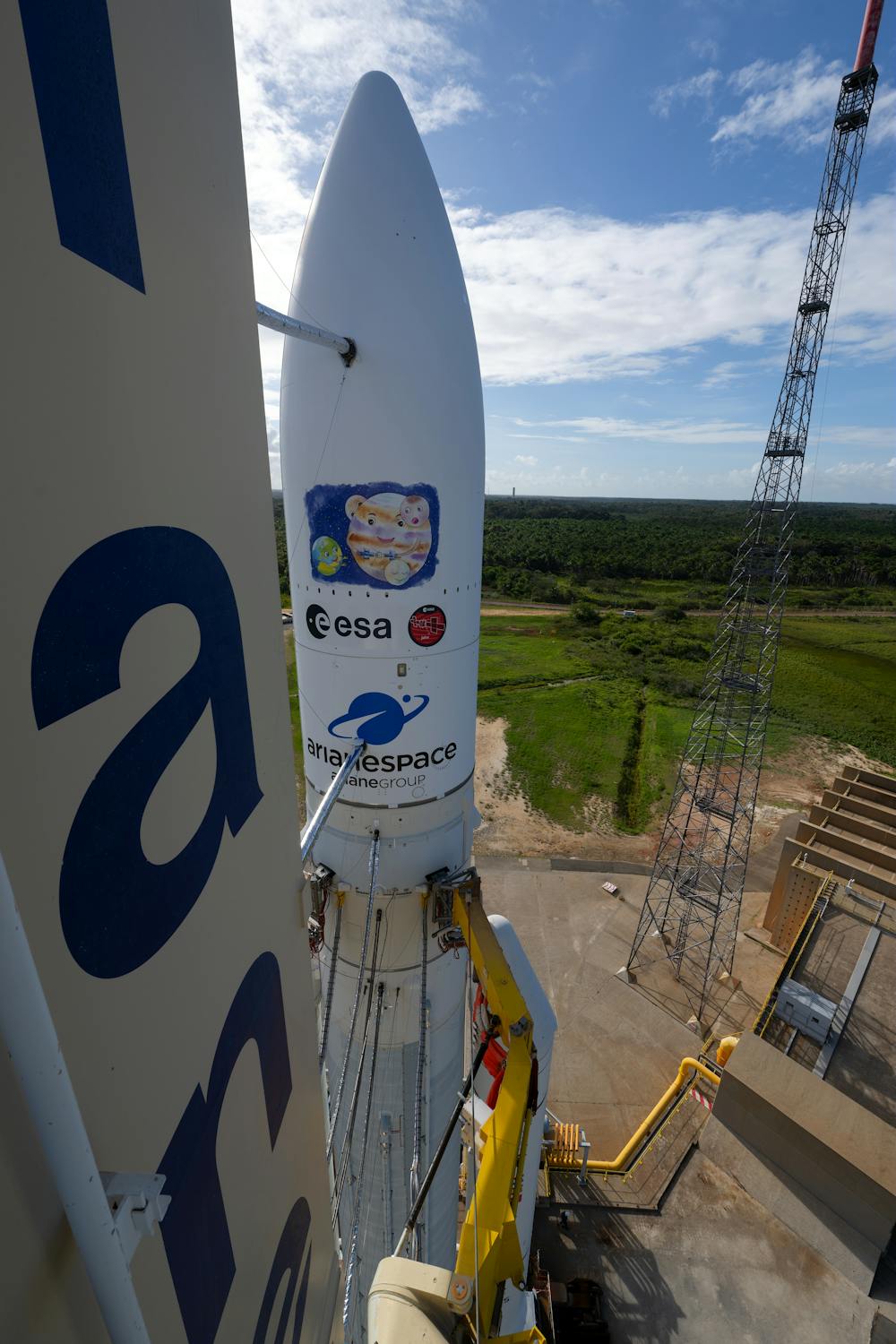 Ariane 5 VA 260 with JUICE ready for launch on the ELA-3 launch pad at Europe’s Spaceport in Kourou, French Guiana on April 12 2023.
ESA/S. Corvaja, CC BY-SA
Ariane 5 VA 260 with JUICE ready for launch on the ELA-3 launch pad at Europe’s Spaceport in Kourou, French Guiana on April 12 2023.
ESA/S. Corvaja, CC BY-SA
Of particular interest is the magnetic field. Ganymede is one of only three rocky bodies in our Solar System known to have one (Earth and Mercury being the other two). Questions JUICE will be able to investigate are not just the basic question of what is creating Ganymede’s magnetic field, but also what happens to it as Ganymede travels through the larger field produced by Jupiter itself, and how their complex interactions influence auroras on both Jupiter and Ganymede.
JUICE will also get a chance to study Jupiter itself, looking into characteristics of giant gas planets that might be universal. Could Jupiter be the key to understanding other solar systems, and the hundreds of exoplanets we have discovered orbiting other stars?
So, we might be waiting a while for JUICE’s arrival at Jupiter, but it will be well worth the wait. Could any of these moons have once supported alien life, and what might we learn about our own Earth, its early oceans, and the conditions needed to spawn life?
Authors: Eleanor K. Sansom, Research Associate, Curtin University

















