

Astronomers have directly detected a massive exoplanet. The method could transform the search for life beyond Earth
- Written by Simon J. Murphy, Senior Lecturer, Astrophysics, University of Southern Queensland
Finding life on other planets might well be the holy grail of astronomy, but the hunt for suitable host planets that can sustain life is a resource-intensive task.
The search for exoplanets (planets outside our Solar System) involves competing for time on Earth’s biggest telescopes – yet the hit rate of this search can be disappointingly low.
In a new study published today in Science, I and my international team of colleagues have combined different search techniques to discover a new giant planet. It could change the way we try to image planets in the future.
Imaging planets is no small feat
To satisfy our curiosity about our place in the universe, astronomers have developed many techniques to search for planets orbiting other stars. Perhaps the simplest of these is called direct imaging. But it’s not easy.
Direct imaging involves attaching a powerful camera to a large telescope and trying to detect light emitted, or reflected, from a planet. Stars are bright, and planets are dim, so it’s akin to searching for fireflies dancing around a spotlight.
It’s no surprise only about 20 planets have been found with this technique to date.
Yet direct imaging is of great value. It helps shed light on a planet’s atmospheric properties, such as its temperature and composition, in a way other detection techniques can’t.
HIP99770b: a new gas giant
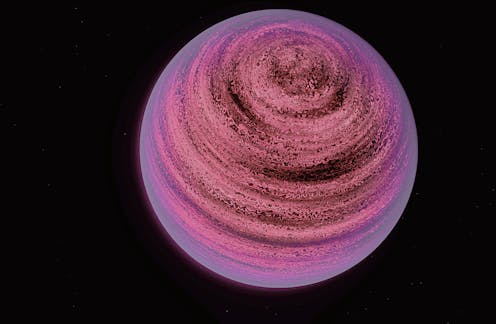
Our direct imaging of a new planet, named HIP99770b, reveals a hot, giant and moderately cloudy planet. It orbits its star at a distance that falls somewhere between the orbital distances of Saturn and Uranus around our Sun.
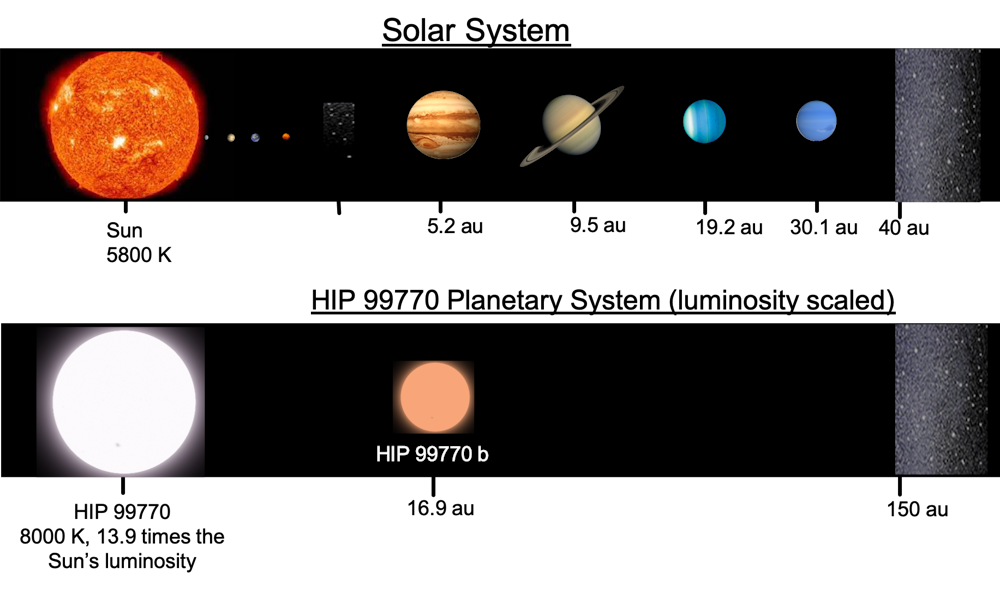
With about 15 times the mass of Jupiter, HIP99770b is a real giant. However, it’s also more than 1,000℃, so it’s not a good prospect for a habitable world.
What the HIP99770 system does offer is an analogy to our own Solar System. It has a cold “debris disk” of ice and rock far out from the star, akin to a scaled-up version of the Kuiper Belt in our Solar System.
The main difference is that the HIP99770 system is dominated by one high-mass planet, rather than several smaller ones.
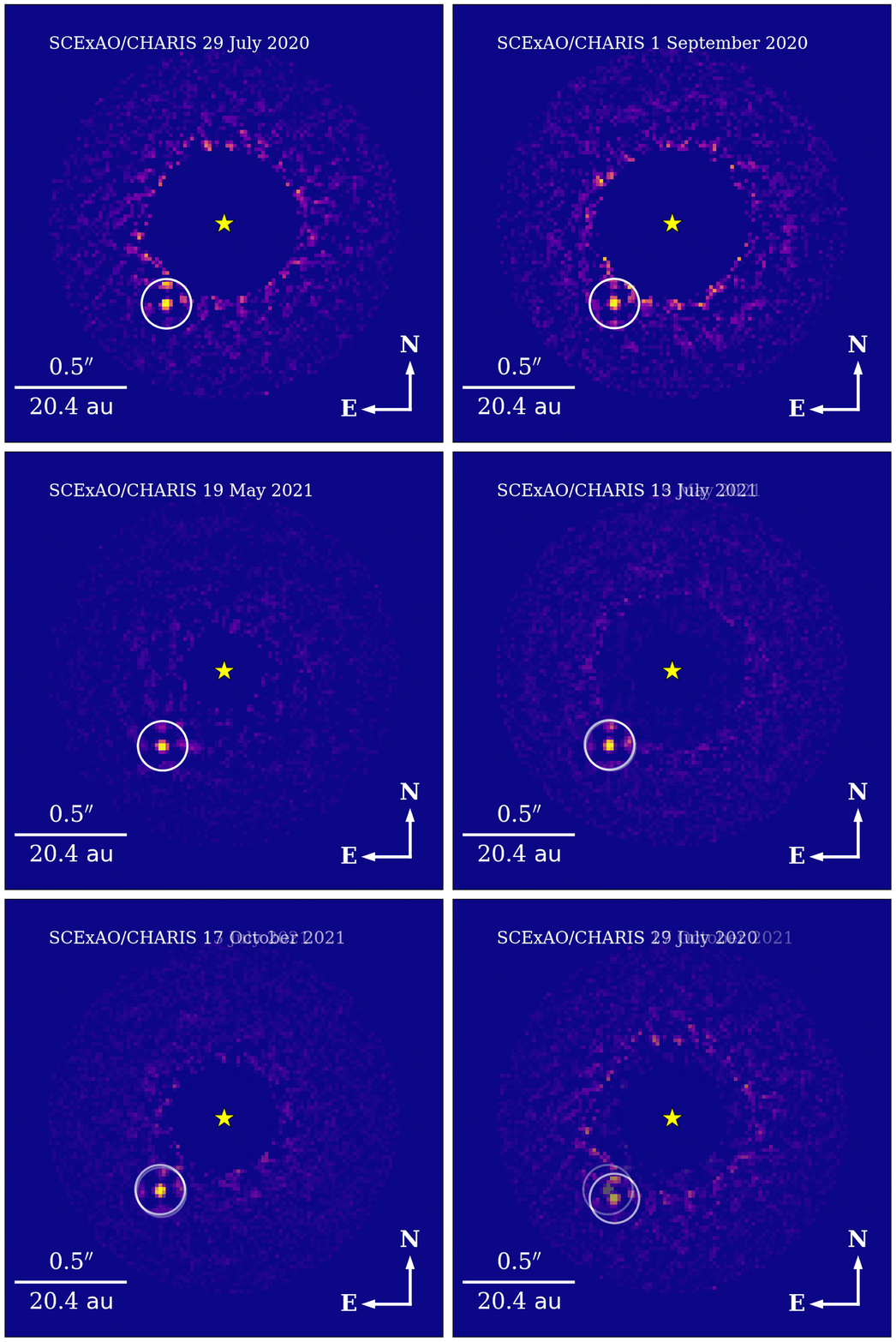 Images of the HIP99770 system, taken with exoplanet imager SCExAO (Subaru Coronagraphic Extreme Adaptive Optics Project) coupled with data from the CHARIS instrument (Coronagraphic High-Resolution Imager and Spectrograph).
Author provided
Images of the HIP99770 system, taken with exoplanet imager SCExAO (Subaru Coronagraphic Extreme Adaptive Optics Project) coupled with data from the CHARIS instrument (Coronagraphic High-Resolution Imager and Spectrograph).
Author provided
Searching with the light on
We reached our findings by first detecting hints of a planet via indirect detection methods. We noticed the star was wobbling in space, which hinted at the presence of a planet in the vicinity with a large gravitational pull.
This motivated our direct imaging efforts; we were no longer searching in the dark.
The extra data came from the European Space Agency’s Gaia spacecraft, which has been measuring the positions of nearly one billion stars since 2014. Gaia is sensitive enough to detect tiny variations of a star’s motion through space, such as those caused by planets.
We also supplemented these data with measurements from Gaia’s predecessor, Hipparcos. In total, we had 25 years’ worth of “astrometric” (positional) data to work with.
Previously, researchers have used indirect methods to guide imaging that has discovered companion stars, but not planets.
It’s not their fault: massive stars such as HIP99770 – which is almost twice the mass of our Sun – are reluctant to give up their secrets. Otherwise-successful search techniques can rarely reach the levels of precision required to detect planets around such massive stars.
Our detection, which used both direct imaging and astrometry, demonstrates a more efficient way to search for planets. It’s the first time the direct detection of an exoplanet has been guided through initial indirect detection methods.
Gaia is expected to continue observing until at least 2025, and its archive will remain useful for decades to come.
Mysteries remain
Astrometry of HIP99770 suggests it belongs to the Argus association of stars – a group of stars that moves together through space. This would suggest the system is rather young, about 40 million years old. That would make it roughly one-hundredth of the age of our Solar System.
However, our analysis of the star’s pulsations, as well as models of the planet’s brightness, suggest an older age of between 120 million and 200 million years. If this is the case, HIP99770 might just be an interloper in the Argus group.
Now that it’s known to host a planet, astronomers will aim to further unravel the mysteries of HIP99770 and its immediate environment.
Read more: A 'next-generation' gamma-ray observatory is underway to probe the extreme Universe
Authors: Simon J. Murphy, Senior Lecturer, Astrophysics, University of Southern Queensland

















