

sugar, slavery and the Sydney Morning Herald
- Written by Sally Young, Professor of Political Science, The University of Melbourne
In a splash of articles published over the past two weeks, the British Guardian has acknowledged and apologised for its historical links with slavery. The Scott Trust, owners of the newspaper that became a global news website, outlined how the Guardian’s founders were linked to transatlantic slavery and announced a programme of restorative justice.
John Edward Taylor, the journalist who founded the Manchester Guardian in 1821, profited from partnerships with cotton manufacturers and merchants who imported raw cotton produced by enslaved people in Jamaica and in the Sea Islands along the coast of South Carolina and Georgia.
In Australia, our oldest surviving newspaper has its own historical links to the shameful practice of slave labour.
In 1841, John Fairfax (1804-1877) became the first of five generations of Fairfax family owners of the Sydney Morning Herald, which had been founded in 1831 as the Sydney Herald.
The Fairfax family also became major shareholders in Colonial Sugar Refining Company (CSR). CSR was founded in Sydney in 1855 by Edward Knox, but it descended from the Australasian Sugar Company, established in 1842. The precise date on which the Fairfax family became sugar investors is not known, but the family was certainly involved by 1855, when John Fairfax’s daughter, Emily, married the general manager of CSR.
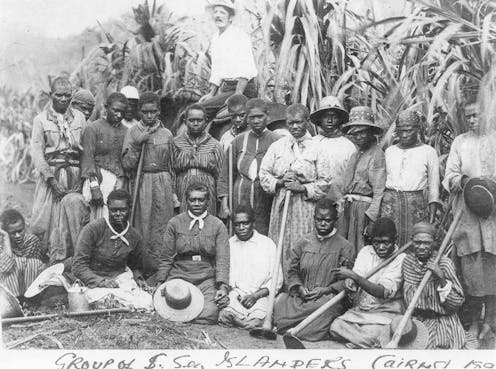
In the 1870s and 1880s, CSR expanded into milling cane in Queensland and Fiji. It profited from the use of what was effectively slave labour through the abduction and importation of tens of thousands of South Sea Islanders, who were disparagingly called “Kanakas” (a Hawaiian word meaning “man”).
According to the Australian Human Rights Commission, between 1863 and 1904, “an estimated 55,000 to 62,500 Islanders were brought to Australia to labour on sugar-cane and cotton farms in Queensland and northern New South Wales”. They were forced to perform backbreaking labour in appalling conditions.
Most came from Vanuatu and Solomon Islands, but they also arrived from more than 70 other Pacific Islands. CSR chartered ships for the express purpose of “recruiting” labourers from these islands. Men, women and children, some as young as nine, were forced, coerced or tricked into coming to Australia. The practice of kidnapping them was known as “blackbirding” (“blackbird” was another word for slave).
Read more: Friday essay: a slave state - how blackbirding in colonial Australia created a legacy of racism
Although a system of indentured labour was later established, Pacific Islanders were still exploited, denied basic rights, and paid miserable wages. In 1901, two acts of parliament facilitated their mass deportation as part of establishing the White Australia Policy.
Although the Sydney Morning Herald was normally a strong supporter of the White Australia Policy, the paper wanted it suspended in the case of the cane fields. In August 1901, it argued there was a special need for “black” labour in the sugar fields of Queensland because the task was not suitable for white men.
The Sydney Morning Herald wrote:
The sun, so deadly to the white man, is to (the ‘kanaka’) only the source of a genial warmth […] these islanders are (like) the Australian aborigine (sic) […] just sufficiently intelligent for work in the canefield […] cheap, and […] inured to outdoor labour in a tropical climate.
The paper argued that “white men” were still getting “all the work calling for intelligence”. And, if the “kanakas” had to go, then the sugar planter should be given some other form of help such as a duty on sugar. At no stage did the paper declare its owners’ interest in the issue.
Like the mining giant Broken Hill Proprietary (BHP), CSR became a powerful monopoly in Australia. Both were helped along by friends in the press, newspaper owners who were heavily invested in companies they were promoting and demanding government assistance for. (Aside from CSR, the Fairfaxes were also shareholders in BHP, as were other newspaper families, including the Symes and the Baillieus).
Read more: Australian politics explainer: the White Australia policy
Although most Pacific Island labourers had been deported from Australia by 1908, CSR continued to prosper off the back of indentured (mostly Indian) labourers in Fiji, where there were severe working conditions and high mortality rates. By 1910, CSR was one of the three largest companies in Australia.
In 1915, the federal government granted CSR protection via an embargo on imported sugar. In 1923, the Queensland state government signed an agreement with CSR that meant the company effectively had a monopoly on sugar production (which lasted until 1989).
By 1930, CSR was the wealthiest company in Australia and the Fairfaxes were among the country’s wealthiest families. The family’s links with CSR were still active in the 1960s. By then, CSR had branched out into industrial chemicals, building materials and, disastrously, asbestos.
The longstanding connection between CSR and the Fairfaxes was not widely known in the mid 20th century, and nor would it have attracted much interest, then, let alone condemnation on the basis of CSR’s history of forced labour.
On the contrary, in a newspaper industry filled with ruthless proprietors, including liars, thugs and crooks, the Fairfaxes had a reputation for being decent, moral and ethical. They were known for being cultured, civically-minded and philanthropic.
The Fairfaxes controlled the Sydney Morning Herald for 149 years, until 1990 when a misguided takeover action mounted by young Warwick Fairfax ended in financial disaster.
Since 2019, the Sydney Morning Herald (along with The Age and The Australian Financial Review) have been owned by the Nine group, a television company that was founded by the Fairfaxes’ nemesis, Frank Packer, a rival newspaper and magazine owner in Sydney. Packer was not known for his philanthropy, nor for holding enlightened attitudes on racial equality.
Racism was often blatantly expressed in newspaper pages, encouraging oppression, discrimination and inhumane treatment to occur, including in the sugar plantations of Queensland. In 1935, the Sydney Morning Herald conceded that “blackbirding” – a practice it had implicitly supported in the 1890s and early 1900s – was actually a “type of slavery”. Now would be a good time for Australia’s oldest newspaper to follow the lead of the Guardian and investigate and acknowledge how its own growth in the 19th and 20th centuries was connected to that slavery.
Sally Young is the author of Paper Emperors (UNSW Press, 2019) and its sequel, Media Monsters: The Transformation of Australia’s Newspaper Empires (UNSW Press), which will be out in June. Comment was sought from the editor of the Sydney Morning Herald for this article but no reply was provided at the time of writing.
Authors: Sally Young, Professor of Political Science, The University of Melbourne
Read more https://theconversation.com/unpapering-the-cracks-sugar-slavery-and-the-sydney-morning-herald-202828

















