

Poorer countries must be compensated for climate damage. But how exactly do we crunch the numbers?
- Written by Andrew King, Senior Lecturer in Climate Science, The University of Melbourne
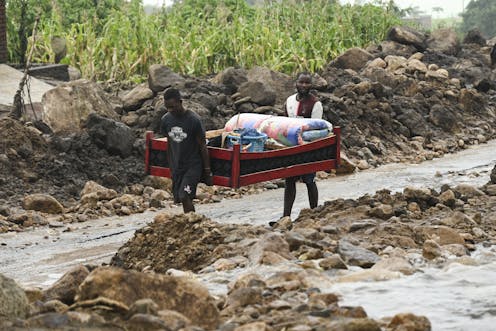
As the planet warms, a key concern in international climate negotiations is to compensate developing nations for the damage they suffer. But which nations should receive money? And which extreme weather events were influenced by climate change?
Most nations last year signed up to an agreement to establish a so-called “loss and damage” fund. It would provide a means for developed nations – which are disproportionately responsible for greenhouse gas emissions – to provide money to vulnerable nations dealing with the effects of climate change.
Part of the fund would help developing nations recover from catastrophic extreme weather. For example, it might be used to rebuild homes and hospitals after a floods or provide food and emergency cash transfers after a cyclone.
Some experts have suggested the science of “event attribution” could be used to determine how the funds are distributed. Event attribution attempts to determine the causes of extreme weather events – in particular, whether human-caused climate change played a part.
But as our new paper sets out, event attribution is not yet a good way to calculate compensation for nations vulnerable to climate change. An alternative strategy is needed.
What is event attribution?
Extreme weather events are complex and caused by multiple factors. The science of extreme event attribution primarily seeks to work out whether either human-caused climate change or natural variability in the climate contributed to these events.
For example, a recent study found the extreme rain that triggered New Zealand’s February flooding was up to 30% more intense due to human influence on the climate system.
Attribution science is progressing quickly. It’s increasingly focused on extreme rain events, which in the past have been tricky to study. But it’s still not a consistent and robust way to estimate the costs and impacts of extreme events.
Read more: COP27: one big breakthrough but ultimately an inadequate response to the climate crisis
Why can’t we use it?
Event attribution science draws on both observational weather data and climate model simulations.
Most commonly, two types of climate model simulations are used: those that include the effects of human-caused greenhouse gas emissions, and those that exclude them. Comparing the two types of simulations allows scientists to estimate how climate change influences the likelihood and severity of extreme events.
But climate models primarily simulate processes in the atmosphere and ocean. They don’t directly simulate the damage caused by an extreme weather event - such as how many people died due to a heatwave or infrastructure loss during a flood.
To directly simulate the effects of an extreme event, we need to know the exact extent to which weather components such as temperature and rainfall caused damage. In some cases, this can be determined. But it requires high-quality data, such as hospital admissions, that’s rarely available in most parts of the world.
Also, climate models are not good at simulating some extreme events, such as thunderstorms or extreme winds. That’s because such events are sporadic and tend to occur across small areas. This makes them harder to model than, say, a heatwave that affects a large area.
So if “loss and damage” funding decisions relied too much on event attribution, then a low-income nation hit by a heatwave may receive more support than a nation damaged by storms or high winds, relative to the damage caused.
What’s more, event attribution is not yet able to estimate how climate change causes damage associated with so-called “compound” extreme events.
Compound events refer to cases where more than one extreme event occurs simultaneously in neighbouring regions, or consecutively in a single region. Examples include a drought followed by a heatwave, or sea level rise which makes damage from a tsunami even worse.
How do we move forward?
Event attribution is not yet advanced enough to calculate “loss and damage” from climate change.
Instead, our paper suggests “loss and damage” funds are used alongside foreign aid spending to support recovery in low-income nations following any extreme events where human-caused climate change may have played a role.
We also present four major recommendations for using event attribution to estimate “loss and damage” in future. These are:
Help developing countries use event attribution techniques: to date, event attribution has largely been conducted by wealthy countries in their own regions
Address more types of extreme events: tornadoes, hailstorms and lightning are largely beyond the capability of climate models used in event attribution because they are localised and complex. New techniques to examine these events should be attempted
More research into the impacts and costs of extreme events: few studies have attempted to attribute the costs of extreme events to climate change. Further efforts are needed, especially in low-income nations
Combine event attribution with other knowledge: scientists and experts in aid and policymaking must collaborate on a strategy for using event attribution information. Better understanding of the needs of policymakers and the limitations of event attribution science could lead to more useful studies.
Read more: Climate change is white colonisation of the atmosphere. It's time to tackle this entrenched racism
A growing burden
Low-income nations have contributed relatively little to global emissions. Compensation from richer nations is vital to helping them manage the growing burden of climate harms.
But distributing these funds in a fair way is challenging. Until the field of event attribution advances, putting too much reliance on event attribution is a risky strategy.
The authors acknowledge the contribution of Izidine Pinto to the research underpinning this article.
Authors: Andrew King, Senior Lecturer in Climate Science, The University of Melbourne

















