

Floods of nutrients from fertilisers and wastewater trash our rivers. Could offsetting help?
- Written by Michele Burford, Professor - Australian Rivers Institute, and Dean - Research Infrastructure, Griffith University

The rivers running through the hearts of Australia’s major cities and towns are often carrying heavy loads of nutrients and sediments.
This is a problem. While nutrients like nitrogen and phosphorus are essential to life in small quantities, in large quantities they become destructive to river and ocean ecosystems.
When rivers are pumped too full of nutrients washing out from farms or from wastewater treatment, bacteria and algae numbers soar. We see the effects in dangerous blue-green algal blooms and in oxygen levels dropping so low that millions of fish can die, as we saw recently in Menindee, New South Wales.
Fixing the problem can be expensive and difficult for landholders. That’s where a new idea could help: nutrient offsetting. Here, large wastewater plants can meet stringent requirements to keep nutrient levels low by fixing eroded riverbanks and gullies upstream, creating wetlands, and preventing fertiliser runoff. The end result: cleaner rivers.
While offsetting schemes for carbon have come under significant scrutiny, nutrient offsetting is a simpler market, with fewer participants and clear ways of measuring success.
Early trials in southeast Queensland by water utilities have proven it can work, as our new report shows.

Why are our rivers too full of nutrients?
In the early industrial period, rivers around the world were seen as dumping grounds, from factory chemicals to tannery waste. Since then, many countries have worked hard to clean up their waterways, with major successes including the UK’s Thames river.
It’s comparatively easy to stop the dumping of chemicals. You can see the pipes and pinpoint who’s doing it. But nutrient overloading is a harder problem, which is why we’re still wrestling with it.
Our cities and towns are growing. Almost seven million more people live in Australia now compared to the year 2000. As our population grows, we need more food, and we create more human waste. Our agriculture sector has also boomed and is exporting more and more food. To make our famously poor soils fertile requires fertiliser. When too much fertiliser is applied, heavy rains can wash it into rivers. Erosion on riverbanks and in gullies make the problem worse.
Read more: Would a nature repair market really work? Evidence suggests it's highly unlikely
Some rivers, estuaries and coastal waters are in real trouble, such as parts of the Murray-Darling, and some urban creeks in our capital cities. We’ve hit their natural limit to handle nutrient loads and gone past it. This can cause algal blooms, fish kills and water too disgusting to drink without expensive treatment.
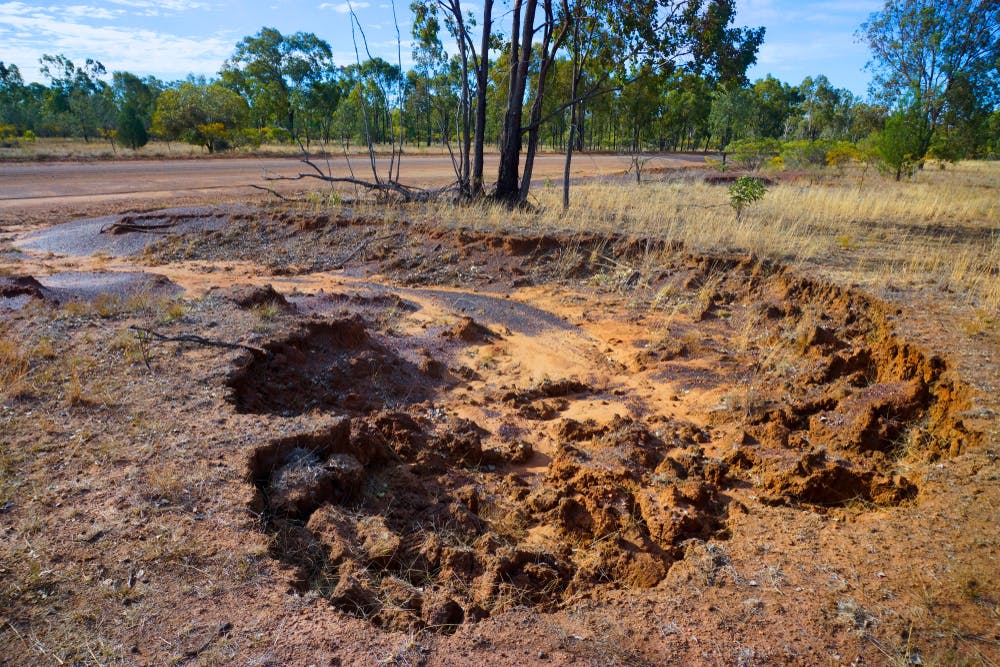 Erosion accelerates nutrient runoff from farms.
Shutterstock
Erosion accelerates nutrient runoff from farms.
Shutterstock
Why do we need offsetting at all?
Chemical dumping can be solved with laws and enforcement. But while we can fix degraded river catchments to reduce nutrient loads, this is rarely done. That’s because the costs are too high to be borne by any one sector, such as farmers.
By contrast, regulations on nutrients discharged by sewage treatment plants place limits of how much can be released into rivers and estuaries. The costs of further upgrades to sewage treatment plants to reduce nutrients to the required low levels is prohibitively expensive, because ratepayers would end up paying much more for water treatment.
That’s why offsetting can be useful, as it offers a win-win. Urban polluters like wastewater treatment plants can meet their regulatory requirements by restoring eroded and degraded catchment areas upstream to reduce nitrogen and phosphorus flows from farmland. Better, this can be done reasonably cheaply when done at scale. Depending on the available sites, this can be done along rivers and creeks on rural properties, or on council owned land in cities and towns.
Making this viable means using a market. Polluters looking for low-cost ways to comply with regulation of nutrient flows are linked with landholders upstream with degraded land.
This is an emerging solution, but early trials show it has promise. Population-dense south east Queensland has large waterways like the Brisbane and Logan Rivers. Wastewater plant operators such as Logan Water, Urban Utilities and Unity Water have replanted shrubs, grasses and trees along riverbanks, as well as undertaking engineering work to stabilise eroding banks.
This led to significant cost savings. Urban Utilities avoided spending A$8 million in upgrading a sewage treatment plant to cut nutrients and got the same result by spending $800,000 in erosion control and revegetation upriver, which prevented five tonnes of nitrogen entering waterways. Operational costs were also much lower, saving $5 million over ten years.
Controlling erosion keeps nutrients in the soil to help crops and grasses to grow, benefiting farmers, rather than having it washed downstream. Healthier riverbanks create better habitat for birds, reptiles and mammals and makes rivers healthier for fish and other species.
What’s next?
Nutrient offsetting is still new in Australia. For it to gain traction across Australia means working to make sure the systems and science are mature.
To maximise benefits and give participants certainty, we’ll need to shift from a piecemeal trial approach to a coordinated trading scheme. Successful overseas examples typically have a third party coordinating buying and selling, and ensure there’s a robust structure to set up and assess these projects.
Canada has seen successes here, such as the South Nation River trading program which has reduced phosphorus in the river, while America has examples such as the nutrient credit trading program in Chesapeake Bay. In Australia, a voluntary reef trading scheme is underway in the catchments of rivers flowing into the waters of the Great Barrier Reef, involving farmers and a range of investors.
To make sure this works, we need detailed scientific knowledge on comparing nutrient pollution from different sources. Catchment runoff nutrients are mostly bound to soil particles, while sewage treatment plants have much more dissolved nutrients. As yet we don’t know how these sources differ.
We also need to know what methods of land management are best suited to stopping nutrients from washing into rivers, to ensure the best outcome for the money spent.
Creative solutions are necessary
Despite our efforts in cleaning up many of our rivers, traditional approaches haven’t been enough to stop nutrient pollution. It’s time to explore creative new approaches to make our rivers and reefs healthier.
Read more: How did millions of fish die gasping in the Darling – after three years of rain?
Authors: Michele Burford, Professor - Australian Rivers Institute, and Dean - Research Infrastructure, Griffith University

















