

Peace may finally be returning to Yemen, but can a fractured nation be put back together?
- Written by Leena Adel, PhD Candidate, Political Science and International Relations, Curtin University
Last month, China brokered a rapprochement between Saudi Arabia and Iran, a landmark deal that restored full diplomatic ties between the two bitter rivals.
There was hope the detente could also bring an end to one of the world’s longest-running – and virtually forgotten – proxy wars in Yemen, as well.
Indeed, peace talks have begun to end the eight years of a brutal conflict between a Saudi-led coalition of nine regional countries and the Iranian-backed Houthi rebels in Yemen. The war has created what is often referred to as the world’s worst humanitarian crisis.
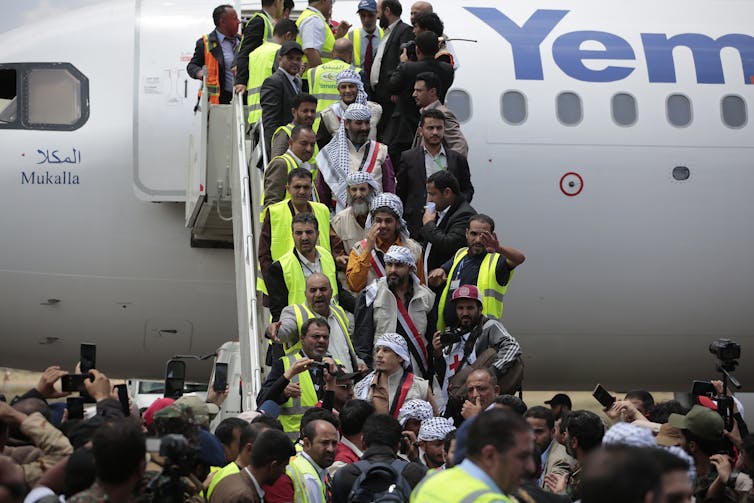
Despite the exchange of hundreds of prisoners between the adversaries this past week and promising discussions of a permanent ceasefire and the lifting of the Saudi-led blockade of Yemen, however, the path towards peace remains incredibly shaky.
Even more uncertain is whether Yemen can ever recover once the hostilities end.
Yemen in pieces
On my trip to Yemen last July, I (Leena) was stopped by militias at over 40 checkpoints between the southern city of Aden and the capital, Sana'a. My driver, a doctor before the war, briefed me ahead of each stop regarding the background and affiliates of the checkpoint officers. The brief would change rapidly throughout the 12-hour drive!
On the ground, it was evident the humanitarian crisis had impacted every part of the country and robbed Yemenis of any meaningful prospects. This proxy war, riddled with foreign interests and fuelled by regional and local competition, has left Yemen a fractured nation.
Multiple armed groups are vying for influence all over the country. In 2014, Houthi rebels drove Yemen’s internationally recognised government into exile and assumed control over Sana'a. Months later, the Saudi-led coalition – backed by the United States, the United Kingdom, Canada and France – launched a military intervention to try to restore the government to power.
Read more: Senate vote could end US complicity in the Saudi-led genocide in Yemen
The Houthis have since tried to hold onto their gains in northern Yemen, while occasionally launching strikes inside Saudi Arabia itself.
In the south, the United Arab Emirates is backing the two secessionist movements – the Southern Transitional Council and the Giant Brigades – and militarising two Yemeni islands off the southern coast.
Saudi Arabia and Oman, meanwhile, have vested interests in the Mahra region in eastern Yemen and are meddling with tribal politics. And Yemen’s largest Islamist political party, known as al-Islah, controls the Marib province northeast of the capital and parts of two other regions, Taiz and Hadramawt.
The division in the country appears in other ways, too. The currency used in the south differs from the one in Sana'a. In Aden, the secessionist flag is visible at every turn. In the north, I caught the image of Iranian General Qassem Soleimani, who was assassinated by the US three years ago, hanging in one of the main streets of Sana'a.
Second only to the devastating humanitarian crisis, Yemen’s fragmentation is arguably the most detrimental outcome of this war – and the most glaring obstacle to any real solutions to end the crisis.
Read more: Yemen's Houthis – and why they're not simply a proxy of Iran
Saudi foreign policy moderation
For the Saudis, the peace process appears to be part of a wider trend of foreign policy moderation as the kingdom seeks to retreat from nearly a decade of gaffes, miscalculations and destructive forays abroad.
Since the kingdom’s inception in 1932, Saudi diplomacy and security policy have been typified by caution and a desire to maintain the status quo of a regional balance of power.
In this, Riyadh never sought overt domination of the region. It focused its efforts to thwart those who did, such as Egypt under Gamal Abdel Nasser, Iraq under Saddam Hussein and post-revolutionary Iran. Importantly, the Saudis also aimed to avoid direct confrontations, instead utilising their petro wealth and diplomatic influence and alliances when dealing with rivals.
The kingdom’s first six monarchs adhered to this approach. But things took a dramatic turn with the ascension of King Salman and the elevation of his heir, Crown Prince Mohammed bin Salman, to key positions in Saudi government in 2015.
Known for his disdain for tradition and self-assured confidence, bin Salman quickly set about defining a new, aggressive foreign policy for the kingdom that eschewed the lessons of the past.
Among other things, this included imposing a blockade on Qatar and only just stopping short of outright invasion, abducting the prime minister of Lebanon, assassinating journalist Jamal Khashoggi and pursuing a provocative approach to its regional rival, Iran.
Under this new muscular foreign policy, the 2015 invasion of Yemen – Saudi Arabia’s first-ever major military operation abroad – was intended to be a brief operation that would demonstrate the military and technological prowess of a dynamic and capable kingdom.
Read more: Is it too soon to herald the 'dawn of a new Middle East'? It all depends what the Saudis do next
Instead, the invasion quickly devolved into a protracted and wasteful quagmire. It has cost the country immensely in terms of lives, resources and reputation. At the same time, it inflicted endless amounts of misery and human suffering on the Yemeni people.
Eight years on, Riyadh is edging back to a less confrontational posture in the region. After the detente with Iran, resolving the Yemen war would be another important step towards resuming a more “normal” approach to Saudi foreign policy.
What next for the Yemeni people?
After eight years of bombs, missiles, destruction and hundreds of thousands of civilian deaths, it is the Yemeni people who have lost the most in this war.
Houthi and Saudi officials may claim work on a political solution is under way, but whether this will have a serious and much-needed humanitarian component remains a big question. For the people of Yemen, the journey to peace will be gruelling as they navigate the broken nation left behind.
If the goal is to ensure lasting peace, the Saudis must honour the requests of the Yemeni negotiators, starting with a permanent ceasefire and lifting the blockade.
It is also imperative the currently exclusive Houthi-Saudi peace talks open up to include leaders from all factions nationwide. A realistic plan for transitional and restorative justice is necessary to address the more pressing humanitarian issues. This requires all parties to be present in discussions.
Finally, peace talks must remain Yemeni-led to eventually pave the path for a Yemeni-led and UN-supported political transition that allows Yemenis to determine the future of their nation.
Authors: Leena Adel, PhD Candidate, Political Science and International Relations, Curtin University

















