

Suzume builds on a long line of Japanese art exploring the impacts of trauma on the individual and the collective
- Written by Gwyn McClelland, Senior Lecturer, Japanese Studies, University of New England
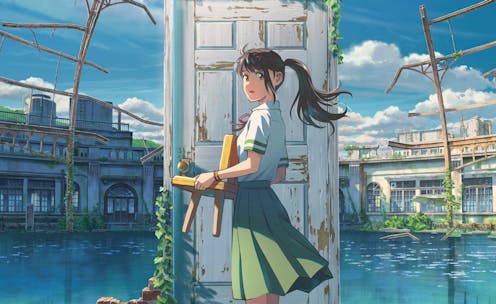
Makoto Shinkai has found a winning formula with the release of his newest anime Suzume, already the fourth-highest-grossing anime film of all time.
Shinkai released his debut animated feature film, The Place Promised in our Early Days, in 2004. Popularly referred to as the “new Miyazaki”, Shinkai is known for his detailed and realistic scenery.
His seventh feature film, Your Name (2016), about a pair of teenagers who have never met but randomly start swapping bodies, became an international sensation and brought Shinkai to mainstream attention.
In Suzume, the teenage titular character travels across Japan with a cat and a mysterious young-man-turned-talking-chair, sealing doors between worlds to prevent natural disasters.
In many ways, Suzume is light-hearted and action-filled, but at its core it is a tale of courage in the face of trauma.
Themes of disaster, loss and the environment are common across many of Shinkai’s films. But this film is his clearest exploration yet of the alignment of collective and personal trauma.
Read more: Miyazaki's legacy is sure to live on ... whether or not he retires
The earthquake in art
The 2011 Japanese earthquake, referred to colloquially as the “triple disaster” due to the subsequent tsunami and meltdown at the Fukushima Dai-ichi Nuclear Plant, looms omnipresent in contemporary Japanese fiction and film.
Kazuto Tatsuta’s manga Ichi-F(いちえふ) (2013-15) explored the author’s experience cleaning up after the disaster as a worker at the plant in 2011.
An archive of oral histories, photographs and real-time tweets about the disaster, named The East Japan Earthquake Archive, includes oral testimonies geomapped onto a Google Earth map.
Chinese artist Ai Weiwei completed a Fukushima Art Project in 2015, visiting the nuclear exclusion zone and installing two art installations in response.
Fukushima 50 (2020) is a movie telling the story of how the employees of Fukushima Dai-ichi responded to the nuclear meltdown. Homeland (2014) is the story of a young man who returns to live in the no-go zone of Fukushima. Odayaka (2012) follows flatmates in Tokyo concerned about radiation and toxicity immediately after the earthquake.
Shinkai’s Your Name has been interpreted as his own indirect response to the catastrophe. In this anime, Taki’s hometown Itomori is wiped out by a comet – Shinkai’s reference to the earthquake.
Suzume is part of an ongoing project for many Japanese creators: to represent the trauma of disaster through a personal, empathetic story.
Read more: Fukushima: ten years on from the disaster, was Japan's response right?
Exploring trauma
There is more than one type of trauma.
There is the trauma experienced by the individual, and cultural trauma shared among a wider population.
In Suzume, Shinkai tackles individual trauma, but the film also reflects a wider cultural trauma.
When she was five, Suzume lost her mother during the chaos following the 2011 earthquake and tsunami. Now 17, she carries the burden of this childhood trauma.
Memories of this event return in her dreams and as she nears her childhood home. But she is not just experiencing her own individual trauma. She shares the wider trauma of the memory of Fukushima and the earthquake with others.
When Suzume prevents new disaster by desperately remembering those who lived in these towns, she draws upon and connects with this collective memory and loss.
The art of recovery
The film follows Suzume’s journey to north-east Japan, beginning by ferry boat from Kyushu to Shikoku, then on to Kobe, Tokyo and Tohoku.
The threat of earthquakes is an everyday reality: notifications light up phones, crowds stand on sidewalks waiting to see what will happen, and then – after the shock – ordinary life returns.
Shinkai’s depiction of devastated countryside, destroyed homes and displaced ships in Suzume’s memories directly draws on footage that emerged from the Tohoku region in 2011, combining Shinkai’s trademark realism with a nation-wide memory of disaster.
Although the film alludes to the nuclear accident through contaminated soil trucks in one scene, this is not the main focus. The focus is on the survivors of the earthquake and tsunami, which claimed 15,500 lives and left 450,000 people homeless.
Suzume has limited but painful memories of this time when she lost both her mother and the world as she knew it. Her only record is a diary where she blacked out those days.
In Suzume, trauma is a “black hole” in which there is no light and in which time does not pass.
This is depicted in the liminal space of tokoyo (“ever after”), a concept from Japanese mythology: a timeless space Suzume enters via wooden doors dotted across Japan. In mythology, tokoyo can also mean the place of the dead. In this film, Suzume became lost in the tokoyo as a girl. In returning to tokoyo, she can seek out and attempt to comfort her childhood self.
She can seek to comfort herself and understand the experience, but she cannot erase the tragic events or their impact.
Moving forward
Suzume could be seen as scriptotherapy – a story written to help the author come to terms with a traumatic event and rediscover a sense of control.
The film uses the journey across Japan, fantastical imagery and evocative comedic music to represent collective and personal healing.
Some of the film’s representations of trauma are a little too clean: ultimately, Suzume’s emotional release is fully achieved through returning an item tied to her lost mother to her younger self.
Yet the film stands its ground in the large collection of films and literature coming to terms with the memory of Japan’s 2011 triple disaster. It also invites consideration of how we might continue to heal from and memorialise our current era: how will we ultimately remember the trauma of the COVID pandemic and what stories will we tell?
Suzume is in Australian cinemas now.
Authors: Gwyn McClelland, Senior Lecturer, Japanese Studies, University of New England

















