keeping the complex story of Anzac Day relevant in the 21st century
- Written by: Katie Pickles, Professor of History, University of Canterbury
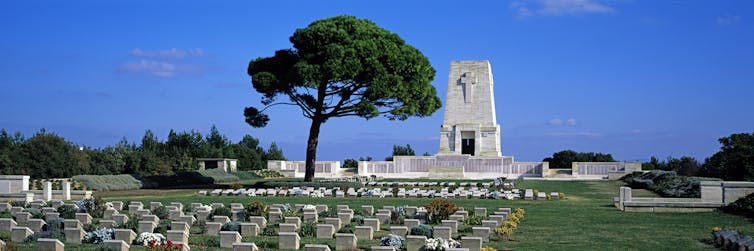
What happened on the Gallipoli peninsula in Turkey 108 years ago has shocked and shaped Aotearoa New Zealand ever since. The challenge in the 21st century, then, is how best to give contemporary relevance to such an epochal event.
The essence of the Anzac story is well known. As part of the first world war British Imperial Forces, the Australian and New Zealand Army Corps (Anzacs) landed at Gallipoli on April 25 1915. For eight months they endured the constant threat of death or maiming in terrible living conditions.
Ultimately, their occupation of that narrow and rugged piece of Turkish coast failed. The 30,000 Anzacs were evacuated after eight months. More than 2,700 New Zealand and 8,700 Australian soldiers died, with many more wounded.
The first anniversary of the landing was a day of mourning, with Anzac Day becoming a public holiday in 1922. A remembrance day of sorrow mixed with pride, it has grown over the years to include all those who served and died in later international conflicts.
Over time, various narratives and themes have emerged from that Gallipoli “origin story”: of Aotearoa New Zealand’s emergence as a nation, proving itself to Britain and Empire; of the brave, fit, loyal soldier-mates who emblemised the Kiwi spirit of egalitarianism, fairness and duty. All this mingled with the lasting shock and underlying anger at class hierarchy and the British leadership’s incompetence.
But historians know well that the “Anzac spirit” is a complex and ever-evolving idea. In 2023, what do we teach school-aged children about its meaning and significance? One way forward is to rethink those Anzac narratives and tropes in a more complex way.
Colonialism and class
The Anzac story is tied up in the nation’s history as part of the British Empire. The Anzac toll was just part of a staggering 46,000 “Britons” – including many from India and Ireland – who died at Gallipoli.
Some 86,000 Turks also died defending their peninsula. We need to teach about the Anzac sacrifice in the context of a global conflict where the magnitude of loss was horrific.
Read more: Less than illustrious: remembering the Anzacs means also not forgetting some committed war crimes
Importantly, Anzac themes are bound up in early forms of colonial nationalism: New Zealand proving itself to Britain and developing its own fighting mentality on battlefields far from home. Part of this involves the notion of incompetent British commanders who let down the Anzac troops – but this is part of a bigger story.
Focusing on imperial and class hierarchies of the time can place what happened in that broader context. The legendary story of Chunuck Bair, taken on August 8 by Colonel William Malone’s Wellington Regiment, but where most of the soldiers were killed when they weren’t relieved in time, is particularly evocative.
Māori and the imperial project
From our vantage point in the present, of course, we cannot ignore the Māori experience of war and colonialism. As the historian Vincent O’Malley has suggested, New Zealand’s “great war” of nation-making was actually Ngā pakanga o Aotearoa – the New Zealand Wars.
It’s time to teach the complexity of this past and the multiple perspectives on it. For example, Waikato leader Te Puea Hērangi led opposition to WWI conscription and spoke against Māori participation on the side of a power that had only recently invaded her people’s land.
Conversely, Māori seeking inclusion in the settler nation did participate. On July 3 1915, the 1st Māori Contingent landed at Anzac Cove. Te Rangi Hiroa (Sir Peter Buck) (Ngāti Mutunga) was to say:
Our feet were set on a distant land where our blood was to be shed in the cause of the Empire to which we belonged.
These words echo the familiar Anzac trope of the New Zealand nation being born at Gallipoli. Such sentiments led to postwar pilgrimages to retrace the steps of ancestors and claim the site as part of an Anzac heritage – a corner of New Zealand even.
For many young New Zealanders it has become a rite of passage, part of the big OE. That a visit to Anzac Cove is still more popular than visiting the sites of Ngā pakanga o Aotearoa is something our teaching can investigate.
Mateship and conformity
The notion of the Anzac soldier as courageous and beyond reproach, willing to make the ultimate sacrifice for nation and empire, is also overdue for revision. The “glue” of mateship – a potent combination of masculine bravery and strength with extreme loyalty to fellow soldiers – is again a contested narrative.
By the 1970s, as historian Rowan Light’s work shows, there was a significant challenge to such perceptions from the counterculture, peace protesters and feminists. And by the 1980s, veterans were sharing their stories more candidly with writer Maurice Shadbolt and war historian Chris Pugsley.
Read more: Peter Weir's Gallipoli 40 years on: deftly directed and still devastating
Teaching about the meaning of mateship might examine the history of those peer-pressured into participating in war, those who were conscripted and had no choice, and more on the fate of conscientious objectors like Archibald Baxter. At its worst, the idea of mateship was window dressing for uniformity and parochialism.
New Zealanders today have complex multicultural and global roots. We have ancestors who were co-opted to fight on different sides in 20th-century wars, including those who fought anti-colonial wars in India, Ireland and Samoa. Some came here as refugees escaping conflict. Jingoism and what it really represents deserves critical analysis.
Poppies and peace
The ubiquitous poppy, an icon much reproduced in classrooms, is also ripe for contextualisation and debate over its meaning. In the age of global environmental crisis, it can be seen as more than a symbol of sacrifice immortalised in verse and iconography.
The poppy also reminds us of the landscapes devastated by the machinery of war that killed and maimed people, plants and animals. It contains within it myriad lessons about the threats science and technology can pose to a vulnerable planet.
Anzac Day rose from the shock, loss and grief felt by those on the home front. And beyond the familiar tropes of nationalism, mateship and egalitarianism, this remains its overriding mood.
Remembering and learning about the terrible physical and mental cost of war is the real point of those familiar phrases “lest we forget” and “never again”. That spirit of humanitarianism chimes with Aotearoa New Zealand’s modern role and evolving self-image as a peacekeeping, nuclear-free nation.
Anzac Day also speaks to the need for global peace and arbitration, and how war is no viable solution to conflict. Those are surely lessons worth teaching.
Authors: Katie Pickles, Professor of History, University of Canterbury