

Coles' Uber Eats deal brings the gig economy inside the traditional workplace
- Written by: Lauren Kate Kelly, PhD Candidate, ARC Centre of Excellence for Automated Decision-Making and Society, RMIT University
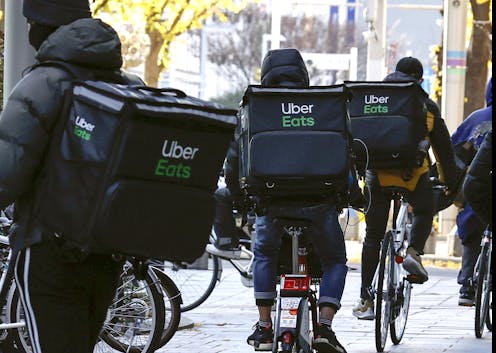
This month Coles announced a major new partnership with Uber Eats that will further expand the supermarket giant’s links with the gig economy. Under the arrangement, Uber Eats drivers will not only complete home delivery for the supermarket, drivers will also pick and pack orders from supermarket shelves.
Previously, online orders were completed by Coles’ directly employed “personal shoppers” who would hand over the order to a delivery partner. More than 500 Coles stores across the country will start selling goods via the digital platform, with gig workers performing the role of a Coles personal shopper.
The deal differs from an existing partnership between Woolworths Metro60 and Uber Eats, forged in June 2022, which also promises rapid delivery, albeit with orders fulfilled by supermarket workers.
The Coles partnership is a significant development that will see Uber Eats drivers working inside the supermarket alongside traditional employees and customers.
The gig economy enters the supermarket
The supermarket duopoly have been steadily recruiting gig workers into their home delivery offerings since Coles set up a partnership with Airtasker in 2017. Demand for rapid deliveries then surged during the pandemic years of 2020 and 2021.
From one perspective, Coles and Woolworths are simply outsourcing specific tasks (such as picking, packing and delivery) to Uber Eats and other gig-work platforms. From another, the supermarkets are absorbing gig workers into their own activities.
Read more: Coles and Woolworths are moving to robot warehouses and on-demand labour as home deliveries soar
Gig workers are not formal employees and do not enjoy the same legal protections as other staff, but they are nonetheless performing work that is core supermarket business.
The so-called “last mile” of delivery – the final leg between a hub such as a warehouse or supermarket and the consumer – is widely considered the most difficult and unprofitable part of logistics, particularly for rapid deliveries. While both supermarkets run their own last-mile systems for deliveries booked in advance, the partnerships with Uber Eats let them offer customers rapid home delivery options while offloading the risk associated with the last mile.
Potentially tens of thousands of jobs at stake
In 2022, I interviewed supermarket workers about the impact of rapid delivery services. Many expressed concerns that the gig economy was “getting closer” with some predicting the role of the personal shopper – a supermarket employee who would gather and pack items for delivery – would eventually be taken up by gig workers.
Coles says the Uber Eats drivers will “complement rather than compete” with existing direct-employed supermarket employees.
Read more: 'A weird dinging sound that everyone dreads': what rapid deliveries mean for supermarket workers
For now, gig workers and employees will work alongside each other. Over time, however, it is possible other supermarket roles will be displaced into the gig economy.
Coles and Woolworths are Australia’s largest private sector employers. As they bring the gig economy into their workplaces, it has the potential to affect tens of thousands of jobs.
Grocery is a winner-takes-all industry
The new partnership was announced just days after grocery delivery startup Milkrun officially folded.
Milkrun was the last standing of four Australian rapid grocery delivery startups launched in the past couple of years. The company failed to turn a profit, was quick to abandon its central proposition of ten-minute delivery, and burned through $86 million in venture capital in less than two years.
Read more: MilkRun's demise is another nail in the 10-minute grocery-delivery business model
With much less fanfare, both Coles and Woolworths have achieved what startups couldn’t. Their advantage has been their enormous scale and market power, enabling them to push suppliers for lower prices and make use of their existing networks of distribution centres, stores, delivery vans – and now partnerships with the gig economy.
In an unfair playing field, the supermarket giants have the best of both worlds: vertical integration with the supply chain and the ability to shift risk away from the business and onto individual gig workers.
Essential service or frivolous convenience?
The example of Milkrun and other startups suggests the business of on-demand grocery delivery may not be feasible without an army of precariously employed workers such as Uber Eats drivers. This raises another question: do we really need or want groceries delivered this quickly?
The supermarkets often frame their new deliveries services as benefiting “vulnerable Australians”, such as the elderly and people living with disabilities. The implication is that the availability of rapid grocery delivery is a social good, rather than simply a convenience.
However, if the service is truly essential, it seems the people doing the work should be valued and supported with well-paid and secure employment. What’s more, it’s not entirely convincing that rapid grocery delivery in its current form is essential at all.
Many personal shoppers I interviewed said on-demand purchases tended to be frivolous. Referring to the partnership between Woolworths and Uber Eats, one worker recalled:
People are ordering […] a single banana and a Red Bull. It’s really weird the stuff you get.
Another added:
No one used to do it. Now, people buy only five things and they’ll pay that fee to have it delivered soon. It’s more popular for alcohol or cigarettes or something like that.
One supermarket worker expressed deep scepticism of rapid delivery, stating:
It didn’t seem like it was about meeting the demands of shoppers, that’s made explicit through the article cap for Uber Eats. […] You can only order 25 [items] so it wasn’t about regular shopping. Really, I think it was just more for the convenience. Instead of going to the shops yourself, you can just wait at home for it, and someone else can pick it for you.
The cost of this convenience will be carried by supermarket workers, who in recent years have already seen their work transformed to adhere to the logic of the gig economy, with on-demand time pressures and ad-hoc scheduling. Now, as the gig economy moves into the physical supermarket space, the distinction between conventional employment and gig work is further blurred.
Authors: Lauren Kate Kelly, PhD Candidate, ARC Centre of Excellence for Automated Decision-Making and Society, RMIT University


















