

School phone bans seem obvious but could make it harder for kids to use tech in healthy ways
- Written by: Joanne Orlando, Researcher: Digital Literacy and Digital Wellbeing, Western Sydney University
School phone bans may seem like the answer to reeling in young people’s technology use.
But if we ban phones and bury this issue under the sand, when and how do our kids learn to have a healthy relationship with technology in a world becoming more tech-focused by the day?
Existing bans in Australian schools
School mobile phone bans have experienced a domino effect throughout Australia. Most jurisdictions now have full or partial bans.
Victoria has banned mobile phones in both primary and secondary schools since term 1 of 2020. Western Australia and Tasmania have similar “off and away all day” policies.
South Australia is transitioning to a ban in all public high schools by term 3 of 2023. New South Wales will ban them in public high school schools in October, as part of a flagship election policy from the incoming Minns government.
Earlier this month, Queensland said it was looking at the issue as well.
Talk of a national approach
While schools are largely a state government responsibility, the phone ban rhetoric has gained popularity at the federal level. Last week federal Education Minister Jason Clare called for a national approach, saying he will meet with state and territory counterparts in the middle of 2023 to discuss and encourage this.
I think the time has come for a national approach to the banning or the restriction on the use of mobile phones by students in schools.
If a national ban is instated, it would likely mean students in all government primary and high schools around the country will restricted or completely banned in their use a mobile phone at school.
Countries with a similar national approach include China, France and Sweden. Many countries, including the United Kingdom and United States, enable individual schools to create their own policy as per their individual needs.
Students need to be included in this
Clare says he will prioritise a collaborative approach to phones and
not make the decision on our own; talk to parents, talk to principals, talk to teachers about what’s the best approach to take.
An obvious omission from this lineup is students. As studies of phone bans overseas show, children’s views are highly important as they are the policy receivers and beneficiaries.
Scenes of school phone bans gone wrong are all over TikTok, with footage of Australian students breaking open pouches often purchased by schools to lock phones away. This footage is quite different from the pro-ban scenes filmed for the nightly news.
It is easy to see why bans are popular
Banning mobile phones is popular with some parents, as it seems like the obvious answer to young people’s problematic technology use.
But this popularity in part is underpinned uncertainty on how to control children’s technology use.
Parents often resort to confiscating phones at home when they don’t know how to control children’s use of technology. School bans are confiscation on a large scale.
They began as a means to stop bullying and to keep kids focused in class – important issues that are proving difficult to solve. But they risk sweeping important issues under the rug. This could make life harder for children in the long run.
Read more: 'Screen time' for kids is an outdated concept, so let's ditch it and focus on quality instead
What are adults doing?
Many young people I am interviewing as part of new research for the eSafety commissioner agree their technology use is not controlled, meaning that they feel they spend too much time using their phone in unproductive and habitual ways. This worries them.
However rather than pointing the finger at the kids, let’s consider what’s happening with the adult population and mobile phones.
Our all-consuming approach to phones has become so worrying that Problematic Mobile Phone Use (PMPU) has been identified by the Australian Psychological Society as one of the biggest behavioural addiction challenges of the 21st century.
Adults use their phones all the time, especially in places they should not be. A 2018 study by Education company Udemy showed millennials (the parents of many school-aged children) checked their phone two hours a day for personal activities during the workday. The 40-hour week has turned into a 30-hour work week, plus ten hours on your phone.
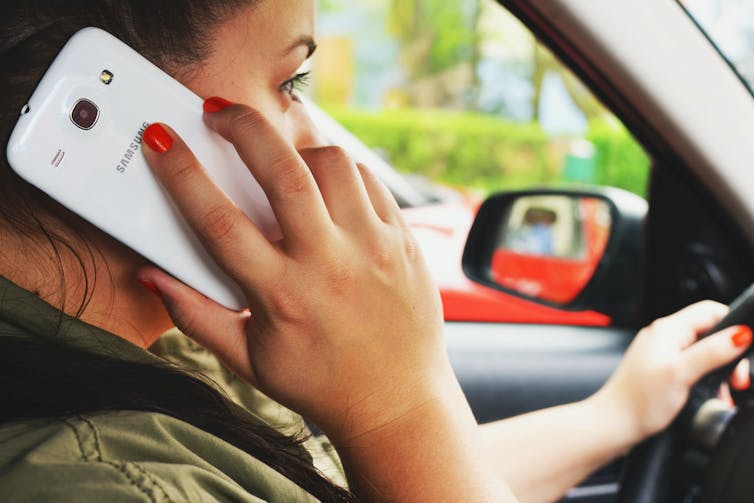
As adults we find it very difficult to cope with mobile phone bans. There are now hundreds of hidden mobile phone detection cameras to catch us out because we can’t be trusted not to use our phones when driving.
These cameras collected about A$66 million last year in fines. This was a $4 million increase from the previous year. It shows how real issues with adult phone use have not been solved with bans or arbitrary penalties.
Where’s the evidence this will work?
The scant research available shows no change to either bullying or class engagement after school phone bans are introduced.
One 2022 Spanish study did attempt to say bans had led to better academic results. But in careful reading of the study, students were permitted to use phones in schools as a learning tool for educational purposes. The researchers state this may have been the reason for increased scores.
Policies need to be made using evidence, and right now we don’t really have any.
In the meantime, bans make it likely we will leave our children without skills they need to be able to learn, work and live in a world saturated with technology. This includes their home and bedroom where they do their homework after school.
Meanwhile, we need a broader conversation about how all of us – children and adults alike – can use phones in a healthy way.
Authors: Joanne Orlando, Researcher: Digital Literacy and Digital Wellbeing, Western Sydney University


















