

Will a preoccupation with party unity destroy the Liberal Party?
- Written by: Carolyn Holbrook, Senior Lecturer in History, Deakin University
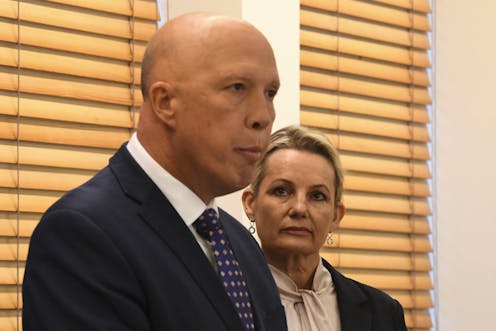
Such has been the turmoil over the Liberal Party’s recent decision to join the National Party in campaigning against the forthcoming referendum on the Voice to Parliament that even some of the most reliable supporters in the media have remarked on the internal division.
But is the Liberal Party really “divided like never before”? Such assertions can scarcely stand if we have regard for history.
The original Liberal Party was created from a fusion of the Protectionist and Free Trade parties in 1910. It was officially named the Liberal Party, with Alfred Deakin as its leader, in 1913. It was reformed twice before the second world war, first in 1916 as the National Party (led by Labor renegade Billy Hughes), and then in 1931 as the United Australia Party (UAP), led by another Labor deserter, Joseph Lyons. In 1941, the UAP, now led by Robert Menzies, was defeated on the floor of parliament.
Division and realignment were elemental anti-Labor politics until the 1940s, as former implacable foes were marshaled to capitalise on opportunities created by turmoil within the Labor Party. The latter was rocked by Hughes and his supporters decamping to the other side during the first world war and shattered again by its defeat during the Depression.
Yet there was policy laziness within the UAP as war threatened. Lyons “knew how to win elections” said former National Party prime minister, Stanley Bruce, but was bereft of policy initiative and struggled to maintain party discipline.
The defeat of the UAP in 1941 was arguably the most consequential collapse we have seen in anti-Labor forces. It would take wholesale party reform and a revitalisation of the liberal message, led by Robert Menzies, for it to re-emerge as the Liberal Party that won government in 1949 and held office for 23 years.
Is current intra-party contention of a scale that saw the implosion of the UAP and the creation of the modern Liberal Party? Surely not, or not yet. Peter Dutton has provoked acrimonious debate with his opposition to the Voice to parliament. He has also suffered a substantial loss of support in the polls, from an already low base.
But to date, a majority of his party colleagues support his position, it is likely branch members do too.
Read more: How does the Liberal Party's Voice policy stack up against the proposed referendum?
More recent Liberal divisions over policy offer further grounds for comparison. The republic issue, championed by Labor prime minister Paul Keating in the 1990s, looked likely to cause division with the Liberal Party. While Howard was a dyed-in-the-wool monarchist, his shadow Cabinet included well-known republicans, Peter Costello, Robert Hill, Richard Alston and Peter Reith.
During the 1996 election campaign, Howard undertook to hold a constitutional convention on the republic if he won the prime ministership. If that convention reached a consensus about a model, Howard would take it to referendum, which is what happened in 1999. Recognising the differing views within his party, the prime minister allowed Liberal parliamentarians a free vote on the republic, but was pleased when the referendum, against which he campaigned enthusiastically, failed.
Despite clear ideological differences, the republic issue never seriously threatened party unity. Indeed, Howard used the occasion to underline, as he often did, that the Liberal Party was a “broad church”.
Malcolm Turnbull’s drawn out, and fruitless attempt in 2018 to introduce a National Energy Guarantee (NEG) – which destroyed his authority and precipitated a spill in which Scott Morrison seized the leadership – provides further lessons for the Liberal Party.
Turnbull, attempting a solution with the NEG that would satisfy business, investors and most of the public, could not withstand the relentless opposition of the party’s right to every progressive initiative. His was not only a moderate and science-based response to a manifest problem, but also a solution that appeared likely to win public support. But Turnbull was unable to deliver what many wanted because he was unable to contain the internal battles within the party room.
Read more: View from The Hill: A shocker performance, even by coup standards
This was division more profound than anything we’ve seen yet in the current Coalition. Morrison was able to contain that division by promising to “win the vote”. He succeeded in this in 2019, not by proposing policy innovation, but by an effective negation of everything that Labor, under Bill Shorten, proposed. Having won the “miracle” election, he presided over a period of government and governance failure that led to Coalition defeat in 2022.
The 2022 performance was so bad that even Howard conceded that “the absence of a program for the future […] the absence of some kind of manifesto, hurt us very badly”.
However, in the months since, Dutton has failed to craft a new liberal message that has wider electoral appeal. Instead, he has persisted with a conservative and highly oppositional approach, such as the Coalition’s opposition to Labor’s 43% emissions reduction target and the safeguard mechanism.
This recourse to negativity and fearmongering, employed with electoral success by Tony Abbott in 2013 and Morrison in 2019, is once more to the fore in Dutton’s resort to questions and division rather than positive engagement with the Voice. It can also be seen in spurious assertions such as Deputy Liberal leader Sussan Ley’s recent claim that if the Voice referendum is successful, the new mechanism could be used to veto Anzac Day.
These oppositional policy stances might maintain party unity and please the membership, but they fail to recognise fundamental problems. Australian electoral politics is undergoing significant realignment. Women and migrants have deserted the Coalition, the concerns of younger Australians about climate change, housing affordability and wealth inequality are registering in voting patterns, and mainstream opinion still inclines to supporting the Voice.
Given the 2022 election result and polling trends since, the only rationale for the Coalition to persist with its oppositional approach is a commitment to its small and unrepresentative base.
There are three things any leader must do. The first is to hold the party together, and this Dutton – aware of Turnbull’s fate – is doing. It will not be enough: social and demographic change are against him. If it is faithful to its members, the party will be destroyed at the ballot box.
The second is to respond to changing circumstances, recruiting an enlarged membership and persuading the party to adopt a constructive policy agenda to suit contemporary conditions. This is where Menzies, and arguably Howard, succeeded.
The third is to successfully communicate its policy purposes to a broad constituency by explaining how they will serve the principal public concerns of the moment. Menzies’ recognition in his time of the need for a revitalised liberalism, and now Howard’s call for a manifesto for the future recognise this.
If the Liberal Party cannot craft a positive message of liberalism that is attuned to the mainstream concerns of today’s electorate, a fate like that of the UAP is inevitable.
Authors: Carolyn Holbrook, Senior Lecturer in History, Deakin University
Read more https://theconversation.com/will-a-preoccupation-with-party-unity-destroy-the-liberal-party-203849


















