

Wild-caught seafood is often untraceable – and some industry players don't want that to change. Here's why
- Written by: Benjamin Thompson, Lecturer in Human Geography, Monash University
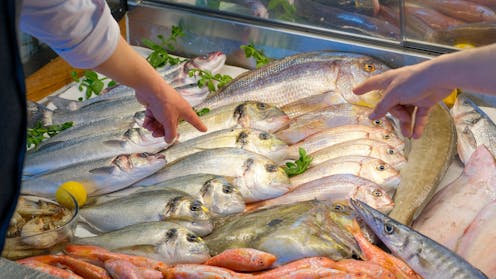
The wild-caught fish you buy was landed far away from cameras or scrutiny. So how do you know it really is what the label says? How do you know it was caught in a sustainable fishery? Even in regulated fisheries like Australia’s, the answer is, broadly, you don’t.
That’s because most wild-caught seafood is untraceable. Yes, it could have been caught sustainably by pole and line fishers. But it could have been relabelled as a different fish altogether. Worldwide, seafood fraud is rampant. That’s why conservationists ask fish buyers to use apps like GoodFish to check.
And while technologies now exist to solve this problem and make opaque supply chains transparent, our new research suggests many players in the Australian industry are not interested in change – particularly large wholesalers, processors and fish markets.

What did we find?
We interviewed people who work in seafood supply chains in Australia – from fishers and aquaculture companies to seafood traders and restaurants.
These insiders believed bigger supply chain actors were often not doing the right thing, by concealing trade information, manipulating prices, and with little concern about product origin.
Fishers and fish farmers explained that once their catch departs for the big seafood markets, they “lose control of the supply chain”, have “no idea where they go”, and that it’s “impossible to keep track of any of it”.
Our interviewees told us a degree of food fraud still exists. This is when a species is incorrectly labelled by name, origin or how it was caught.
This can be accidental, or done deliberately to mask certain information or to justify selling it at a higher price. For example, critically endangered species such as the school shark are being mislabelled as gummy shark – which is sustainably caught in Australia.
Chefs told us about regularly seeing species labelled as locally caught when they knew they were out of season in their state.
Fish farmers told us cheap overseas fish of questionable quality would often be sold as their fish. As one barramundi farm representative told us:
It honestly really frustrates and upsets me because you do all this work and your barramundi is happily substituted.
Fishers, fish farmers, and restaurants were largely supportive of traceability technologies. But they feared a backlash from the wholesalers on which their sales relied. Some interviewees reported experiences of threatening, bullying and cajoling from some wholesalers.
As one interviewee told us:
I know that these guys [wholesalers], right or wrong, can hold me to ransom. If they don’t buy my fish, we don’t have ability to send [high volumes] to anyone else.
How would traceability improve the situation?
At present, tracking where fish, prawns, shellfish and other seafood come from relies on largely paper-based systems. These are prone to human error, negligence, or manipulation.
In an effort to fix the problem, several traceability platforms have been developed in Australia. These tend to rely on blockchain, where encrypted “blocks” of product, trade, and price data are stored along a digital “chain” which is publicly visible.
This data is linked to a QR code on individual fish or boxes of fish. Data added include the species name, time of catch, product weight, and the time of each physical handover point – with new data being verified against preexisting data in the chain. Traders and consumers can scan these QR codes to access information on the seafood product in front of them.
In short, digital tracing of seafood would create a transparent trading environment by making public how the market operates, from buyers and sellers to the prices paid, and the ability to track seafood from ocean to plate.
A system like this would also give fishers more power. At present, wholesalers are often able to name a price that fishers simply have to accept.
Fishers would much prefer to be able to set their own prices. Traceability technology could help here too, to give fishers a sense of which seafood products are in demand right now and allow them to price their products accordingly.
 What if seafood was trackable from ocean to plate?
Sascha Rust, Author provided
What if seafood was trackable from ocean to plate?
Sascha Rust, Author provided
Australia should embrace greater seafood transparency
Estimates of food fraud in global fisheries range widely, from 20% up to 90%. That is to say, we know there’s a real problem here – we just don’t know exactly how large. But we do know there are very real problems in the world’s wild-caught fisheries.
Australia could have a role here to demonstrate what good fisheries can look like. At present, our fishing authorities are primarily concerned with catch regulations at sea.
There’s not enough focus on what happens next. Our label-based traceability systems are weak compared to the European Union which has the strict import laws and seafood labelling standards that conservationists in Australia are pushing for.
But digital technology could offer something even better. While the EU’s solution is positive, it’s been criticised by scholars for being overly bureaucratic and not delivering the same depth of information.
Could it happen? Yes – but it would have to happen over the protests of those who would be disadvantaged, such as some seafood wholesalers.
One way it could happen is if the government adds more information disclosure requirements to laws governing fair competition. This would give the market the nudge required to see traceability technologies more rapidly adopted.
If nothing is done, Australia’s seafood industry could become less viable since illegal fishing practices would remain difficult to identify, putting strain on fish stocks. But we are optimistic that innovators will eventually succeed in bringing together enough actors across the supply chain to make the shift to digital traceability happen.
While many academics, disruptors and commentators often laud blockchain as a way to rapidly drive sustainable change, our research suggests this will only occur if the most influential supply chain actors see value in using it.
Read more: Blockchains can trace foods from farm to plate, but the industry is still behind the curve
Authors: Benjamin Thompson, Lecturer in Human Geography, Monash University


















