

Stephen Hawking's final, god's-eye view of the cosmos ponders the ultimate origin of our universe
- Written by: Geraint Lewis, Professor of Astrophysics, University of Sydney
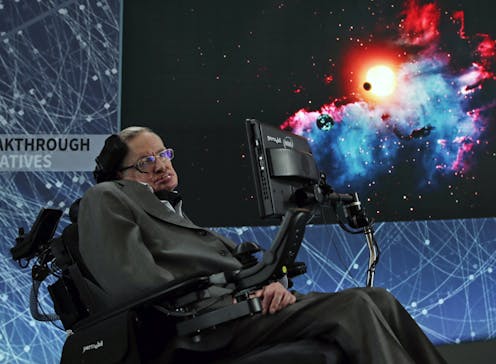
In the public’s mind, Stephen Hawking is a giant of 20th century science. He burst onto the popular stage with the 1988 publication of A Brief History of Time, which presented his esoteric ideas of evaporating black holes and the birth of the universe. It was an international bestseller, but given the complexity of its ideas, A Brief History has been called the most unread book of all time.
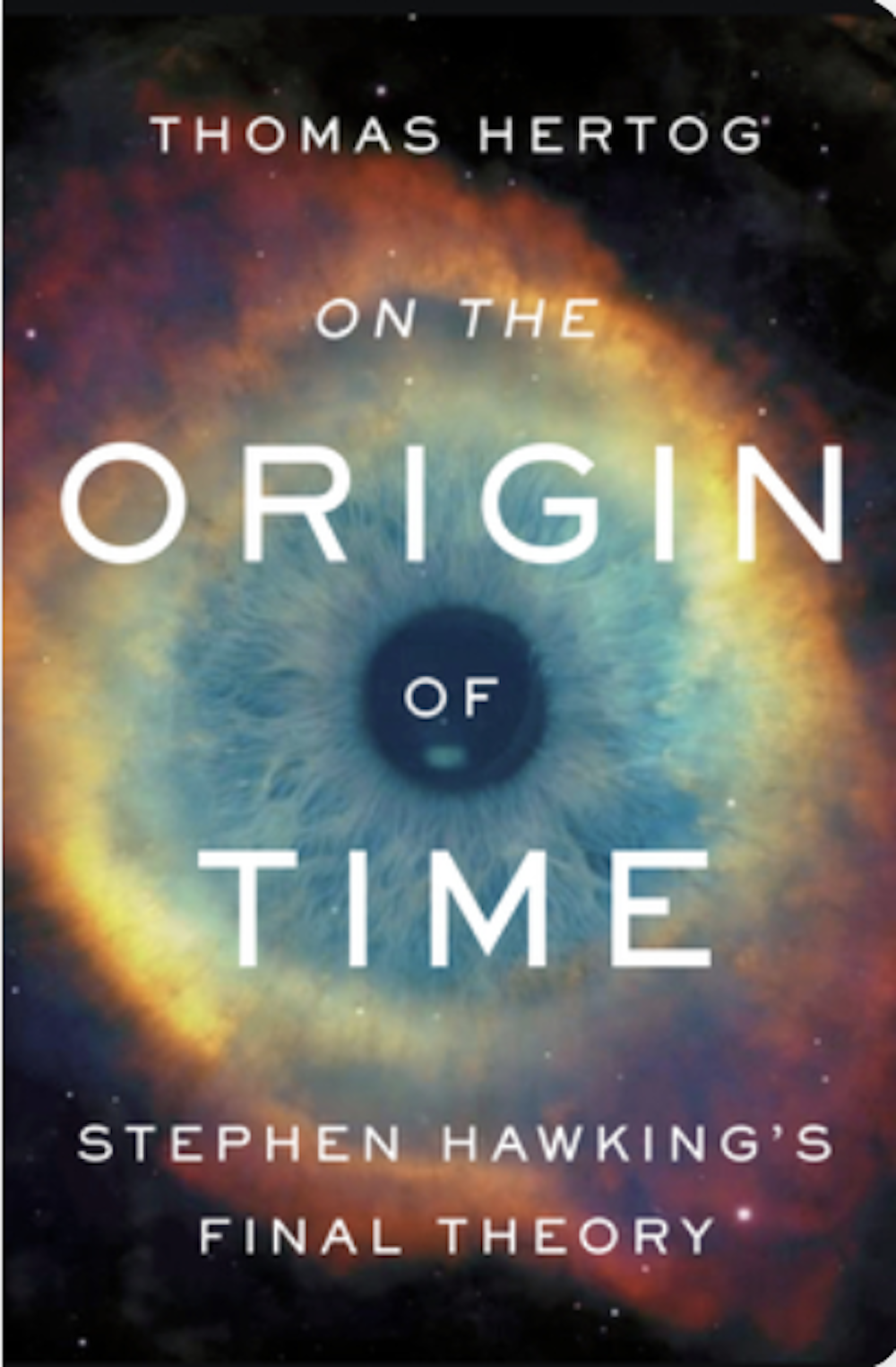
Hawking continued to explore the fundamental nature of the universe until his death in 2018. In a new book, On The Origin of Time, Belgian physicist Thomas Hertog unravels Hawking’s final theory, which focuses upon one of the biggest questions of all – just why our universe is the way it is.
Review: On the Origin of Time: Stephen Hawking’s Final Theory – Thomas Hertog (Penguin Random House)
Hertog is no passive player in this story, having been a student and collaborator of Hawking. He is, instead, an active participant. Intriguingly, as Hertog explains, we are all active participants in Hawking’s final theory, shaping the universe by observing it.
In this new book, Hertog tells us that Hawking’s final theory tries to address one of the deep mysteries of the universe, something known as the problem of cosmological fine-tuning.
Cosmologists have realised that the more they peer at the underlying nature of the universe (for instance the strengths of fundamental forces and the masses of fundamental particles), the more the cosmos seems tuned for our existence.
If the universe had been born with slightly different values for these fundamental properties, it would be dead and sterile, lacking the complexity and energy essential for life.
For some, the solution to cosmological fine-tuning lies in the multiverse, the idea that our universe is just one of countless others. Our universe, and all the others, crystallise out of a bout of eternal inflation, a super-energetic cosmic expansion. Each individual universe, at birth, is written with its own unique laws of physics. Most of these universes in the multiverse are dead, but our cosmic home won the physics lottery. We, unsurprisingly, find ourselves in a universe that can host life.
Read more: What are the best conditions for life? Exploring the multiverse can help us find out
However, as Hertog writes in this new book, Hawking dismissed the multiverse and went on the hunt for an alternative solution to cosmic fine-tuning.
Familiar ground
To get to this point, Hertog treads some very familiar ground, discussing the history of modern cosmological ideas. This includes the theoretical groundwork of Albert Einstein and Georges Lemaitre, and the observational insights of Edwin Hubble that revealed the expansion of the universe.
Hertog interweaves the story with the development, over the 20th century, of that other great pillar of physics, the strange behaviour in the world of the quantum, where the deterministic world of Isaac Newton, in which things have precise locations at precise times, is replaced by a fuzzy world of probabilities and uncertainties.
Usually we think of quantum mechanics describing the subatomic world, of electrons and atoms, but Hawking was thinking of the entire universe as a quantum system. The tale is brought up to date with the idea of cosmic inflation in the earliest instances of the universe and the surprising discovery of the dominance of dark energy in the closing years of the last century.
Read more: Explainer: quantum computation and communication technology
Hawking’s own story is similarly interwoven in the book including his revelation that black holes are not truly black.
Combining Einstein’s general theory of relativity, which dictates the space-time curvature of a black hole, with quantum field theory, which describes the strange, ephemeral nature of seemingly empty space, Hawking showed that black holes actually radiate. Through this dribble of energy, black holes steadily evaporate into an eventual nothingness.
But if you are looking for an accurate description of just how Hawking’s idea of black hole radiation operates, unfortunately Hertog relies on the same flawed picture of particles popping into existence at the edge of the hole as Hawking presented in A Brief History of Time.
 A copy of A Brief History of Time featuring a thumbprint of its author at an auction at Christie’s London in 2018.
Neil Hall/AAP
A copy of A Brief History of Time featuring a thumbprint of its author at an auction at Christie’s London in 2018.
Neil Hall/AAP
Hertog also tells us that Hawking explored the state of the universe at the very beginning, arguing that at this initial point, at least in terms of general relativity, the density of stuff in the universe must have been infinite, (this idea is formally known as a singularity).
Hawking returned to this question with physicist Jim Hartle in the early 1980s to try and wrap quantum mechanics into the picture. Hartle and Hawking claimed that if you wind the universe back to the beginning, time loses its distinct nature and effectively becomes space. With this no boundary hypothesis, the universe did not have an origin, not at least one we would ever really understand.
Read more: A timeline of Stephen Hawking's remarkable life
A subtle argument
Hawking’s motivation for disliking the multiverse is a somewhat subtle argument, built on the idea of the anthropic principle, the fact that we should not be surprised to find ourselves in a universe which allows us to be here.
Hertog tells us that we should be, in some sense, typical of the possible observers who could inhabit the universes in the multiverse. But quite what typical means is a complicated topic. Does it mean that other life in other universes should be like life on Earth? Or typical in a more broader sense, that life should be composed of the same elements as us? Typical can be judged on many different criteria. And how will we ever find out how typical we are if we are forever limited to the observations of our one universe?
To posit an alternative solution, Hawking’s first step was to upend the approach to understanding the universe.
The goal of modern science has been to unravel the fundamental operations of the universe and use these to predict how physical systems evolve. To do this, we need more than the laws of physics, but we need to know the starting point, the boundary conditions. But for a universe emerging from the strange singular state at its origin, where infinities abound, just what are these boundary conditions, and do they uniquely define the universe we inhabit?
Hertog explains that he and Hawking adopted a different view, a top-down view of the universe. Quantum mechanics is again wrapped into the picture, and the life of the universe is treated as a quantum system, described in terms of possibilities and probabilities.
It is here that Hugh Everett III’s many-worlds interpretation of quantum mechanics makes its appearance. According to Everett, all of the possible outcomes of a quantum experiment play out in parallel existences, and it is this notion that Hawking applies to the universe.
Within this final theory, as expressed by Hertog, the observer now plays a central role. The fact that we all exist and observe the world around it, means we participate in shaping the universe we appear to inhabit.
Of all of the possible histories of the universe that could potentially exist in a sea of parallel universes, the fact that we are here observing this universe, singles out this universe, with all the others lost in a sea of quantum uncertainty. The situation becomes strangely self-referential.
 At this point, the general reader is quite possibly going to be confused. This is, of course, quite a radical notion in understanding the nature of the universe. And, quite frankly, the reader might wonder what separates Hawking’s final theory from what some might consider pseudo-scientific ramblings.
The idea that we, as observers, are essential for bringing the universe into being is not a new one, and is often the source of ridicule. Of course, given the scientific weight of the authors, this final theory must be given merit, but whether this hypothesis is a true contender for an accurate description of the life of our universe is hard to judge.
This should not put the reader off. Hertog’s easy writing style jumps from topic to topic and provides an overview of the development of modern cosmology and the need for quantum mechanics in understanding the ultimate origins of the universe.
But when the going gets tough and the intricate ideas of Hawking’s cosmos are explored, some things are stepped over a little too quickly and a little more time lingering on what might seem straightforward to quantum cosmologists would have been a benefit.
In closing, it is worth pointing out that there are some irritating features to the writing, including the almost hero worship Hawking receives. Clearly given the close relationship between the author and his subject, this is somewhat understandable, but can still be grating.
The text also mixes the philosophy-bashing that appears to be a badge of honour of modern physicists with various philosophical musings that underpin the cosmological and quantum thinking. But given the scope of the topic, and with a mix of anecdotes, quotes and analogies, Hertog provides an intriguing snapshot of our pondering of the ultimate origin of our universe.
Authors: Geraint Lewis, Professor of Astrophysics, University of Sydney
At this point, the general reader is quite possibly going to be confused. This is, of course, quite a radical notion in understanding the nature of the universe. And, quite frankly, the reader might wonder what separates Hawking’s final theory from what some might consider pseudo-scientific ramblings.
The idea that we, as observers, are essential for bringing the universe into being is not a new one, and is often the source of ridicule. Of course, given the scientific weight of the authors, this final theory must be given merit, but whether this hypothesis is a true contender for an accurate description of the life of our universe is hard to judge.
This should not put the reader off. Hertog’s easy writing style jumps from topic to topic and provides an overview of the development of modern cosmology and the need for quantum mechanics in understanding the ultimate origins of the universe.
But when the going gets tough and the intricate ideas of Hawking’s cosmos are explored, some things are stepped over a little too quickly and a little more time lingering on what might seem straightforward to quantum cosmologists would have been a benefit.
In closing, it is worth pointing out that there are some irritating features to the writing, including the almost hero worship Hawking receives. Clearly given the close relationship between the author and his subject, this is somewhat understandable, but can still be grating.
The text also mixes the philosophy-bashing that appears to be a badge of honour of modern physicists with various philosophical musings that underpin the cosmological and quantum thinking. But given the scope of the topic, and with a mix of anecdotes, quotes and analogies, Hertog provides an intriguing snapshot of our pondering of the ultimate origin of our universe.
Authors: Geraint Lewis, Professor of Astrophysics, University of Sydney 

















