

‘Kidfluencer’ culture is harming kids in several ways – and there’s no meaningful regulation of it
- Written by: Catherine Jane Archer, Senior Lecturer, Communication, Edith Cowan University
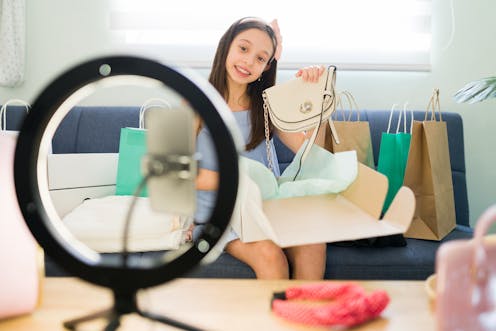
Parents share content of their children for myriad reasons, including to connect with friends and family, and to seek validation or support.
However, some parents also do this for commercial gain. They manage their children as social media “kidfluencers” – allowing them to work with brands to market products to other children (and adults).
The Australian Competition and Consumer Commission’s latest interim report for the Digital Platforms Services Inquiry has acknowledged key issues relevant to kidfluencers, including privacy concerns and possible labour exploitation issues.
Our research, published recently in the M/C Journal, further highlights how the kidfluencer culture opens the door for possible child exploitation and a host of other problems.
There is a clear need for regulation in this space – and achieving it will require a considered, collective effort.
Is YouTube the world’s most popular babysitter?
Speaking to Forbes in 2019, Eyal Baumel, the chief executive of Yoola (a management company which also manages digital child stars), described YouTube as “the most popular babysitter in the world”.
Since then, the COVID pandemic has prompted a surge in screentime for kids, who are being marketed toys as well as other products normally targeted to adults.
Product lines for kids are big business. In 2021, the global toys market was projected to grow from about US$141 billion to $230.6 billion by 2028.
It’s now common to see YouTube kidfluencers marketing toys to other kids through toy “reviews”. But these videos aren’t the same as traditional product reviews. They’re mash-ups that blur the lines between three major genres: reviews, branded content and entertainment.
The most popular toy review channels have millions of subscribers, and their hosts are some of YouTube’s top earners. Ryan’s World is probably the most well-known channel in this genre. Conservative estimates suggest 10-year-old Ryan Kanji’s family earns about US$25 million each year.
Instakids are on the rise
Apart from YouTube (now more popular among kids than television), a significant number of kids and teens are also spending time on Instagram.
According to a 2021 report by child protection organisation Thorn, about 40% of children under age 13 (out of some 750 interviewed) said they’d used Instagram. This is despite the platform ostensibly only being for people aged 13 and older.
For our latest research, we analysed the Instagram accounts of two Australian influencer siblings to better understand the nature of child-to-child marketing in 2023.
Pixie Curtis, age 11, started her online toy store Pixie’s Pix during COVID, when toy sales rose globally. This came after initial success selling hair bows through Pixie’s Bows, a business managed by her mother, PR entrepreneur and reality TV personality Roxy Jacenko.
Pixie’s Instagram account (which has about 136,000 followers), and her brother Hunter’s (20,000 followers), have been used to promote Pixie’s Pix toys as well as other brands and products.
And although Pixie recently “retired” from the toy shop business, she continues to promote products, including her original line of hair bows and other brands’ skincare and beauty products.
Our research identifies key areas of concern, including:
- a lack of online privacy for kidfluencers, who have many aspects of their lives publicised online
- the commodification of children, and the enabling of a culture geared at up-selling them products and services
- the gendered marketing of toys and an increased focus on appearance for girls (which can be harmful for their self-esteem)
- the “stealth” marketing of toys and other products through advertorials.
Read more: 3 ways app developers keep kids glued to the screen – and what to do about it
Regulation is needed now
So far, the French government appears to be the only one that has taken tangible action to regulate the labour of child social media influencers. Under French law, children below age 16 can only work limited hours, and their earnings must be safeguarded in an account made accessible when they turn 16.
France is also considering legislation to regulate “sharenting” – a portmanteau of sharing and parenting that describes the practice of consistently posting content about one’s children on social media.
In the US, the Coogan Act (named after child star Jackie Coogan) was signed into law in 1939 to regulate child labour in the entertainment industry, but no equivalent laws have been enacted for child social media stars.
Nonetheless, the problems surrounding kidfluencing are starting to gain attention around the world.
Last year a UK House of Commons report investigated the implications of influencers targeting children with advertorials, especially those that provide little to no disclosure of the post being an ad.
The committee made several recommendations, including promoting young people’s social media literacy, developing a code of conduct for influencer marketing, and strengthening the powers of the UK’s Advertising Standards Authority and Competition and Markets Authority.
As a result, the UK’s Department for Education is now “open to exploring legislative ways of improving employment protection for child influencers”.
Read more: Is 13 too young to have a TikTok or Instagram account?
The unintended consequences of regulation
In January, Meta (the parent company of Facebook and Instagram) held its first Summit on Youth Safety and Wellbeing. It might be trying to get on the front foot as regulators continue to scrutinise platforms on issues relevant to young people’s social media use.
But regulating in the kidfluencer space won’t be easy. In March, Utah introduced laws to stop children under 18 having access to social media without parents’ explicit consent – but critics have pointed out the potential negative consequences.
Teens use social media for important connections, including with friends and online support groups. Vulnerable teens may become isolated without online support from their peers. Beyond that, social media provide kids with a sense of enjoyment and identity. Taking this away could do more harm than good.
More work is needed to determine what effective regulation would look like. While parents and educators have a role to play to increase children’s social media literacy, digital platforms and businesses should also step up.
Authors: Catherine Jane Archer, Senior Lecturer, Communication, Edith Cowan University


















